Biochemistry: Mod 1
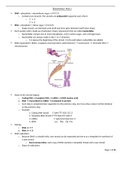
• DNA = phosphate + deoxyribose sugar + A/T/C/G o Contains two strands. The strands are antiparallel (opposite each other). o 5’ → 3’ 3’ ← 5’ • RNA = phosphate + ribose sugar + A/U/C/G o Single strand, can fold back onto itself and form pairs between itself (stem‐loop). • Each nucleic acid is made up of polymers (many monomers) that are called nucleotides. o Nucleotides contain one or more phosphates, a five‐carbon sugar, and a nitrogen base. o Nucleotides are always made in the 5’ to 3’ direction. o 5 is always the beginning of the strand, 3 is the end where nucleotides are added. • DNA organization: DNA is wrapped around proteins called histones → nucleosome → chromatin fiber→ chromosomes • Steps to the central dogma: o Coding DNA → template DNA → mRNA → tRNA (amino acid) o DNA → transcribed to mRNA → translated to protein o Each step is complementary (opposite) to the previous step, but if you skip a step it will be identical to the previous step. o Example 1. Coding DNA strand 5’ AAA TTT GGG CCC 3’ 2. Template DNA strand 3’ TTT AAA CCC GGG 5’ 3. mRNA 5’ AAA UUU GGG CCC 3’ 4. tRNA Lys Phe Gly Pro • Pairing: o DNA: A → T o RNA: A → U • DNA replication: o Because DNA is a double helix, one strand can be separated and serve as a template for synthesis of a new strand. o Semi‐conservative: each copy of DNA contains a template strand and a new strand. o Steps of replication: o 1. The DNA must be separated, creating a replication fork. This is done by helicase. o 2. Primase attaches an RNA primer, where the replication is to start. o 3. DNA polymerase adds bases to the remaining of the strand until it reaches a stop codon. This is done in fragments, called okazaki fragments. • If an error is detected, it removes the nucleotides and replaces them with correct ones, known as exonuclease. o Exonuclease removes all of the RNA primers, and DNA polymerase fills in those gaps. o DNA ligase seals the two strands forming a double helix. • DNA → transcribed → mRNA → translated → protein • Transcription occurs in the nucleus: o Initiation: RNA polymerase binds to a sequence of DNA called the promoter, found near the beginning of a gene. Each gene has its own promoter. Once bound, RNA polymerase separates the DNA strands, providing the single‐stranded template needed for transcription. o Elongation: One strand of DNA, the template strand, acts as a template for RNA polymerase. As it "reads" this template one base at a time, the polymerase builds an RNA molecule out of complementary nucleotides, making a chain that grows from 5' to 3'. The RNA transcript carries the same information as the non‐template (coding) strand of DNA, but it contains the base uracil (U) instead of thymine (T). o Termination. Sequences called terminators signal that the RNA transcript is complete. Once they are transcribed, they cause the transcript to be released from the RNA polymerase. o Pre‐mRNA must go through extra processing before it can direct translation. • They must have their ends modified, by addition of a 5' cap (at the beginning) and 3' poly‐A tail (at the end). • Pre‐mRNAs must also undergo splicing. In this process, parts of the pre‐mRNA (called introns) are chopped out, and the remaining pieces (called exons) are stuck back together. • Translation occurs in the cytoplasm: o Initiation: The ribosome assembles around the mRNA to be read and tRNA brings in its perspective protein, decoding 3 bases at a time, beginning with the start codon, AUG. o These 3 base pairs of mRNA are called codons. The mRNA base pairs are complementary to the base pairs of the tRNA, called anticodons. o Elongation: The amino acid chain gets longer. The mRNA is read one codon at a time, and the amino acid matching each codon is added to a growing protein chain. When the complementary pairs are formed, they are added to the protein chain by peptide bonds, the result is polypeptides. o Termination: The finished polypeptide chain is released when a stop codon (UAG, UAA, or UGA) enters the ribosome. • Gene regulation o Promotor sites: can be turned off or on, enabling or disabling a gene from being replicated. o Alternative splicing: Exons are used to code for protein, introns are clipped out. The order of exons can determine different mature mRNA strands which result in different proteins. o Epigenetics: involves packaging of DNA. DNA is round around histones. These packages are called nucleosomes. How tightly packed they are determines whether or not the gene is on or off. o Loosely packed = transcription possible. o Tightly packed = transcription impeded. o Modifications determine how tightly/loosely packed they are. Many of these modifications are determined by environment/diet.
Document information
- Uploaded on
- May 29, 2022
- Number of pages
- 40
- Written in
- 2021/2022
- Type
- Exam (elaborations)
- Contains
- Questions & answers