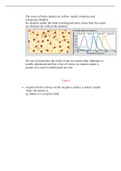
The cones of birds contain red, yellow, nearly colourless and
transparent droplets
the droplets enable the birds to distinguish more colors than the would
see distinctively without the droplets.
We are so locked into the world of our own senses that, although we
readily understand and fear a loss of vision, we cannot conjure a
picture of a visual world beyond our own.
Task 4:
• receptive field is always on the receptive surface, it doesn`t matter
where the neuron is.
eg. Retina is a receptive field.
,Superior Colluculi: Receives some of the input from the eye.
Important role in controlling the movement of the eye
Optic Chiasm: some of the fiber for each eye cross over to the other
side
Occipital Lobe: Visual Receiving area (Aka. Striate Cortex or V1) –
the place where signals from the retina and LGN first reach the cortex.
LGN receives 90% of the optic nerve fibers, the other 10% goes to
superior colliculi.
, LGN does:
• regulates the neural information (the signal coming out of LGN is
smaller than the input coming to LGN)
• it receives more information from cortex than retina = the backward
information = called feedback
V1:
This is where signals arrive at the cortex for the first time.
They found that V1 has also cells with centre-surround receptive fields just like
retina and LGN; but they are side by side, small spots of light (not moving) =
simple cortical cells
• would respond best to the vertical lines.
, There are neurons that responds to all of the orientations in the environment.
Complex cells = responds only when a corrected oriented bar of light moves
across the entire receptive field. Many complex cells respond best to a very
particular direction of movement.
The stimulus bar is moved back and
forth across the receptive field.
This cell fires best when the bar is
positioned with a specific orientation
and is moved from left to right
Insensitive to location
transparent droplets
the droplets enable the birds to distinguish more colors than the would
see distinctively without the droplets.
We are so locked into the world of our own senses that, although we
readily understand and fear a loss of vision, we cannot conjure a
picture of a visual world beyond our own.
Task 4:
• receptive field is always on the receptive surface, it doesn`t matter
where the neuron is.
eg. Retina is a receptive field.
,Superior Colluculi: Receives some of the input from the eye.
Important role in controlling the movement of the eye
Optic Chiasm: some of the fiber for each eye cross over to the other
side
Occipital Lobe: Visual Receiving area (Aka. Striate Cortex or V1) –
the place where signals from the retina and LGN first reach the cortex.
LGN receives 90% of the optic nerve fibers, the other 10% goes to
superior colliculi.
, LGN does:
• regulates the neural information (the signal coming out of LGN is
smaller than the input coming to LGN)
• it receives more information from cortex than retina = the backward
information = called feedback
V1:
This is where signals arrive at the cortex for the first time.
They found that V1 has also cells with centre-surround receptive fields just like
retina and LGN; but they are side by side, small spots of light (not moving) =
simple cortical cells
• would respond best to the vertical lines.
, There are neurons that responds to all of the orientations in the environment.
Complex cells = responds only when a corrected oriented bar of light moves
across the entire receptive field. Many complex cells respond best to a very
particular direction of movement.
The stimulus bar is moved back and
forth across the receptive field.
This cell fires best when the bar is
positioned with a specific orientation
and is moved from left to right
Insensitive to location