

Summary Lipscomb University - NURS 3093 Study guide for pathophysiology test 1, Rated A+ guide.
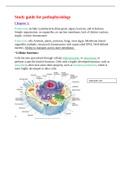
Study guide for pathophysiology Chapter 1: Prokaryotes include cyanobacteria (blue-green algae), bacteria, and rickettsiae. Simple organization, no organelles, no nuclear membrane, lack of distinct nucleus, single, circular chromosome. Eukaryotic cells Animals, plants, protozoa, fungi, most algae, Membrane bound organelles multiple, structured chromosomes with supercoiled DNA, Well-defined nucleus, Ability to transport across outer membrane. *Cellular functions: Cells become specialized through cellular differentiation, or maturation, to perform a specific kind of function. Cells with a highly developed function, such as movement, often lack some other property, such as hormone production, which is more highly developed in other cells. Eukaryotic cell *Plasma membrane proteins and their functions *The nucleus* This is involved in cell division and contains our genetic information. Within the nucleus we find: ---Nucleolus- Dense RNA protein –and ---Histones – DNAbinding proteins, cause coiling. Functions: Receptors Transport channels/carriers Enzymes Surface markers Cell adhesion molecules (CAMs) Catalysts
Document information
- Uploaded on
- May 26, 2022
- Number of pages
- 63
- Written in
- 2020/2021
- Type
- Exam (elaborations)
- Contains
- Questions & answers


