100% tevredenheidsgarantie Direct beschikbaar na je betaling Lees online óf als PDF Geen vaste maandelijkse kosten 4,6 TrustPilot
logo-home
Tentamen (uitwerkingen)

PYC4807 Psychological Assessment (2022 - Semester 1 - Assignment 1)

Beoordeling
-
Verkocht
1
Pagina's
5
Cijfer
A+
Geüpload op
21-05-2022
Geschreven in
2022/2023

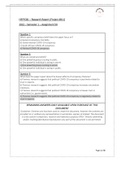
PYC4807 – Psychological Assessment 2022 – Semester 1– Assignment 1 Question #1: In the case of a norm-referenced test the individual’s performance is … a) interpreted in terms of the performance of a representative group b) expressed as a percentage c) normally distributed d) compared to a criterion or standard of performance Question #2 In the article by Gadd and Phipps (2012), they refer to the challenges faced by psychological and, specifically, neuropsychological assessment. Their study focused on a preliminary standardisation of the Wisconsin Card Sorting Test (a non-verbal measure) for Setswana-speaking university students. The US normative sample is described as participants (N = 899) from both genders who were screened beforehand to exclude individuals with a history of neurological, learning, emotional and attention difficulties. The South African sample consisted of university students (N = 93) from both genders, between the ages of 18 and 29, who were screened in terms of hearing and visual impairments and any history of psychiatric/neurological difficulties. The latter was done to prevent contamination of the results by these variables. The students were from the University of Limpopo, Medunsa Campus. Why can the Wisconsin Card Sorting Test be described as a norm-referenced test? Choose the most correct response. a) The performance of a representative group is used to interpret the individual performance. b) The US normative sample is representative of the general population. c) The performance of Setswana-speaking university students in South Africa on the test was explored. d) Individual performance is compared against an external performance standard. REMAINING QUESTIONS ONLY AVAILABLE UPON PURCHASE OF THIS DOCUMENT Disclaimer: Extreme care has been used to create this document, however the contents are provided ‘as is’ without any representation or warranties, express of implied. This document is to be used for comparison, research and reference purposes ONLY. Directly submitting and/or reselling/distribution/reproduction any part of this document is not permitted.   Question #3: Jane is a 20-year-old female who has been in a motorcar accident. Scores she obtained on the Wisconsin Card Sorting Test before the accident are compared to scores she obtained after the accident. The test is thus used in a/an … manner. a) normative b) normative and ipsative c) criterion-referenced d) ipsative Question #4: In the article by Gadd and Phipps (2012), they refer to the challenges faced by psychological and, specifically, neuropsychological assessment. Their study focused on a preliminary standardisation of the Wisconsin Card Sorting Test (a non-verbal measure) for Setswana-speaking university students. The US normative sample is described as participants (N = 899) from both genders who were screened beforehand to exclude individuals with a history of neurological, learning, emotional and attention difficulties. The South African sample consisted of university students (N = 93) from both genders, between the ages of 18 and 29, who were screened in terms of hearing and visual impairments and any history of psychiatric/neurological difficulties. The latter was done to prevent contamination of the results by these variables. The students were from the University of Limpopo, Medunsa Campus. The South African normative sample is not representative of the broader South African population aged 18 to 29 years in terms of … (a) age (b) gender (c) educational level (d) language (a) (b) (b) (d) (a) (c) (c) (d) Question #5: Gadd and Phipps (2012) found that the results of the South African sample on the Wisconsin Card Sorting Test did not resemble a normal distribution and could not be converted to a normal distribution. This implies that the … a) mean performance of this sample cannot be calculated b) results cannot be replicated c) standard deviation will differ below and above the mean d) mean and standard deviation do not provide a predetermined distribution of performance Question #6: The item difficulty values of the items in a test and the order in which these items are arranged, should be considered when determining ….. reliability. a) inter-item b) test-retest c) split-half d) alternate-form Question #7: Gradidge and De Jager (2011) evaluated the psychometric properties of the Wellness Questionnaire for Higher Education. The questionnaire comprises seven subscales, namely Physical wellness, Career wellness, Intellectual wellness, Environmental wellness, Social wellness, Emotional wellness and Spiritual wellness. The Cronbach’s Alpha coefficients ranged between 0.80 and 0.96 for the seven subscales of the questionnaire and the test-retest coefficients ranged between -0.04 and 0.71 for the seven subscales. The questionnaire will provide reliable indications of wellness levels among student populations. a) false, different constructs are measured b) true, the measure is stable over time c) true, the measure is internally consistent d) false, the items are not related Question #8: Gradidge and De Jager (2011) evaluated the psychometric properties of the Wellness Questionnaire for Higher Education. The questionnaire comprises seven subscales, namely Physical wellness, Career wellness, Intellectual wellness, Environmental wellness, Social wellness, Emotional wellness and Spiritual wellness. The Cronbach’s Alpha coefficients ranged between 0.80 and 0.96 for the seven subscales of the questionnaire and the test-retest coefficients ranged between -0.04 and 0.71 for the seven subscales. The methods to determine internal consistency and test-retest reliability are similar in terms of the following: (a) The test/forms of the test can be administered on two different occasions. (b) The test is administered in a single session. (c) One sample of respondents are involved. (d) Two different samples of respondents complete the test/forms of the test. (e) Only one form of the test is required. (f) A correlation is calculated. (a) (b) (c) (b) (d) (e) (d) (e) (f) (c) (e) (f) Question #9: Question #10: Gradidge and De Jager (2011) evaluated the psychometric properties of the Wellness Questionnaire for Higher Education. The questionnaire comprises seven subscales, namely Physical wellness, Career wellness, Intellectual wellness, Environmental wellness, Social wellness, Emotional wellness and Spiritual wellness. The Cronbach’s Alpha coefficients ranged between 0.80 and 0.96 for the seven subscales of the questionnaire and the test-retest coefficients ranged between -0.04 and 0.71 for the seven subscales. Which factors could have affected the test-retest coefficients? Choose the most correct response. a) error due to content sampling b) transfer effects such as practice and memory c) changes in the wellness construct over time d) a lack of internal consistency Question #11: The predictive validity of infant measures is poor in the first year of life, but this improves gradually and pre-school measures correlate highly with later measures of intelligence. This statement is (choose the most correct response): a) True, unless there is neuropsychological damage at infancy. b) True, because infant tests are play-based. c) False, the best predictive validity is between 18 months and four years. d) False, because performance depends on the experience of the test administrator. Question #12: Suppose that researchers want to use The Wellness Questionnaire for Higher Education to determine if wellness plays a role in academic achievement. The academic achievement in this instance can be regarded as … a) an unknown b) a psychological construct c) observable behaviour d) a criterion Question #13: Gradidge and De Jager (2011) evaluated the psychometric properties of the Wellness Questionnaire for Higher Education. The questionnaire comprises seven subscales, namely Physical wellness, Career wellness, Intellectual wellness, Environmental wellness, Social wellness, Emotional wellness and Spiritual wellness. They reported that no practically significant differences were found between the mean wellness of demographic groups (gender, language or academic year level). This is in line with wellness theory and previous research. Factor analysis also revealed the expected factor structure. Correlations between the seven subscales furthermore indicated that scales measure the same theoretical construct (i.e., Wellness). The statistical methods described above, are … (a) discriminant validity (b) theory-related group comparison (c) correlations with other tests (d) factorial validity (e) convergent validity (f) incremental validity (a) (b) (d) (c) (d) (e) (c) (e) (f) (b) (d) (e) Question #14: If a questionnaire of wellness correlates highly with a measure of resilience and with a measure of working memory, this implies that the wellness questionnaire shows … a) low convergent and discriminant validity b) low convergent but high discriminant validity c) high convergent and discriminant validity d) high convergent but low discriminant validity Question #15: Suppose that researchers want to use The Wellness Questionnaire for Higher Education to determine if wellness plays a role in academic achievement. They would need to determine the … validity of the questionnaire. a) construct b) predictive c) content d) concurrent

Meer zien Lees minder
Instelling
Vak


Oeps! We kunnen je document nu niet laden. Probeer het nog eens of neem contact op met support.

Geschreven voor

Instelling
Vak

Documentinformatie

Geüpload op
21 mei 2022
Aantal pagina's
5
Geschreven in
2022/2023
Type
Tentamen (uitwerkingen)
Bevat
Antwoorden

Onderwerpen

Voorbeeld van de inhoud

PYC4807 – Psychological Assessment
2022 – Semester 1– Assignment 1


Question #1:
In the case of a norm-referenced test the individual’s performance is …
a) interpreted in terms of the performance of a representative group
b) expressed as a percentage
c) normally distributed
d) compared to a criterion or standard of performance

Question #2
In the article by Gadd and Phipps (2012), they refer to the challenges faced by psychological
and, specifically, neuropsychological assessment. Their study focused on a preliminary
standardisation of the Wisconsin Card Sorting Test (a non-verbal measure) for Setswana-
speaking university students. The US normative sample is described as participants (N =
899) from both genders who were screened beforehand to exclude individuals with a history
of neurological, learning, emotional and attention difficulties. The South African sample
consisted of university students (N = 93) from both genders, between the ages of 18 and 29,
who were screened in terms of hearing and visual impairments and any history of
psychiatric/neurological difficulties. The latter was done to prevent contamination of the
results by these variables. The students were from the University of Limpopo, Medunsa
Campus.

Why can the Wisconsin Card Sorting Test be described as a norm-referenced test? Choose
the most correct response.
a) The performance of a representative group is used to interpret the individual
performance.
b) The US normative sample is representative of the general population.
c) The performance of Setswana-speaking university students in South Africa on the test
was explored.
d) Individual performance is compared against an external performance standard.

REMAINING QUESTIONS ONLY AVAILABLE UPON PURCHASE OF THIS
DOCUMENT
Disclaimer: Extreme care has been used to create this document, however the contents are
provided ‘as is’ without any representation or warranties, express of implied. This document
is to be used for comparison, research and reference purposes ONLY. Directly submitting
and/or reselling/distribution/reproduction any part of this document is not permitted.


Page 1 of 5

Maak kennis met de verkoper

Seller avatar
De reputatie van een verkoper is gebaseerd op het aantal documenten dat iemand tegen betaling verkocht heeft en de beoordelingen die voor die items ontvangen zijn. Er zijn drie niveau’s te onderscheiden: brons, zilver en goud. Hoe beter de reputatie, hoe meer de kwaliteit van zijn of haar werk te vertrouwen is.
studentworx University of South Africa (Unisa)
Volgen Je moet ingelogd zijn om studenten of vakken te kunnen volgen
Verkocht
460
Lid sinds
6 jaar
Aantal volgers
313
Documenten
0
Laatst verkocht
1 jaar geleden
Studentworx

4.2

69 beoordelingen

5
38
4
17
3
9
2
2
1
3

Recent door jou bekeken

Waarom studenten kiezen voor Stuvia

Gemaakt door medestudenten, geverifieerd door reviews

Kwaliteit die je kunt vertrouwen: geschreven door studenten die slaagden en beoordeeld door anderen die dit document gebruikten.

Niet tevreden? Kies een ander document

Geen zorgen! Je kunt voor hetzelfde geld direct een ander document kiezen dat beter past bij wat je zoekt.

Betaal zoals je wilt, start meteen met leren

Geen abonnement, geen verplichtingen. Betaal zoals je gewend bent via iDeal of creditcard en download je PDF-document meteen.

Student with book image

“Gekocht, gedownload en geslaagd. Zo makkelijk kan het dus zijn.”

Alisha Student

Veelgestelde vragen