

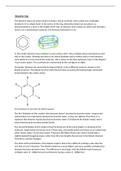
Benzene ring
The benzene ring is six carbon atoms forming a ring of six bonds. Each carbon has a hydrogen
bonded to it in a single bond. In the centre of the ring, delocalised electrons are placed, as
demonstrated by a circle in the middle of the ring. As benzene only consists of carbon and hydrogen
atoms, it is a hydrocarbon molecule. The formula of benzene is C 6H6.
In this model, benzene has p-orbitals on each carbon atom. The p-orbitals extend outwards on each
side of the carbon, allowing electrons to be shared between each p-orbital and to travel between
each orbital in a circle around the molecule. This is shown in the blue and green rings on the diagram
I have drawn above. The p-orbitals are represented by the red figures of eight.
Previously, benzene was presumed by August Kekulé to be a different structure, known as the
Kekulé structure. The Kekulé structure describes benzene as having alternating single and double
bonds between the carbon atoms.
This structure is incorrect for three reasons:
The first limitation of this model is that benzene doesn’t decolourise bromine water. Unsaturated
hydrocarbons are expected to decolourise bromine water, as they are alkenes. Therefore, it is
expected that benzene should decolourise bromine water if it followed the Kekulé model, which
states that benzene has three double bonds.
The second limitation of this model is that the bonds are all the same length in a drawing of the
molecule. Single bonds are known to be 147pm long, and double bonds are known to be 134pm long
when shown under a X-ray microscope. If benzene did follow these rules, then it would take a
slightly skewed hexagonal shape, rather than the even lengths that we see in the Kekulé structure
that forms a perfect hexagon.
The third and final limitation of the Kekulé model is that it has a different enthalpy value than the
one that we see in benzene. The Kekulé model has a much higher and more unstable enthalpy than
benzene has been proved to have. The difference is very large, with the Kekulé model having an
enthalpy value of –360kj/mol and real benzene having a value of –208kj/mol.
The benzene ring is six carbon atoms forming a ring of six bonds. Each carbon has a hydrogen
bonded to it in a single bond. In the centre of the ring, delocalised electrons are placed, as
demonstrated by a circle in the middle of the ring. As benzene only consists of carbon and hydrogen
atoms, it is a hydrocarbon molecule. The formula of benzene is C 6H6.
In this model, benzene has p-orbitals on each carbon atom. The p-orbitals extend outwards on each
side of the carbon, allowing electrons to be shared between each p-orbital and to travel between
each orbital in a circle around the molecule. This is shown in the blue and green rings on the diagram
I have drawn above. The p-orbitals are represented by the red figures of eight.
Previously, benzene was presumed by August Kekulé to be a different structure, known as the
Kekulé structure. The Kekulé structure describes benzene as having alternating single and double
bonds between the carbon atoms.
This structure is incorrect for three reasons:
The first limitation of this model is that benzene doesn’t decolourise bromine water. Unsaturated
hydrocarbons are expected to decolourise bromine water, as they are alkenes. Therefore, it is
expected that benzene should decolourise bromine water if it followed the Kekulé model, which
states that benzene has three double bonds.
The second limitation of this model is that the bonds are all the same length in a drawing of the
molecule. Single bonds are known to be 147pm long, and double bonds are known to be 134pm long
when shown under a X-ray microscope. If benzene did follow these rules, then it would take a
slightly skewed hexagonal shape, rather than the even lengths that we see in the Kekulé structure
that forms a perfect hexagon.
The third and final limitation of the Kekulé model is that it has a different enthalpy value than the
one that we see in benzene. The Kekulé model has a much higher and more unstable enthalpy than
benzene has been proved to have. The difference is very large, with the Kekulé model having an
enthalpy value of –360kj/mol and real benzene having a value of –208kj/mol.


