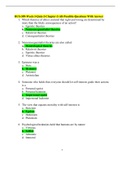
BUS-309-Week-3-Quiz-2-Chapter-2-All-Possible-Questions With Answer
1. Which theories of ethics contend that right and wrong are determined by
more than the likely consequences of an action?
a. Egoistic theories
b. Nonconsequentialist theories
c. Relativist theories
d. Consequentialist theories
2. Nonconsequentialist theories are also called
a. Deontological theories
b. Relativist theories
c. Egoistic theories
d. Virtue ethics theories
3. Epicurus was a
a. Stoic
b. Hedonist
c. Platonist
d. Aristotelian
4. Someone who holds that everyone should let self-interest guide their actions
is a
a. Personal egoist
b. Personal hedonist
c. Impersonal egoist
d. Impersonal hedonist
5. The view that equates morality with self-interest is
a. Stoicism
b. Egoism
c. Hedonism
d. Platonism
6. Psychological hedonists hold that humans are by nature
a. Virtuous
b. Selfish
c. Altruistic
d. Immoral
1
1. Which theories of ethics contend that right and wrong are determined by
more than the likely consequences of an action?
a. Egoistic theories
b. Nonconsequentialist theories
c. Relativist theories
d. Consequentialist theories
2. Nonconsequentialist theories are also called
a. Deontological theories
b. Relativist theories
c. Egoistic theories
d. Virtue ethics theories
3. Epicurus was a
a. Stoic
b. Hedonist
c. Platonist
d. Aristotelian
4. Someone who holds that everyone should let self-interest guide their actions
is a
a. Personal egoist
b. Personal hedonist
c. Impersonal egoist
d. Impersonal hedonist
5. The view that equates morality with self-interest is
a. Stoicism
b. Egoism
c. Hedonism
d. Platonism
6. Psychological hedonists hold that humans are by nature
a. Virtuous
b. Selfish
c. Altruistic
d. Immoral
1