

Lecture 1: Personality & (Work) Values
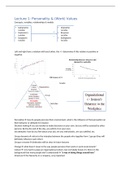
Concepts, variables, relationships & models
Left and right have a relation with each other, the +/- determines if this relation is positive or
negative
OB issues at 3
levels:
Perception how do people perceive their environment, what is the influence of that perception on
their behavior or attitude for instance
Decision making you are tended to make decisions on your own, but you will be assisted by other
persons. But by the end of the day, you will do it on your own.
Job attitudes: how do you feel about your job, are you enthusiastic, are you satisfied, etc.
Group dynamics refers to the interplay between the people who together form 1 group (they will
definitely influence each other)
Groups vs teams distinction will be clear in future lectures
Change what does it mean in the way people perceive their work or work environment?
Culture very hard to grasp an organizational culture, but everybody knows it’s there (in the
background that many people don’t understand) “a way of doing things around here”
Structure the hierarchy in a company, very important
,Idea of course: not a single variable is independent, each variable influences the other!
Organizational (human!) behavior in the workplace organizations are dead objects!. It’s always
about human interactions and dealing with trouble/winnings
Personality:
What is personality?
- definition: “sum total of ways in which an individual reacts to and interacts with other”
-determinants: Heredity (the genes) > environment (so personality is hard to modify)
This definition implies that if there is no interaction with others, there is no personality (according to
professor)
Does personality matter?--> YES! If you want to understand anything about organizations, you need
to understand the people in it
Johan Lundgren
(CEO of easyjet) example:
In google, you receive normal pictures what you would expect. The right men for the
job. He understands customers, has a close relationship with them, want to give them
what they want and need, customer is king
Michael O’Leary (CEO of RyanAir) example:
In google, you receive weird pictures with wives, or a plane in his mouth. This is another
personality than Lundgren. “We will find another way to get some money out of you”. He
sees people as a bag of money. Gambling in the aircraft, delating oxygenmasks (was a
joke, but Lundgren wouldn’t make a joke like that). He implies “Customers don’t know what’s good
for them, I know that!)
Can personality be “easily measured”?
-“God gave all the easy (measurement) problems to the physicists”
-Measurement instruments often problematic
-Self-reports: Mood, impression management, attitude, etc
Professor it can’t be easily measured
“God…. Physicists” basically true. Like Kilo, Meter: nobody will argue with this
Self-reports measure the mood on Monday morning compared to Friday afternoon, the attitude. A
lot of unreliability wil be introduced by measuring these things
Impression management: what is the best answer to say to get the job? What would the boss prefer?
You start to manipulate the answers for what you think the other want to hear
, Personality management: MBTI (on the right some example questions)
it
are binary questions: only a yes or a no see the outcomes below (very convenient and handy. You
can determine what you think is best and select these people
Personality measurement: Big 5 (much more deeper measurement)
Other personality traits relevant for OB:
Machiavellianism: Ends justify all (?) means ruthless person
Narcissism: It’s all about me Trump
Psychopathy: Lack of concern for other, lack of guilt or remorse
Approach Avoidance
Positive/negative core self-evaluations
Concepts, variables, relationships & models
Left and right have a relation with each other, the +/- determines if this relation is positive or
negative
OB issues at 3
levels:
Perception how do people perceive their environment, what is the influence of that perception on
their behavior or attitude for instance
Decision making you are tended to make decisions on your own, but you will be assisted by other
persons. But by the end of the day, you will do it on your own.
Job attitudes: how do you feel about your job, are you enthusiastic, are you satisfied, etc.
Group dynamics refers to the interplay between the people who together form 1 group (they will
definitely influence each other)
Groups vs teams distinction will be clear in future lectures
Change what does it mean in the way people perceive their work or work environment?
Culture very hard to grasp an organizational culture, but everybody knows it’s there (in the
background that many people don’t understand) “a way of doing things around here”
Structure the hierarchy in a company, very important
,Idea of course: not a single variable is independent, each variable influences the other!
Organizational (human!) behavior in the workplace organizations are dead objects!. It’s always
about human interactions and dealing with trouble/winnings
Personality:
What is personality?
- definition: “sum total of ways in which an individual reacts to and interacts with other”
-determinants: Heredity (the genes) > environment (so personality is hard to modify)
This definition implies that if there is no interaction with others, there is no personality (according to
professor)
Does personality matter?--> YES! If you want to understand anything about organizations, you need
to understand the people in it
Johan Lundgren
(CEO of easyjet) example:
In google, you receive normal pictures what you would expect. The right men for the
job. He understands customers, has a close relationship with them, want to give them
what they want and need, customer is king
Michael O’Leary (CEO of RyanAir) example:
In google, you receive weird pictures with wives, or a plane in his mouth. This is another
personality than Lundgren. “We will find another way to get some money out of you”. He
sees people as a bag of money. Gambling in the aircraft, delating oxygenmasks (was a
joke, but Lundgren wouldn’t make a joke like that). He implies “Customers don’t know what’s good
for them, I know that!)
Can personality be “easily measured”?
-“God gave all the easy (measurement) problems to the physicists”
-Measurement instruments often problematic
-Self-reports: Mood, impression management, attitude, etc
Professor it can’t be easily measured
“God…. Physicists” basically true. Like Kilo, Meter: nobody will argue with this
Self-reports measure the mood on Monday morning compared to Friday afternoon, the attitude. A
lot of unreliability wil be introduced by measuring these things
Impression management: what is the best answer to say to get the job? What would the boss prefer?
You start to manipulate the answers for what you think the other want to hear
, Personality management: MBTI (on the right some example questions)
it
are binary questions: only a yes or a no see the outcomes below (very convenient and handy. You
can determine what you think is best and select these people
Personality measurement: Big 5 (much more deeper measurement)
Other personality traits relevant for OB:
Machiavellianism: Ends justify all (?) means ruthless person
Narcissism: It’s all about me Trump
Psychopathy: Lack of concern for other, lack of guilt or remorse
Approach Avoidance
Positive/negative core self-evaluations


