BLS for Healthcare Providers Exam
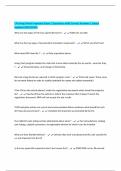
BLS for Healthcare Providers Exam How would you know that a rescue breath for a victim of any age is effective? - You should see their chest rise. A child has a heart rate greater than 60 per minute and a pulse, but has ineffective breathing or is not breathing, what should the rescuer do? - Give rescue breaths. (every 3-5 seconds) What ventilation device/ technique is not recommended for a single rescuer to provide breaths during CPR? - The bag-mask ventilation technique. What would be the correct compression and ventilation rates for 2-rescuer CPR in the presence of an advanced airway? - 100/min (compressions) and 1 breath every 6-8 seconds. After the AED delivers a shock, what should the rescuer do? - Resume CPR immediately, starting with compressions. An unresponsive infant is not breathing, has a heart rate of 53 beats per minute and there are signs of poor perfusion even with oxygenation and ventilation with bag and mask. What would you perform? - Perform CPR. Where do you place your hands to perform chest compressions on an adult? - On the breastbone, center of chest, between the nipples/sternum. What is the preferred chest compression technique for an infant for 2-rescuer CPR? - The two thumb-encircling hands technique. What is the rate for performing chest compressions for a victim all ages? - 100 per minute. What is the depth of compressions for an adult? - 2 inches. What is the ratio for 2-rescuer child CPR? - 15/2 What is the ratio for 1-rescuer adult CPR? - 30/2 (5 cycles) What is the ratio for 2-rescuer infant CPR? - 15/2 (10 cycles) ...........................
Geschreven voor
- Instelling
-
Pasadena City College
- Vak
-
BLS
Documentinformatie
- Geüpload op
- 27 april 2022
- Aantal pagina's
- 2
- Geschreven in
- 2021/2022
- Type
- Tentamen (uitwerkingen)
- Bevat
- Vragen en antwoorden
Onderwerpen
-
bls for healthcare providers exam