Engelse taalkunde II – History of English
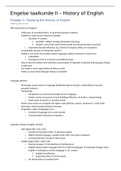
Chapter 1: Studying the History of English
Setti ng the scene
Why study history of English?
- 1200 years of recorded history good documentary evidence
- English has experienced important changes
o Synthetic analytic
Synthetic: suffixes encode grammatical meaning
Analytic: word order and function words encode grammatical meaning)
o Important external influences (e.g. Norman Conquest: effect on vocabulary)
- Considerable amount of scholarship about it
- English is one of the most widely spoken languages: global importance results from
o Colonialism
o Emergence of US as economic and political power
- Way to become familiar with methods and principles of linguistics in general and language change
in particular
- Can make us more appreciative of literary works
- Makes us aware that language change is inevitable
Language domains
- Phonology: sound system of language (distinctive speech sounds, combinations of sounds,
prosodic features)
- Morphology
o Morphemes as minimal meaningful units in language
o Studies various processed of word building (inflection, derivation, compounding)
o Major parts of speech vs. function words
- Syntax: how words are arranged into higher units (phrases, clauses, sentences) + word order
- Semantics: lexical and grammatical meaning
- Pragmatics: study of language in use
o Function of language in its social context
o Communicative intensions of speakers
Linguistic change in English: periods
- Old English (OE): 450 -1100
o Invasion of Germanic tribes Norman invasion
o Highly infected language, variable word order, Germanic vocabulary
o Surviving literature mostly in West Saxon
- Middle English (ME): 1066-1500
o Norman invasion introduction of printing press
o English largely spoken language (French as official language) important changes when
English re-emerged as written language in 13 th century
English lost inflection
Important influx of French words
o No preservation of standard form
, - Early Modern English (EModE): 1500-1700
o Renaissance death of poet John Dryden
o Rise of standard dialect
o Major linguistic development: Great Vowel Shift
- Late Modern English (LModE): 1700-1900
o Beginning of English plain style
o Spread op English around the globe
- Present-Day English (PDE): 1900-now
Chapter 2: Sounds and Sound Change of English
The sounds and writi ng in English
Writing of English
- Origin: Semitic alphabet 1800 BC: 22 symbols representing consonant sounds
Greeks (10th century BC)
Etruscans: Runic alphabet (Northwest Germanic tribes): came to England with Anglo-
Saxon invasions
Latin alphabet: brought to British Isles with Roman legionnaires and with
missionaries (to spread Christianity)
, Chapter 4: The Indo-European Language Family and Proto-Indo-
European
The classifi cati on of languages – The Indo-European language family
2 types of classification
- Typological classification
o Isolating/agglutinating/inflecting (fairly old categorization)
Isolating: 1 word = 1 morpheme
Agglutinating:
1 word > 1 meaning (root + affixes)
1 morpheme = 1 meaning
Inflecting:
1 word > 1 morpheme (root+affix(es))
1 morpheme > 1 meaning
o Analytic/synthetic/polysynthetic (new categorization)
Analytic: grammatical relations expressed by word order + function words
Synthetic: grammatical relations primarily expressed by affixes (inflecting +
agglutinating affixes)
Polysynthetic: long string of morphemes (stem + affixes)
o Classification in terms of order of subject, object, verb
SVO, SOV, VSO are most common orders cross-linguistically
Describing change from OE to PDE in terms of these categories
More inflecting more agglutinative and isolating
Inflecting: inflections in OE indicating more than one meaning: case, gender,
number)
Agglutinative: comparative/plural/preterite suffix
Isolating: more monomorphemic function words
- Genealogical classification (starting from common origin)
o Family tree model
o Wave model: acknowledges that language spreads through contact (but very hard to
represent)
Indo-European language family
- Branches: see pp; 102-109, 107
- Reconstruction of unattested proto-language through comparative method
o Rests on assumption that similarities of form and meaning among words are not product
of chance but must be result from common origin
Chapter 1: Studying the History of English
Setti ng the scene
Why study history of English?
- 1200 years of recorded history good documentary evidence
- English has experienced important changes
o Synthetic analytic
Synthetic: suffixes encode grammatical meaning
Analytic: word order and function words encode grammatical meaning)
o Important external influences (e.g. Norman Conquest: effect on vocabulary)
- Considerable amount of scholarship about it
- English is one of the most widely spoken languages: global importance results from
o Colonialism
o Emergence of US as economic and political power
- Way to become familiar with methods and principles of linguistics in general and language change
in particular
- Can make us more appreciative of literary works
- Makes us aware that language change is inevitable
Language domains
- Phonology: sound system of language (distinctive speech sounds, combinations of sounds,
prosodic features)
- Morphology
o Morphemes as minimal meaningful units in language
o Studies various processed of word building (inflection, derivation, compounding)
o Major parts of speech vs. function words
- Syntax: how words are arranged into higher units (phrases, clauses, sentences) + word order
- Semantics: lexical and grammatical meaning
- Pragmatics: study of language in use
o Function of language in its social context
o Communicative intensions of speakers
Linguistic change in English: periods
- Old English (OE): 450 -1100
o Invasion of Germanic tribes Norman invasion
o Highly infected language, variable word order, Germanic vocabulary
o Surviving literature mostly in West Saxon
- Middle English (ME): 1066-1500
o Norman invasion introduction of printing press
o English largely spoken language (French as official language) important changes when
English re-emerged as written language in 13 th century
English lost inflection
Important influx of French words
o No preservation of standard form
, - Early Modern English (EModE): 1500-1700
o Renaissance death of poet John Dryden
o Rise of standard dialect
o Major linguistic development: Great Vowel Shift
- Late Modern English (LModE): 1700-1900
o Beginning of English plain style
o Spread op English around the globe
- Present-Day English (PDE): 1900-now
Chapter 2: Sounds and Sound Change of English
The sounds and writi ng in English
Writing of English
- Origin: Semitic alphabet 1800 BC: 22 symbols representing consonant sounds
Greeks (10th century BC)
Etruscans: Runic alphabet (Northwest Germanic tribes): came to England with Anglo-
Saxon invasions
Latin alphabet: brought to British Isles with Roman legionnaires and with
missionaries (to spread Christianity)
, Chapter 4: The Indo-European Language Family and Proto-Indo-
European
The classifi cati on of languages – The Indo-European language family
2 types of classification
- Typological classification
o Isolating/agglutinating/inflecting (fairly old categorization)
Isolating: 1 word = 1 morpheme
Agglutinating:
1 word > 1 meaning (root + affixes)
1 morpheme = 1 meaning
Inflecting:
1 word > 1 morpheme (root+affix(es))
1 morpheme > 1 meaning
o Analytic/synthetic/polysynthetic (new categorization)
Analytic: grammatical relations expressed by word order + function words
Synthetic: grammatical relations primarily expressed by affixes (inflecting +
agglutinating affixes)
Polysynthetic: long string of morphemes (stem + affixes)
o Classification in terms of order of subject, object, verb
SVO, SOV, VSO are most common orders cross-linguistically
Describing change from OE to PDE in terms of these categories
More inflecting more agglutinative and isolating
Inflecting: inflections in OE indicating more than one meaning: case, gender,
number)
Agglutinative: comparative/plural/preterite suffix
Isolating: more monomorphemic function words
- Genealogical classification (starting from common origin)
o Family tree model
o Wave model: acknowledges that language spreads through contact (but very hard to
represent)
Indo-European language family
- Branches: see pp; 102-109, 107
- Reconstruction of unattested proto-language through comparative method
o Rests on assumption that similarities of form and meaning among words are not product
of chance but must be result from common origin