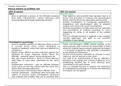
Forensic essay plans
Discuss bottom-up profiling (16)
AO1 (6 marks) AO3 (12 marks)
Intro Scientific basis
- Aims to generate a picture of the offender including - More objective and scientific than top-down due to it
their likely characteristics, routine behaviour and being more grounded in evidence and psychological
social background through systematic analysis theory and less driven by speculation and hunches
- Enables investigators to manipulate geographical,
biographical and psychological data to produce
insights and results that assist investigations
- Recently expanded to include areas such as interview
and examination of material presented in court,
supporting its utility in all aspects of the judicial
process
- This is a strength because it suggests it has valuable
real-life application and adds to the scientific
credibility of psychology
Investigative psychology Supporting evidence for investigative psychology
- Aims to establish patterns of behaviour likely to occur - Carter and Heritage’s (1990) content analysis of 66
or co-exist across crime scenes developing a sexual assault cases involved the examination of data
statistical ‘database’ which then acts as a baseline for using the smallest space analysis statistical technique
comparison – a computer programme that identifies correlations
- Details of the offence are then matched against this across patterns of behaviour
database to reveal important details about the - Several characteristics identified as common in most
offender – personal history, family background etc cases e.g. lack of reaction to the victim
- May also reveal whether a series of linked offences - Can lead to an understanding of how an offender’s
were likely to have been committed by the same behaviour may change over a series of offences, or in
person establishing whether two or more offences were
- Interpersonal coherence – way an offender behaves committed by the same person
at the scene as how they interact with the victim may - This is a strength because it supports the usefulness
reflect their everyday behaviour of investigative psychology as it shows how statistical
- Time and place may indicate where offender lives techniques can be applied
- Forensic awareness – individuals who have been the
subject of previous police interrogation; behaviour
may indicate how mindful they are of covering their
, Forensic essay plans
tracks
Geographical profiling Supporting evidence for geographical profiling
- Information related to the location of linked crime - Lundrigan and Canter (2001) combined information
scenes to make inferences about the likely home from 120 murder cases involving serial killers in the
base of an offender – crime mapping USA
- Combined with psychological theory to generate - Smallest space analysis revealed spatial consistency
hypotheses about how the offender is thinking as well in the behaviour of killers
as their modus operandi - Location of each body disposal site was in a different
- Assumes serial offenders restrict their work to familiar direction from previous sites creating a ‘centre of
areas, and so understanding a spatial pattern of gravity’; the offender’s base was invariably located in
behaviour provides a ‘centre of gravity’ which is likely the centre of the pattern
to include the offender’s base - Effect was more noticeable for marauders (offenders
- Helps investigators guess where the offender is likely who travelled short distances)
to strike – jeopardy surface - This is a strength because it supports Canter’s claim
- Marauder – operates in close proximity to their home that spatial information is key in determining the
base base of an offender
- Commuter – likely to have travelled away from their
social residence
- Gives insight into the nature of their offence i.e.
planned/opportunistic
- Reveals important factors about the offender e.g.
‘mental maps’, mode of transport, employment status
etc
Discuss bottom-up profiling (16)
AO1 (6 marks) AO3 (12 marks)
Intro Scientific basis
- Aims to generate a picture of the offender including - More objective and scientific than top-down due to it
their likely characteristics, routine behaviour and being more grounded in evidence and psychological
social background through systematic analysis theory and less driven by speculation and hunches
- Enables investigators to manipulate geographical,
biographical and psychological data to produce
insights and results that assist investigations
- Recently expanded to include areas such as interview
and examination of material presented in court,
supporting its utility in all aspects of the judicial
process
- This is a strength because it suggests it has valuable
real-life application and adds to the scientific
credibility of psychology
Investigative psychology Supporting evidence for investigative psychology
- Aims to establish patterns of behaviour likely to occur - Carter and Heritage’s (1990) content analysis of 66
or co-exist across crime scenes developing a sexual assault cases involved the examination of data
statistical ‘database’ which then acts as a baseline for using the smallest space analysis statistical technique
comparison – a computer programme that identifies correlations
- Details of the offence are then matched against this across patterns of behaviour
database to reveal important details about the - Several characteristics identified as common in most
offender – personal history, family background etc cases e.g. lack of reaction to the victim
- May also reveal whether a series of linked offences - Can lead to an understanding of how an offender’s
were likely to have been committed by the same behaviour may change over a series of offences, or in
person establishing whether two or more offences were
- Interpersonal coherence – way an offender behaves committed by the same person
at the scene as how they interact with the victim may - This is a strength because it supports the usefulness
reflect their everyday behaviour of investigative psychology as it shows how statistical
- Time and place may indicate where offender lives techniques can be applied
- Forensic awareness – individuals who have been the
subject of previous police interrogation; behaviour
may indicate how mindful they are of covering their
, Forensic essay plans
tracks
Geographical profiling Supporting evidence for geographical profiling
- Information related to the location of linked crime - Lundrigan and Canter (2001) combined information
scenes to make inferences about the likely home from 120 murder cases involving serial killers in the
base of an offender – crime mapping USA
- Combined with psychological theory to generate - Smallest space analysis revealed spatial consistency
hypotheses about how the offender is thinking as well in the behaviour of killers
as their modus operandi - Location of each body disposal site was in a different
- Assumes serial offenders restrict their work to familiar direction from previous sites creating a ‘centre of
areas, and so understanding a spatial pattern of gravity’; the offender’s base was invariably located in
behaviour provides a ‘centre of gravity’ which is likely the centre of the pattern
to include the offender’s base - Effect was more noticeable for marauders (offenders
- Helps investigators guess where the offender is likely who travelled short distances)
to strike – jeopardy surface - This is a strength because it supports Canter’s claim
- Marauder – operates in close proximity to their home that spatial information is key in determining the
base base of an offender
- Commuter – likely to have travelled away from their
social residence
- Gives insight into the nature of their offence i.e.
planned/opportunistic
- Reveals important factors about the offender e.g.
‘mental maps’, mode of transport, employment status
etc