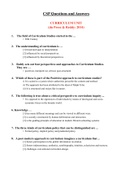
CSP Questions and Answers
CURRICULUM UNIT
(du Preez & Reddy: 2014)
1. The field of Curriculum Studies started in the …
• 20th Century
2. The understanding of curriculum is …
[1] broad and open to interpretation.
[2] influenced by social perspectives.
[3] influenced by theoretical perspectives
3. Reddy sets out four perspectives and approaches to Curriculum Studies.
They are …
• positivist, interpretivist, critical, post-structural.
4. Which of these is part of the Positivist approach to curriculum studies?
i) It is suited to a system where authorities prescribe the content and method.
ii) The approach has been attributed to the ideas of Ralph Tyler.
iii) It is structured and recipe-like in nature.
5. The following is true about a critical perspective to curriculum inquiry ...
• It is opposed to the oppression of individuals by means of ideological and socio-
economic forces in the broader world.
6. Knowledge …
[1] has many different meanings and can be viewed in different ways.
[2] is socially constructed by human deliberation and interaction.
[3] is the guiding principle of education in modern Western schooling systems.
7. The three kinds of curriculum policy that can be distinguished are ...
• Formal policy, implicit policy and prudential policy.
8. A post-modern approach to curriculum imagines a curriculum that ...
[1] fosters participation in the global information revolution.
[2] fosters indeterminacy, aesthetics, autobiography, intuition, eclecticism and mystery.
[3] challenges conventional curriculum design.
CURRICULUM UNIT
(du Preez & Reddy: 2014)
1. The field of Curriculum Studies started in the …
• 20th Century
2. The understanding of curriculum is …
[1] broad and open to interpretation.
[2] influenced by social perspectives.
[3] influenced by theoretical perspectives
3. Reddy sets out four perspectives and approaches to Curriculum Studies.
They are …
• positivist, interpretivist, critical, post-structural.
4. Which of these is part of the Positivist approach to curriculum studies?
i) It is suited to a system where authorities prescribe the content and method.
ii) The approach has been attributed to the ideas of Ralph Tyler.
iii) It is structured and recipe-like in nature.
5. The following is true about a critical perspective to curriculum inquiry ...
• It is opposed to the oppression of individuals by means of ideological and socio-
economic forces in the broader world.
6. Knowledge …
[1] has many different meanings and can be viewed in different ways.
[2] is socially constructed by human deliberation and interaction.
[3] is the guiding principle of education in modern Western schooling systems.
7. The three kinds of curriculum policy that can be distinguished are ...
• Formal policy, implicit policy and prudential policy.
8. A post-modern approach to curriculum imagines a curriculum that ...
[1] fosters participation in the global information revolution.
[2] fosters indeterminacy, aesthetics, autobiography, intuition, eclecticism and mystery.
[3] challenges conventional curriculum design.