Aantekeningen TT2
Lecture 8
Motor systems: the organization of action
Chapter 5 Purves
Overview
• Motor control is hierarchical (p. 132-136 not BOX 5A)
• Cortical pathways for motor control (p. 137-143, not BOX 5B)
• Coding movements by the activity of neuronal populations (p. 143-144)
• Planning movements (p. 144-149)
• Sequential Movements and the SMA (p. 149-151)
• Sensory-Motor Coordination (p.151-152)
• Initiation of movement and the basal ganglia (p. 152-156)
• Basal ganglia and cognition (only slides)
• Error correction and motor coordination by the cerebellum (p. 159-161)
Motor control is hierarchical
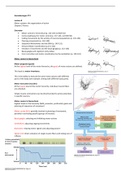
Motor programs (goals)
At the highest level of the motor hierarchy, the goals of motor actions are defined.
This leads to motor invariance.
This is the ability to execute the same motor actions with different
parts of the body (see example: writing with different body parts).
Motor execution (muscles)
At the lowest level of the motor hierarchy, individual muscle fibers
are activated.
Simple muscle contractions can be directly linked to action potentials
in specific neurons.
Motor control is hierarchical
Highest levels in the hierarchy (SMA, premotor, prefrontal): goals and
planning of sequences of movement
Motor cortex (M1): partially involved in planning of movement,
partially in activating specific (groups of) muscles.
Basal ganglia: selecting and inhibiting motor actions
Cerebellum: adjusting ongoing movements
Brainstem: relaying motor signals and adjusting posture
Spinal cord: direct activation of single muscle fibers and taking care of
reflexes
,Subcortical motor structures
Cortical pathways for motor control
• Supplementary motor cortex (SMA): planning of
already learned sequences of motor actions. Internal
cues (no sensory information required). Playing guitar
when you have already mastered it.
• Premotor cortex: learning sequences of motor actions.
External cues (sensory information is required). Looking
and listening to your guitar teacher when repeating a
played sequence.
• Motor cortex (M1): execution of single movement, can
be a complex multijoint movement.
Contralateral control of movement →
,Cortical pathways for motor control
Somatopy: a topographical map of the body is present in all motor
structures
Cortical regions: SMA, premotor cortex, motor cortex
,
Lecture 8
Motor systems: the organization of action
Chapter 5 Purves
Overview
• Motor control is hierarchical (p. 132-136 not BOX 5A)
• Cortical pathways for motor control (p. 137-143, not BOX 5B)
• Coding movements by the activity of neuronal populations (p. 143-144)
• Planning movements (p. 144-149)
• Sequential Movements and the SMA (p. 149-151)
• Sensory-Motor Coordination (p.151-152)
• Initiation of movement and the basal ganglia (p. 152-156)
• Basal ganglia and cognition (only slides)
• Error correction and motor coordination by the cerebellum (p. 159-161)
Motor control is hierarchical
Motor programs (goals)
At the highest level of the motor hierarchy, the goals of motor actions are defined.
This leads to motor invariance.
This is the ability to execute the same motor actions with different
parts of the body (see example: writing with different body parts).
Motor execution (muscles)
At the lowest level of the motor hierarchy, individual muscle fibers
are activated.
Simple muscle contractions can be directly linked to action potentials
in specific neurons.
Motor control is hierarchical
Highest levels in the hierarchy (SMA, premotor, prefrontal): goals and
planning of sequences of movement
Motor cortex (M1): partially involved in planning of movement,
partially in activating specific (groups of) muscles.
Basal ganglia: selecting and inhibiting motor actions
Cerebellum: adjusting ongoing movements
Brainstem: relaying motor signals and adjusting posture
Spinal cord: direct activation of single muscle fibers and taking care of
reflexes
,Subcortical motor structures
Cortical pathways for motor control
• Supplementary motor cortex (SMA): planning of
already learned sequences of motor actions. Internal
cues (no sensory information required). Playing guitar
when you have already mastered it.
• Premotor cortex: learning sequences of motor actions.
External cues (sensory information is required). Looking
and listening to your guitar teacher when repeating a
played sequence.
• Motor cortex (M1): execution of single movement, can
be a complex multijoint movement.
Contralateral control of movement →
,Cortical pathways for motor control
Somatopy: a topographical map of the body is present in all motor
structures
Cortical regions: SMA, premotor cortex, motor cortex
,