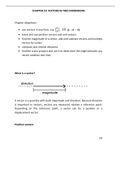
CHAPTER 10: VECTORS IN TWO DIMENSIONS
Chapter objectives:
𝑎
• use vectors in any form, e.g. x y , )))))⃗
𝐴𝐵 , 𝐩, 𝑎𝐢 − 𝑏𝐣
𝑏
• know and use position vectors and unit vectors
• find the magnitude of a vector; add and subtract vectors and multiply
vectors by scalars
• compose and resolve velocities
• find the scalar product and use it to determine the angle between any
vector notation two lines
What is a vector?
A vector is a quantity with both magnitude and direction. Because direction
is important in vectors, vectors are measured relative a reference point.
Depending on the reference point, a vector can be a position or a
displacement vector.
Position vectors
189
,A position vector is a vector measured relative to the origin 𝑂. The position
vector of an arbitrary point 𝐴 relative to the origin is written as )))))⃗
𝑂𝐴 or 𝒂.
The position vector of a point can also be given in the format:
𝑎
𝒂=x y
𝑏
Where (𝑎; 𝑏) are the coordinates of the point 𝐴.
Position vectors can also be given in the 𝒊 − 𝒋 format:
𝒂 = 𝑎𝒊 + 𝑏𝒋
(where 𝒊 and 𝒋 the unit vectors in the 𝑥 and 𝑦 directions respectively)
190
, In fact, any vector can be written in this format:
𝑥/
‡ ˆ = 𝑥/ 𝒊 + 𝑦/ 𝒋
𝑦/
Displacement vectors
The displacement vector of a point is its relative position from a point of
reference which is not necessarily the origin. The displacement vector of the
)))))⃗. The displacement vector of the
point B relative to the point A is written 𝐴𝐵
point A relative to the point B is written )))))⃗
𝐵𝐴.
Note that:
)))))⃗ ≠ 𝐵𝐴
𝐴𝐵 )))))⃗ but 𝐴𝐵
)))))⃗ = −𝐵𝐴
)))))⃗
In general, when the direction of a vector is reversed, its sign is also reversed.
191
Chapter objectives:
𝑎
• use vectors in any form, e.g. x y , )))))⃗
𝐴𝐵 , 𝐩, 𝑎𝐢 − 𝑏𝐣
𝑏
• know and use position vectors and unit vectors
• find the magnitude of a vector; add and subtract vectors and multiply
vectors by scalars
• compose and resolve velocities
• find the scalar product and use it to determine the angle between any
vector notation two lines
What is a vector?
A vector is a quantity with both magnitude and direction. Because direction
is important in vectors, vectors are measured relative a reference point.
Depending on the reference point, a vector can be a position or a
displacement vector.
Position vectors
189
,A position vector is a vector measured relative to the origin 𝑂. The position
vector of an arbitrary point 𝐴 relative to the origin is written as )))))⃗
𝑂𝐴 or 𝒂.
The position vector of a point can also be given in the format:
𝑎
𝒂=x y
𝑏
Where (𝑎; 𝑏) are the coordinates of the point 𝐴.
Position vectors can also be given in the 𝒊 − 𝒋 format:
𝒂 = 𝑎𝒊 + 𝑏𝒋
(where 𝒊 and 𝒋 the unit vectors in the 𝑥 and 𝑦 directions respectively)
190
, In fact, any vector can be written in this format:
𝑥/
‡ ˆ = 𝑥/ 𝒊 + 𝑦/ 𝒋
𝑦/
Displacement vectors
The displacement vector of a point is its relative position from a point of
reference which is not necessarily the origin. The displacement vector of the
)))))⃗. The displacement vector of the
point B relative to the point A is written 𝐴𝐵
point A relative to the point B is written )))))⃗
𝐵𝐴.
Note that:
)))))⃗ ≠ 𝐵𝐴
𝐴𝐵 )))))⃗ but 𝐴𝐵
)))))⃗ = −𝐵𝐴
)))))⃗
In general, when the direction of a vector is reversed, its sign is also reversed.
191