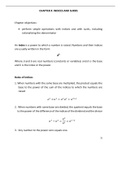
CHAPTER 4: INDICES AND SURDS
Chapter objectives:
• perform simple operations with indices and with surds, including
rationalising the denominator
An index is a power to which a number is raised. Numbers and their indices
are usually written in the form:
𝑨𝒃
Where 𝐴 and 𝑏 are real numbers (constants or variables) and 𝐴 is the base
and 𝑏 is the index or the power.
Rules of indices
1. When numbers with the same base are multiplied, the product equals the
base to the power of the sum of the indices to which the numbers are
raised
𝑎 T × 𝑎 £ = 𝑎 T 𝑎£ = 𝑎TU£
2. When numbers with same base are divided, the quotient equals the base
to the power of the difference of the indices of the dividend and the divisor
𝑎T
𝑎 ÷ 𝑎 = £ = 𝑎T^£
T £
𝑎
3. Any number to the power zero equals one.
75
, 𝑎k = 1
4. The inverse of a number equals that number to the power of negative its
index.
1
T
= 𝑎^T
𝑎
5. When a base with an index is raised to another power the result is that
base to the power of the product of the indices
(𝑎 T )£ = 𝑎T£
/
6. The 𝑛th root of a number equals that number to the power
•
/
¥
√𝑎 = 𝑎•
7. When two bases with the same indices are multiplied or divided, the
result is the product or quotient of the bases (respectively) to the power
of the common index.
𝑎T 𝑏 T = (𝑎𝑏) T
𝑎T 𝑎 T
=x y
𝑏T 𝑏
Example 4.1
Simplify }𝑥 ¦ 𝑦/k ÷ }𝑥 ] 𝑦 ^“ giving the answer in the form 𝑥 6 𝑦 7 .
§
76
Chapter objectives:
• perform simple operations with indices and with surds, including
rationalising the denominator
An index is a power to which a number is raised. Numbers and their indices
are usually written in the form:
𝑨𝒃
Where 𝐴 and 𝑏 are real numbers (constants or variables) and 𝐴 is the base
and 𝑏 is the index or the power.
Rules of indices
1. When numbers with the same base are multiplied, the product equals the
base to the power of the sum of the indices to which the numbers are
raised
𝑎 T × 𝑎 £ = 𝑎 T 𝑎£ = 𝑎TU£
2. When numbers with same base are divided, the quotient equals the base
to the power of the difference of the indices of the dividend and the divisor
𝑎T
𝑎 ÷ 𝑎 = £ = 𝑎T^£
T £
𝑎
3. Any number to the power zero equals one.
75
, 𝑎k = 1
4. The inverse of a number equals that number to the power of negative its
index.
1
T
= 𝑎^T
𝑎
5. When a base with an index is raised to another power the result is that
base to the power of the product of the indices
(𝑎 T )£ = 𝑎T£
/
6. The 𝑛th root of a number equals that number to the power
•
/
¥
√𝑎 = 𝑎•
7. When two bases with the same indices are multiplied or divided, the
result is the product or quotient of the bases (respectively) to the power
of the common index.
𝑎T 𝑏 T = (𝑎𝑏) T
𝑎T 𝑎 T
=x y
𝑏T 𝑏
Example 4.1
Simplify }𝑥 ¦ 𝑦/k ÷ }𝑥 ] 𝑦 ^“ giving the answer in the form 𝑥 6 𝑦 7 .
§
76