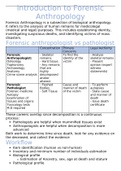
Introduction to Forensic
Anthropology
Forensic Anthropology is a subsection of biological anthropology.
It refers to the analysis of human remains for medicolegal
(medical and legal) purposes. This includes establishing identity,
investigating suspicious deaths, and identifying victims of mass
disasters.
Forensic anthropologist vs pathologist
Concentration Primary Legal Authority
Concerns
Forensic - Skeletal To find the - Analyse
Anthropologist: remains. identity of the skeletal remains
Osteology - Hard tissue. victim - Present
Taphonomy - Any remains opinion (expert
Archaeology that are witness
Anatomy highly statements)
Crime scene analysis decomposed
and/or
altered.
Forensic - Fleshed Cause and - To perform
Pathologist: Bodies manner of death autopsies
Forensic medicine - Soft Tissue of the victim - State cause
Autopsy and manner of
Examination of death
tissues and organs - Issue death
Toxicology tests certificate
M.D required
These careers overlap since decomposition is a continuous
process:
Pathologists are helpful when mummified tissues exist
Anthropologists are helpful when decomposition is more
advanced
Both work to determine time since death, look for any evidence on
the deceased, and collect the evidence
Workflow
Item identification (human vs non-human)
Inventory and minimum number of individuals estimation
Biological profile
o Estimation of Ancestry, sex, age at death and stature
Pathological profile
Anthropology
Forensic Anthropology is a subsection of biological anthropology.
It refers to the analysis of human remains for medicolegal
(medical and legal) purposes. This includes establishing identity,
investigating suspicious deaths, and identifying victims of mass
disasters.
Forensic anthropologist vs pathologist
Concentration Primary Legal Authority
Concerns
Forensic - Skeletal To find the - Analyse
Anthropologist: remains. identity of the skeletal remains
Osteology - Hard tissue. victim - Present
Taphonomy - Any remains opinion (expert
Archaeology that are witness
Anatomy highly statements)
Crime scene analysis decomposed
and/or
altered.
Forensic - Fleshed Cause and - To perform
Pathologist: Bodies manner of death autopsies
Forensic medicine - Soft Tissue of the victim - State cause
Autopsy and manner of
Examination of death
tissues and organs - Issue death
Toxicology tests certificate
M.D required
These careers overlap since decomposition is a continuous
process:
Pathologists are helpful when mummified tissues exist
Anthropologists are helpful when decomposition is more
advanced
Both work to determine time since death, look for any evidence on
the deceased, and collect the evidence
Workflow
Item identification (human vs non-human)
Inventory and minimum number of individuals estimation
Biological profile
o Estimation of Ancestry, sex, age at death and stature
Pathological profile