Psychology: Attachment
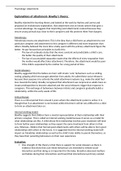
Explanations of attachment- Bowlby’s theory:
Bowlby rejected the learning theory and looked at the work by Harlow and Lorenz and
proposed an evolutionary explanation; that attachment was an innate system that gave a
survival advantage. He suggests that imprinting (and attachment) evolved because they
ensure young animals stay close to their caregivers and this protects them from dangers.
Monotropy:
Monotropy means one attachment. This is the idea that a child forms an attachment to one
particular caregiver and attachment to this caregiver is different and more important than
others. Bowlby believed the more time a baby spent with the primary attachment figure the
better. He put forward two principles to clarify this:
- The law of continuity states that the more constant and predictable a child’s care,
the better the quality of their attachment.
- The law of accumulated separation states that the effects of every separation from
the mother would affect later attachment. Therefore, the attachment would be poor
if the child is separated by the mother for a long period of time.
Social releasers:
Bowlby suggested that the babies are born with innate ‘cute’ behaviours such as smiling,
cooing, gripping which encourages attention from adults. He called these social releasers
because their purpose is to activate the adult attachment systems (e.g. make the adult feel
love towards the baby). Bowlby recognised that attachment was reciprocal as adults have an
innate predisposition to become attached and the social releasers trigger that response in
caregivers. This exchange of behaviours between infants and caregivers gradually builds a
relationship, within the early weeks of life.
Critical Period:
There is a critical period from around 2 years where the attachment system is active. It is
thought that if an attachment is not formed within this time it will be very difficult for a child
to form an attachment later on.
Internal working model:
Bowlby suggests that children form a mental representation of their relationship with their
primary caregiver. This is called an internal working model because it serves as a model for
what relationships are like. A child whose first relationship involves poor treatment will tend
to form further poor relationships as they expect the same treatment from others in that
way. Whereas, children that formed good attachments with others will be able to form good
relationships with others in the future. It is suggested that the internal working model will
impact on friendship relationships as well as the child’s later ability to parent themselves, as
they base their parenting behaviours on their own experience.
Evaluation:
One strength of this theory is that there is support for social releasers as there is
evidence that show that cute infant behaviours are intended to initiate social
interaction and that doing so is important for the baby. Brazelton observed mothers
and babies during their interactions and found that interactional synchrony existed.
Explanations of attachment- Bowlby’s theory:
Bowlby rejected the learning theory and looked at the work by Harlow and Lorenz and
proposed an evolutionary explanation; that attachment was an innate system that gave a
survival advantage. He suggests that imprinting (and attachment) evolved because they
ensure young animals stay close to their caregivers and this protects them from dangers.
Monotropy:
Monotropy means one attachment. This is the idea that a child forms an attachment to one
particular caregiver and attachment to this caregiver is different and more important than
others. Bowlby believed the more time a baby spent with the primary attachment figure the
better. He put forward two principles to clarify this:
- The law of continuity states that the more constant and predictable a child’s care,
the better the quality of their attachment.
- The law of accumulated separation states that the effects of every separation from
the mother would affect later attachment. Therefore, the attachment would be poor
if the child is separated by the mother for a long period of time.
Social releasers:
Bowlby suggested that the babies are born with innate ‘cute’ behaviours such as smiling,
cooing, gripping which encourages attention from adults. He called these social releasers
because their purpose is to activate the adult attachment systems (e.g. make the adult feel
love towards the baby). Bowlby recognised that attachment was reciprocal as adults have an
innate predisposition to become attached and the social releasers trigger that response in
caregivers. This exchange of behaviours between infants and caregivers gradually builds a
relationship, within the early weeks of life.
Critical Period:
There is a critical period from around 2 years where the attachment system is active. It is
thought that if an attachment is not formed within this time it will be very difficult for a child
to form an attachment later on.
Internal working model:
Bowlby suggests that children form a mental representation of their relationship with their
primary caregiver. This is called an internal working model because it serves as a model for
what relationships are like. A child whose first relationship involves poor treatment will tend
to form further poor relationships as they expect the same treatment from others in that
way. Whereas, children that formed good attachments with others will be able to form good
relationships with others in the future. It is suggested that the internal working model will
impact on friendship relationships as well as the child’s later ability to parent themselves, as
they base their parenting behaviours on their own experience.
Evaluation:
One strength of this theory is that there is support for social releasers as there is
evidence that show that cute infant behaviours are intended to initiate social
interaction and that doing so is important for the baby. Brazelton observed mothers
and babies during their interactions and found that interactional synchrony existed.