Psychology: Attachment
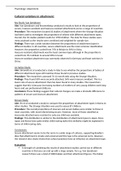
Cultural variations in attachment:
Key Study: Van Ijzendoorn
Aim: Van Ijzendoorn and Kroonenberg conducted a study to look at the proportions of
secure, insecure-avoidant and insecure-resistant attachments across a range of countries.
Procedure: The researchers located 32 studies of attachment where the Strange Situation
had been used to investigate the proportions of infants with different attachment types.
Overall, the 32 studies yielded results for 1990 children. The data for these studies were
meta-analysed so the results were combined and weighted for sample size.
Findings: There was a wide variation between the proportions of attachment types in
different studies. In all countries, secure attachment was the most common classification.
However, the proportion varied from 75% in Britain to 50% in China.
Insecure resistant attachment was the least common type although in the proportion is
varied from 3% in Britain to around 30% in Israel.
Insecure-avoidant attachment was commonly observed in Germany and least common in
China.
An Italian Study:
Aim: Simonella et al conducted a study in Italy to see whether the proportions of babies of
different attachment types still matches those found in previous studies.
Procedure: The researchers assessed 76 12 month olds using the Strange Situation.
Findings: They found 50% were securely attached, 36% were insecure avoidant. This is a
lower rate of secure attachment than has been found in many studies. The researchers
suggest that this is because increasing numbers of mothers of very young children work long
hours and use professional childcare.
Conclusion: These findings suggest that cultural changes can make a dramatic difference to
patterns of secure and insecure attachment.
Korean Study:
Aim: Jin et al conducted a study to compare the proportions of attachment types in Korea to
other studies. The Strange Situation was used to assess 87 children.
Procedure: The overall proportions of insecure and secure babies were similar to those in
most countries, with most infants being secure. However, more of those classified as
insecurely attached were resistant to only one child was avoidant.
Findings: This distribution is similar to the distribution of attachment types in Japan. Since
Japan and Korea have quite similar child rearing styles this similarity might be explained in
terms of child rearing style.
Conclusions:
Secure attachment seems to be the norm in a wide range of cultures, supporting Bowlby’s
idea that attachment is innate and universal and this type is the universal norm. However,
the research also clearly shows that cultural practises have an influence on attachment type.
Evaluation:
A strength of combining the results of attachment studies carried out in different
countries is that you can end up with a large sample. For e.g. Van Ijzendoorn
research there was a total of 2000 babies and their attachment figures. The Italian
Cultural variations in attachment:
Key Study: Van Ijzendoorn
Aim: Van Ijzendoorn and Kroonenberg conducted a study to look at the proportions of
secure, insecure-avoidant and insecure-resistant attachments across a range of countries.
Procedure: The researchers located 32 studies of attachment where the Strange Situation
had been used to investigate the proportions of infants with different attachment types.
Overall, the 32 studies yielded results for 1990 children. The data for these studies were
meta-analysed so the results were combined and weighted for sample size.
Findings: There was a wide variation between the proportions of attachment types in
different studies. In all countries, secure attachment was the most common classification.
However, the proportion varied from 75% in Britain to 50% in China.
Insecure resistant attachment was the least common type although in the proportion is
varied from 3% in Britain to around 30% in Israel.
Insecure-avoidant attachment was commonly observed in Germany and least common in
China.
An Italian Study:
Aim: Simonella et al conducted a study in Italy to see whether the proportions of babies of
different attachment types still matches those found in previous studies.
Procedure: The researchers assessed 76 12 month olds using the Strange Situation.
Findings: They found 50% were securely attached, 36% were insecure avoidant. This is a
lower rate of secure attachment than has been found in many studies. The researchers
suggest that this is because increasing numbers of mothers of very young children work long
hours and use professional childcare.
Conclusion: These findings suggest that cultural changes can make a dramatic difference to
patterns of secure and insecure attachment.
Korean Study:
Aim: Jin et al conducted a study to compare the proportions of attachment types in Korea to
other studies. The Strange Situation was used to assess 87 children.
Procedure: The overall proportions of insecure and secure babies were similar to those in
most countries, with most infants being secure. However, more of those classified as
insecurely attached were resistant to only one child was avoidant.
Findings: This distribution is similar to the distribution of attachment types in Japan. Since
Japan and Korea have quite similar child rearing styles this similarity might be explained in
terms of child rearing style.
Conclusions:
Secure attachment seems to be the norm in a wide range of cultures, supporting Bowlby’s
idea that attachment is innate and universal and this type is the universal norm. However,
the research also clearly shows that cultural practises have an influence on attachment type.
Evaluation:
A strength of combining the results of attachment studies carried out in different
countries is that you can end up with a large sample. For e.g. Van Ijzendoorn
research there was a total of 2000 babies and their attachment figures. The Italian