Psychology: Attachments
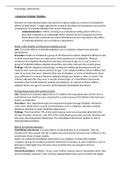
=omanian Orphan Studies:
Research on material deprivation has turned to orphan studies as a means of studying the
effects of deprivation. A tragic opportunity to look at the effects of institutional care and the
consequence of institutionalisation that arose in Romania.
- Institutionalisation—Effects of living in an institutional setting which refers to a
place like a hospital or an orphanage where children live for a long period of time.
These places lack emotional care and in attachment we are interested in the effects
of institutionalisation care on children’s attachment.
Rutter’s ERA (English and Romanian Adoptee) study:
Aim: To see the effects of institutionalisation care on children’s attachment and later
development.
Procedure: Rutter et al followed a group of 165 Romanian orphans adopted in Britain to test
to what extent good care can make up for early experiences in institutions. Physical,
emotional and cognitive development has been assessed at age 4,6,11 and 15 years. A
group of 52 British children adopted around the same time and were the control group.
Findings: Half the adoptees showed signs of delayed intellectual development and the
majority were severely undernourished. At age 11 the adopted children showed differential
rates of recovery that were related to their age of adoption. In terms of attachment, there
was a difference in outcome between adoption taking pace before or after 6 months. The
children adopted after they were 6 months showed signs of a disinhibited attachment;
Symptoms that include attention seeking and clinginess. In contrast to those children
adopted before the age of 6 months rarely displayed disinhibited attachment.
The Bucharest Early Intervention Project:
Aim: Zeanah et al assessed attachment in 95 children who had spent most of their lives in
institutional care and they were compared to a control group of 50 children who had never
lived in an institution.
Procedure: Their attachment type was measured using the Strange Situation. Moreover,
carers were asked about unusual social behaviour such as clinginess, attention seeking
behaviour directed at adults (inhibited attachment).
Findings: They found that 74% of the control group came out as securely attached in the
Strange Situation. However, only 19% of the institutional group were securely attached and
65% were the disorganised attachment. The disinhibited attachment applied to 44% of
institutionalised children.
Effects of institutionalisation:
Disinhibited attachment is a typical effect of spending time in an institution. They are
friendly with other people and this is highly unusual behaviour because most children in the
second year show stranger anxiety.
Rutter has explained disinhibited attachment as an adaption to living with multiple
caregivers during the sensitive period for attachment formation. In poor institutions such as
Romania a child might have 50 carers none of whom they see enough to form an
attachment.
Mental Retardation. In Rutter’s study, most children showed signs of retardation when they
arrived in Britain. However, most of those adopted before they were 6 months old caught
=omanian Orphan Studies:
Research on material deprivation has turned to orphan studies as a means of studying the
effects of deprivation. A tragic opportunity to look at the effects of institutional care and the
consequence of institutionalisation that arose in Romania.
- Institutionalisation—Effects of living in an institutional setting which refers to a
place like a hospital or an orphanage where children live for a long period of time.
These places lack emotional care and in attachment we are interested in the effects
of institutionalisation care on children’s attachment.
Rutter’s ERA (English and Romanian Adoptee) study:
Aim: To see the effects of institutionalisation care on children’s attachment and later
development.
Procedure: Rutter et al followed a group of 165 Romanian orphans adopted in Britain to test
to what extent good care can make up for early experiences in institutions. Physical,
emotional and cognitive development has been assessed at age 4,6,11 and 15 years. A
group of 52 British children adopted around the same time and were the control group.
Findings: Half the adoptees showed signs of delayed intellectual development and the
majority were severely undernourished. At age 11 the adopted children showed differential
rates of recovery that were related to their age of adoption. In terms of attachment, there
was a difference in outcome between adoption taking pace before or after 6 months. The
children adopted after they were 6 months showed signs of a disinhibited attachment;
Symptoms that include attention seeking and clinginess. In contrast to those children
adopted before the age of 6 months rarely displayed disinhibited attachment.
The Bucharest Early Intervention Project:
Aim: Zeanah et al assessed attachment in 95 children who had spent most of their lives in
institutional care and they were compared to a control group of 50 children who had never
lived in an institution.
Procedure: Their attachment type was measured using the Strange Situation. Moreover,
carers were asked about unusual social behaviour such as clinginess, attention seeking
behaviour directed at adults (inhibited attachment).
Findings: They found that 74% of the control group came out as securely attached in the
Strange Situation. However, only 19% of the institutional group were securely attached and
65% were the disorganised attachment. The disinhibited attachment applied to 44% of
institutionalised children.
Effects of institutionalisation:
Disinhibited attachment is a typical effect of spending time in an institution. They are
friendly with other people and this is highly unusual behaviour because most children in the
second year show stranger anxiety.
Rutter has explained disinhibited attachment as an adaption to living with multiple
caregivers during the sensitive period for attachment formation. In poor institutions such as
Romania a child might have 50 carers none of whom they see enough to form an
attachment.
Mental Retardation. In Rutter’s study, most children showed signs of retardation when they
arrived in Britain. However, most of those adopted before they were 6 months old caught