HESI Exit Exam 3 – Question and Answers with Rationales
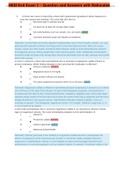
1. A home care nurse is instructing a client with hyperemesis gravidarum about measures to ease the nausea and vomiting. The nurse tells the client to: A. Eat foods high in calories and fat B. Lie down for at least 20 minutes after meals C. Eat carbohydrates such as cereals, rice, and pasta Correct D. Consume primarily soups and liquids at mealtimes Rationale: Low-fat foods and easily digested carbohydrates such as fruit, breads, cereals, rice, and pasta provide important nutrients and help prevent a low blood glucose level, which can cause nausea. Soups and other liquids should be taken between meals to avoid distending the stomach and triggering nausea. Sitting upright after meals reduces gastric reflux. Additionally, food portions should be small and foods with strong odors should be eliminated from the diet, because food smells often incite nausea. A nurse is caring for a client with preeclampsia who is receiving a magnesium sulfate infusion to prevent eclampsia. Which finding indicates to the nurse that the medication is effective? E. Clonus is present. Incorrect F. Magnesium level is 10 mg/dL. G. Deep tendon reflexes are absent. H. The client experiences diuresis within 24 to 48 hours. Correct Rationale: Magnesium sulfate is effective in preventing seizures (eclampsia) if diuresis occurs within 24 to 48 hours of the start of the infusion. As part of the therapeutic response, renal perfusion is increased and the client is free of visual disturbances, headache, epigastric pain, clonus (the rapid rhythmic jerking motion of the foot that occurs when the client’s lower leg is supported and the foot is sharply dorsiflexed), and seizure activity. Hyperreflexia indicates cerebral irritability. Clonus is normally not present. The therapeutic magnesium level is 4 to 8 mg/dL. Reflexes range from 1+ to 2+ but should not be absent. A client with preeclampsia who is receiving magnesium sulfate in an intravenous infusion exhibits signs of magnesium toxicity. The nurse immediately prepares for the administration of: I. Vitamin K J. Protamine sulfate Incorrect K. Calcium gluconate Correct L. Naloxone hydrochloride Rationale: Calcium gluconate is the antidote to magnesium sulfate because it antagonizes the effects of magnesium at the neuromuscular junction. It should be readily available whenever magnesium is administered. Vitamin K is the antidote in cases of hemorrhage induced by the administration of oral anticoagulants such as warfarin sodium (Coumadin). Protamine sulfate is the antidote in cases of hemorrhage induced by the administration of heparin. Naloxone hydrochloride is administered to treat opioid-induced respiratory depression. A nurse instructs a pregnant client about foods that are high in folic acid. Which item does the nurse tell the client is the best source of folic acid? M. Milk N. Steak O. Chicken P. Lima beans Correct Rationale: The best sources of folic acid are liver; kidney, pinto, lima, and black beans; and fresh dark-green leafy vegetables. Other good sources of folic acid are orange juice, peanuts, refried beans, and peas. Milk is high in calcium. Chicken and steak are high in protein. A nurse is providing instructions to a mother of an infant with seborrheic dermatitis (cradle cap) about treatment of the condition. The nurse tells the mother to: Q. Avoid the use of shampoo on the infant’s scalp Incorrect R. Apply oil to the affected area on the infant’s scalp Correct S. Wash the infant’s scalp daily, using only tepid water T. Shampoo the infant’s scalp, avoiding the anterior fontanel area Rationale: Seborrheic dermatitis, a chronic inflammation of the scalp or other areas of the skin, is characterized by yellow, scaly, oily lesions. It sometimes results when parents do not wash over the anterior fontanel carefully for fear that they will hurt the infant. Treatment includes the application of oil (e.g., mineral oil) to the area to help soften the lesions followed by gentle removal of the scaly lesions with a comb before the head is shampooed. The nurse should teach the mother how to shampoo the scalp and explain that she will not damage the fontanel with normal gentle shampooing. The scalp should be rinsed well to remove all soap, which could cause irritation. A nurse is monitoring a client who was given an epidural opioid for a cesarean birth. The nurse notes that the client’s oxygen saturation on pulse oximetry is 92%. The nurse first: U. Notifies the registered nurse V. Documents the findings W. Instructs the client to take several deep breaths Correct X. Administers 100% oxygen by way of face mask Incorrect Rationale: If the client has been given an epidural opioid, the nurse should monitor the client’s respiratory status closely. If the oxygen saturation falls below 95%, the nurse instructs the client to take several deep breaths to increase the level. Although the finding would be documented, action is required to increase the oxygen saturation level. It is not necessary to contact the registered nurse. If the deep breaths fail to increase the oxygen saturation level, the registered nurse is notified and may prescribe oxygen. A client who delivered a healthy newborn 11 days ago calls the clinic and tells the nurse that she is experiencing a white vaginal discharge. The nurse tells the client: Y. To perform a vaginal douche Z. To come to the clinic for a checkup Incorrect AA. That this is an indication of an infection AB. That this is a normal postpartum occurrence Correct Rationale: For the first 3 days following childbirth, lochia consists almost entirely of blood, with small particles of decidua and mucus, and is called lochia rubra because of its red color. The amount of blood decreases by about the fourth day, and which time the lochia changes from red to pink or brown-tinged; this stage is called lochia serosa. By about the 11th day, the erythrocyte component of lochia has decreased and the discharge becomes white or cream-colored. This final stage is known as lochia alba. Lochia alba contains leukocytes, decidual cells, epithelial cells, fat, cervical mucus, and bacteria. It is present in most women until the third week after childbirth but may persist for as long as 6 weeks. Lochia alba is a normal finding during the postpartum course, and no intervention is required, so the other options are incorrect. A rubella antibody screen is performed in a pregnant client, and the results indicate that the client is not immune to rubella. The nurse tells the client that: AC. A rubella vaccine must be administered immediately Incorrect AD. A rubella vaccine must be administered after childbirth Correct AE. She will not contract rubella if she is exposed to the disease AF. She does not need to be concerned about being exposed to rubella Rationale: A prenatal rubella antibody screen is performed in every pregnant woman to determine whether she is immune to rubella, which can cause serious fetal anomalies. If she is not immune, rubella vaccine is offered after childbirth to keep her from contracting rubella during subsequent pregnancies. The vaccine is a live virus, and defects might occur in the fetus if the vaccine were administered during pregnancy or if the mother were to become pregnant soon after it was administered. Administering a rubella vaccine immediately places the fetus at risk. Telling the client that she does not need to be concerned about being exposed to rubella is incorrect, because the possibility of exposure, which could be harmful to the fetus, does exist. A nurse is monitoring a client who delivered a healthy newborn 12 hours ago. The nurse takes the client’s temperature and notes that it is 38° C (100.4° F). The most appropriate nursing action would be to: AG. Notify the registered nurse AH. Recheck the temperature in 1 hour Incorrect AI. Encourage the intake of oral fluids Correct AJ. Tell the client that antibiotics will be prescribed Rationale: A temperature of 38° C (100.4° F) is common during the 24 hours after childbirth. It may be the result of dehydration or normal postpartum leukocytosis. If the increased temperature persists for longer than 24 hours or exceeds 38° C, infection is a possibility, and the fever is reported to the registered nurse. Because the client delivered her baby just 12 hours ago, the most appropriate nursing action is to encourage the intake of oral fluids. A nurse is assessing the uterine fundus of a client who has just delivered a baby and notes that the fundus is boggy. The nurse massages the fundus, and then presses to expel clots from the uterus. To prevent uterine inversion during this procedure, the nurse: AK. Has the client void before the uterine assessment AL. Tells the woman to bear down during fundal message AM. Simultaneously provides pressure over the lower uterine segment Correct AN. Asks the client to take slow, deep breaths during fundal assessment Incorrect Rationale: After massaging a boggy fundus until it is firm, the nurse presses the fundus to expel clots from the uterus. The nurse must also keep one hand pressed firmly just above the symphysis (over the lower uterine segment) the entire time. Removing the clots allows the uterus to contract properly. Providing pressure over the lower uterine segment prevents uterine inversion. Having the client void before uterine assessment will not prevent uterine inversion. Telling the woman to bear down while the nurse performs fundal message and asking the client to take slow, deep breaths during fundal assessment also will not prevent uterine inversion. A nurse is monitoring a client after vaginal delivery notes a constant trickle of bright-red blood from the client’s vagina. In which order would the nurse perform the following actions? Assign the number 1 to the first action and the number 5 to the last. Incorrect A. Assessing the client’s fundus B. Checking the client’s vital signs C. Changing the client’s peripads D. Contacting the physician E. Documenting the findings The correct order is: F. Assessing the client’s fundus G. Checking the client’s vital signs H. Contacting the physician I. Changing the client’s peripads J. Documenting the findings Rationale: A constant trickle of bright-red blood may indicate abnormal bleeding and requires immediate attention. The nurse first checks the client’s fundus. Once it has been determined that the bleeding is not the result of a boggy uterus, the nurse should check the vital signs to determine whether the blood loss has compromised the client’s condition. Next the nurse would contact the physician and report the bleeding, fundal height and condition, and vital signs. After contacting the physician the nurse would attend to the client’s comfort needs, including, in this case, frequent changes of peripads. The nurse would document the findings once assessment and implementation had been completed and the client’s condition was considered stable. A nonstress test is performed, and the physician documents “accelerations lasting less than 15 seconds throughout fetal movement.” The nurse interprets these findings as: A. Normal B. Reactive Incorrect C. Nonreactive Correct D. Inconclusive Rationale: A reactive nonstress test is a normal, or negative, result and indicates a healthy fetus. The result requires two or more fetal heart rate accelerations of at least 15 beats/min lasting at least 15 seconds from the beginning of the acceleration to the end, in association with fetal movement, during a 20-minute period. A nonreactive test is an abnormal test, showing no accelerations or accelerations of less than 15 beats/min or lasting less than 15 seconds during a 40-minute observation. An inconclusive result is one that cannot be interpreted because of the poor quality of the fetal heart rate recording. A stillborn infant was delivered a few hours ago. After the birth, the family remains together, holding and touching the baby. Which statement by the nurse is appropriate? E. “I know how you feel.” F. “This must be hard for you.” Correct G. “Now you have an angel in heaven.” H. “You’re young. You can have other children.” Rationale: Therapeutic communication helps the mother, father, and other family members express their feelings and emotions. “This must be hard for you” is a caring and empathetic response, focused on feelings and encouraging communication. The other options are nontherapeutic and may devalue the family members' feelings. A nurse is providing nutritional counseling to pregnant client with a history of cardiac disease. What does the nurse advise the client to eat? I. Water and pretzels J. Low-fat cheese omelet Incorrect K. Nachos and fried chicken L. Apple and whole-grain toast Correct
Written for
- Institution
- Hesi exit
- Course
- Hesi exit
Document information
- Uploaded on
- March 29, 2022
- Number of pages
- 45
- Written in
- 2021/2022
- Type
- Exam (elaborations)
- Contains
- Questions & answers
Subjects
-
hesi exit exam 3 – question and answers with rationales

Also available in package deal