Question Bank
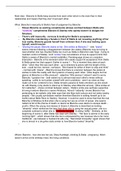
Theme 1 – A-posteriori, Inductive Arguments:
1. Examine Aquinas’ cosmological argument for the existence of God. (AO1)
First Way – Motion: Aristotle differentiated between actual and potential
things. Some things are in motion; some things that are actual must actualise
the potentiality of something else for it to become actual – e.g. a red rubber
ball has the potential to be red goo once it is melted.
A thing cannot; in the same respect and in the same way, move itself; it
requires a mover – e.g. a rubber ball (in act) has the potency to become goo
when melted by fire (in act and the mover) with the potency to melt.
An infinite regress of movers is impossible. In accidental causation (Per
Accidens) causal power is underived in the here and now; derives from itself;
does not need an original cause to exist. In essential causation (per se) causal
power is derived in the here and now from something else; there must be a
first member that is not first temporally but First in the sense of being the
fundamental cause of the motion of all the instrumental members in the
series directly causing the motion of the last member.
Therefore, there is an unmoved mover from whom all motion proceeds,
which we call God which is purely actual because it is unmoved and does not
need to become actualised to actualise the potentiality of other things in the
here and now.
Second Way – Causality: Some things are caused. The effect/ultimate cause is
produced by an intermediate cause that has an effect from deriving power
from an efficient cause which does not derive its causal power from anything
else – e.g. a hammer is the intermediate cause, the human hand is the
efficient cause, the nail is the effect/ultimate cause.
The Principle of Causality: “everything that begins to exist has a cause” – e.g.
even the efficient cause of a human being was caused by two other humans.
Something would have to exist before it causes itself to exist, thus there is an
incoherence to holding to that.
An infinite regress of efficient causation is impossible as the First Way shows
that motion cannot go on for an infinite amount of time so there must be a
First Cause.
Therefore, there must be an uncaused cause of all that is caused, which we
call God, which is the fundamental cause in a Per Se causal series.
Third Way - Contingency: Some things exist contingently (dependent on
something else).
If something exists contingently, then there is a time at which it did not exist
and will go out of existence.
If everything exists contingently, then at one time nothing existed.
If at one time nothing existed, then now nothing should exist – Causal
Principle: ex nihilo, nihil fit = out of nothing, nothing comes.
Therefore, there must be a necessary being (permanent, not corruptible,
cannot be in existence) which we call God, whose existence is not contingent
on other beings.
, 2. Outline the Kalam Argument with reference to William Lane Craig. (AO1)
Whatever begins to exist has a cause – he attests this as a causal first
principle of science. Rational tuition – this is self-evident based on the Causal
Principle. Personal experience – it would be inexplicable why things do not
randomly appear into existence without a cause. Inductive reasoning –
common experience and scientific evidence constantly verifies and never
falsifies the truth of the first premise.
The universe began to exist. Physical evidence – scientific confirmation
against a past-infinite universe in the form of the 2nd law a of
Thermodynamics: the universe is running out of usable energy, thus the
universe must have a definite beginning, because if it had been here forever,
it would have ran out of reusable energy by now. The Big Bang – universe
must have began from a singularity and it is constantly expanding as
confirmed by Edward Hubble’s empirical evidence of the red shift in light
from distant galaxies, signifying that they are expanding away from us.
Metaphysical evidence – differentiates between an actual infinite
(paradoxical idea of things with an infinite number of members and a part
within the set is equal to the whole) and a potential infinite (exists as it is
always possible to theoretically add one more to an infinite value, serving as
an ideal limit). The mathematic impossibility of forming an actual infinite as
successive addition/subtraction to an infinite value does not change anything
– e.g. an infinite library with an infinite number of red and black books: red =
black, if the red books are taken away there is still an infinite number of black
books meaning there is still an infinite value of books altogether as there
were before the red books were taken away; equally, if an infinite amount of
yellow books were added the overall quantity would remain the same. This
impossibility of transgressing an infinite means the universe must have
began from a certain point.
Therefore, the universe must have a cause beyond the space-time universe; it
must be spaceless, timeless, immaterial, uncaused and unimaginably
powerful – qualities we ascribe to God.
3. ‘The challenges to the cosmological argument for God’s existence are
unconvincing.’ Assess. (AO2)
Applicable to Kalam and the First and Third Way: Fallacy of composition – an
error that one makes when they presume that, since the parts of something
have a certain property, the whole thing has that property – e.g. “Just
because every man has a mother, it doesn’t mean that there is a mother of
the human race” -Bertrand Russel. Criticism of David Hume: just because
each of the elements of the chain has a cause, it is not necessary to follow
that the chain itself has a cause; just because events in the universe have a
cause it does not mean that the universe as a whole has a cause.
Applicable to Kalam and Second Way: Cause and effect in the mind - Hume:
we think 1 snooker ball causes another to move – in reality, we just see 1 ball
move towards the second ball which then moves; two separate events. We
add this idea of cause to this experience.
Theme 1 – A-posteriori, Inductive Arguments:
1. Examine Aquinas’ cosmological argument for the existence of God. (AO1)
First Way – Motion: Aristotle differentiated between actual and potential
things. Some things are in motion; some things that are actual must actualise
the potentiality of something else for it to become actual – e.g. a red rubber
ball has the potential to be red goo once it is melted.
A thing cannot; in the same respect and in the same way, move itself; it
requires a mover – e.g. a rubber ball (in act) has the potency to become goo
when melted by fire (in act and the mover) with the potency to melt.
An infinite regress of movers is impossible. In accidental causation (Per
Accidens) causal power is underived in the here and now; derives from itself;
does not need an original cause to exist. In essential causation (per se) causal
power is derived in the here and now from something else; there must be a
first member that is not first temporally but First in the sense of being the
fundamental cause of the motion of all the instrumental members in the
series directly causing the motion of the last member.
Therefore, there is an unmoved mover from whom all motion proceeds,
which we call God which is purely actual because it is unmoved and does not
need to become actualised to actualise the potentiality of other things in the
here and now.
Second Way – Causality: Some things are caused. The effect/ultimate cause is
produced by an intermediate cause that has an effect from deriving power
from an efficient cause which does not derive its causal power from anything
else – e.g. a hammer is the intermediate cause, the human hand is the
efficient cause, the nail is the effect/ultimate cause.
The Principle of Causality: “everything that begins to exist has a cause” – e.g.
even the efficient cause of a human being was caused by two other humans.
Something would have to exist before it causes itself to exist, thus there is an
incoherence to holding to that.
An infinite regress of efficient causation is impossible as the First Way shows
that motion cannot go on for an infinite amount of time so there must be a
First Cause.
Therefore, there must be an uncaused cause of all that is caused, which we
call God, which is the fundamental cause in a Per Se causal series.
Third Way - Contingency: Some things exist contingently (dependent on
something else).
If something exists contingently, then there is a time at which it did not exist
and will go out of existence.
If everything exists contingently, then at one time nothing existed.
If at one time nothing existed, then now nothing should exist – Causal
Principle: ex nihilo, nihil fit = out of nothing, nothing comes.
Therefore, there must be a necessary being (permanent, not corruptible,
cannot be in existence) which we call God, whose existence is not contingent
on other beings.
, 2. Outline the Kalam Argument with reference to William Lane Craig. (AO1)
Whatever begins to exist has a cause – he attests this as a causal first
principle of science. Rational tuition – this is self-evident based on the Causal
Principle. Personal experience – it would be inexplicable why things do not
randomly appear into existence without a cause. Inductive reasoning –
common experience and scientific evidence constantly verifies and never
falsifies the truth of the first premise.
The universe began to exist. Physical evidence – scientific confirmation
against a past-infinite universe in the form of the 2nd law a of
Thermodynamics: the universe is running out of usable energy, thus the
universe must have a definite beginning, because if it had been here forever,
it would have ran out of reusable energy by now. The Big Bang – universe
must have began from a singularity and it is constantly expanding as
confirmed by Edward Hubble’s empirical evidence of the red shift in light
from distant galaxies, signifying that they are expanding away from us.
Metaphysical evidence – differentiates between an actual infinite
(paradoxical idea of things with an infinite number of members and a part
within the set is equal to the whole) and a potential infinite (exists as it is
always possible to theoretically add one more to an infinite value, serving as
an ideal limit). The mathematic impossibility of forming an actual infinite as
successive addition/subtraction to an infinite value does not change anything
– e.g. an infinite library with an infinite number of red and black books: red =
black, if the red books are taken away there is still an infinite number of black
books meaning there is still an infinite value of books altogether as there
were before the red books were taken away; equally, if an infinite amount of
yellow books were added the overall quantity would remain the same. This
impossibility of transgressing an infinite means the universe must have
began from a certain point.
Therefore, the universe must have a cause beyond the space-time universe; it
must be spaceless, timeless, immaterial, uncaused and unimaginably
powerful – qualities we ascribe to God.
3. ‘The challenges to the cosmological argument for God’s existence are
unconvincing.’ Assess. (AO2)
Applicable to Kalam and the First and Third Way: Fallacy of composition – an
error that one makes when they presume that, since the parts of something
have a certain property, the whole thing has that property – e.g. “Just
because every man has a mother, it doesn’t mean that there is a mother of
the human race” -Bertrand Russel. Criticism of David Hume: just because
each of the elements of the chain has a cause, it is not necessary to follow
that the chain itself has a cause; just because events in the universe have a
cause it does not mean that the universe as a whole has a cause.
Applicable to Kalam and Second Way: Cause and effect in the mind - Hume:
we think 1 snooker ball causes another to move – in reality, we just see 1 ball
move towards the second ball which then moves; two separate events. We
add this idea of cause to this experience.