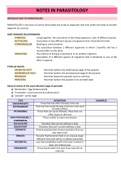
NOTES IN PARASITOLOGY
INTRODUCTION TO PARASITOLOGY
PARASITOLOGY is the area of science which deals the study of organisms that lives within the body of another
organism for survival.
HOST-PARASITE RELATIONSHIPS:
SYMBIOSIS: Living together, the association of two living organisms, each of different species.
MUTUALISM: Association of two different species of organisms that is beneficial to both.
COMMENSALISM: Relating to commensalism.
The association between 2 different organisms in which 1 benefits and has a
neutral effect on the other.
PARASITISM: The practice of living as a parasite in or on another organism.
Association of 2 different species of organisms that is beneficial to one at the
other’s expense.
TYPES OF HOSTS:
DEFINITIVE HOST: Host that harbors the adult/sexual stage of the parasite.
INTERMEDIATE HOST: Host that harbors the larval/asexual stage of the parasite.
RESERVOIR: Host that allows the parasite cycle to continue.
PARATENIC: Host that harbors the parasite in its arrested state.
General review of the usual infective stage of parasites
Nematodes = Egg (embryonated)
Trematode = Larva (cercaria & multicercaria)
Cestode = Larval stage
TYPE DEFINITION EXAMPLES
ENDOPARASITE Those that lives within the body of the host
ECTOPARASITE Those that lives outside the body of the host; those found
on body surfaces
PATHOGENIC Those that can cause diseases; those that can
inflict injury to the host
NON-PATHOGENIC / Those unable to cause any disease
COMMENSAL
FACULTATIVE Parasites that can live without a host
OBLIGATORY Parasites that can’t survive without a host
ZOONOTIC Animal parasites/non-human parasites that can
also infect man
ERRATIC Parasite that becomes fixed in an unusual organ
different from that which it ordinary parasitize
INCIDENTAL one that establishes itself in the host in which it
does not ordinary live
PERMANENT Those found within the host from early life to
maturity
INTRODUCTION TO PARASITOLOGY
PARASITOLOGY is the area of science which deals the study of organisms that lives within the body of another
organism for survival.
HOST-PARASITE RELATIONSHIPS:
SYMBIOSIS: Living together, the association of two living organisms, each of different species.
MUTUALISM: Association of two different species of organisms that is beneficial to both.
COMMENSALISM: Relating to commensalism.
The association between 2 different organisms in which 1 benefits and has a
neutral effect on the other.
PARASITISM: The practice of living as a parasite in or on another organism.
Association of 2 different species of organisms that is beneficial to one at the
other’s expense.
TYPES OF HOSTS:
DEFINITIVE HOST: Host that harbors the adult/sexual stage of the parasite.
INTERMEDIATE HOST: Host that harbors the larval/asexual stage of the parasite.
RESERVOIR: Host that allows the parasite cycle to continue.
PARATENIC: Host that harbors the parasite in its arrested state.
General review of the usual infective stage of parasites
Nematodes = Egg (embryonated)
Trematode = Larva (cercaria & multicercaria)
Cestode = Larval stage
TYPE DEFINITION EXAMPLES
ENDOPARASITE Those that lives within the body of the host
ECTOPARASITE Those that lives outside the body of the host; those found
on body surfaces
PATHOGENIC Those that can cause diseases; those that can
inflict injury to the host
NON-PATHOGENIC / Those unable to cause any disease
COMMENSAL
FACULTATIVE Parasites that can live without a host
OBLIGATORY Parasites that can’t survive without a host
ZOONOTIC Animal parasites/non-human parasites that can
also infect man
ERRATIC Parasite that becomes fixed in an unusual organ
different from that which it ordinary parasitize
INCIDENTAL one that establishes itself in the host in which it
does not ordinary live
PERMANENT Those found within the host from early life to
maturity