CHRONIC RESP
1 Tuberculosis Granuloma formation in
lungs as
infection macrophage involvement to attempt
primary
phagocytosis
Latent TB affects 44 of world population
can be seen on X ray bloods
Cell mediated immunity contains
the infection the lesion granuloma
continue to become active pulmonary
may
TB communicable
Mycobacterium tuberculosis Slow growing with a
lipid rich cell wall
OH i Can affect
any body system notes on pulmonary
Presentation Cough Cproductive 2 3 weeks
pleurisy haemoptysis
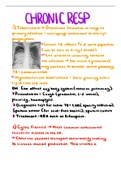
Diagnostic test for active TB CX RC opacity 1 effusion
Sputum smear for acid fast bacilli sputum culture
Treatment A BX such as Rifampicin
2 Cystic Fibrosis Most common autosomnal
recessive disease in the UK
Chlorine channeltransport abnormality leading
to viscous mucoid production This creates a
, nutritious environment for 9 bacterial colonisation
Step wise alterations in respiratory organisms
Strep pneuma t H Influenzae
T treatment
Staph Aureus
Challenge
Pseudomonas Very adaptible
3 Bronchiectasis infection and
Primary
inflammatory response
Long term loss of lung architecture
Widened
airways with more secretions
pooling
step wise colonisation
with unusual
organisms
TB
non
Mycobacterium
Patient risk factors for chronic resp infections
COPD
Cigarette smoking
Air pollution t chronic
allergens
1 Tuberculosis Granuloma formation in
lungs as
infection macrophage involvement to attempt
primary
phagocytosis
Latent TB affects 44 of world population
can be seen on X ray bloods
Cell mediated immunity contains
the infection the lesion granuloma
continue to become active pulmonary
may
TB communicable
Mycobacterium tuberculosis Slow growing with a
lipid rich cell wall
OH i Can affect
any body system notes on pulmonary
Presentation Cough Cproductive 2 3 weeks
pleurisy haemoptysis
Diagnostic test for active TB CX RC opacity 1 effusion
Sputum smear for acid fast bacilli sputum culture
Treatment A BX such as Rifampicin
2 Cystic Fibrosis Most common autosomnal
recessive disease in the UK
Chlorine channeltransport abnormality leading
to viscous mucoid production This creates a
, nutritious environment for 9 bacterial colonisation
Step wise alterations in respiratory organisms
Strep pneuma t H Influenzae
T treatment
Staph Aureus
Challenge
Pseudomonas Very adaptible
3 Bronchiectasis infection and
Primary
inflammatory response
Long term loss of lung architecture
Widened
airways with more secretions
pooling
step wise colonisation
with unusual
organisms
TB
non
Mycobacterium
Patient risk factors for chronic resp infections
COPD
Cigarette smoking
Air pollution t chronic
allergens