Unit 11- Genetics and Genetic Engineering Nucleic acids.
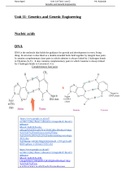
Unit 11- Genetics and Genetic Engineering Nucleic acids.Nucleic acids DNA DNA is the molecule that holds the guidance for growth and development in every living thing. Its structure is described as a double-stranded helix held together by integral base pairs. It contains complementary base pairs in which adenine is always linked by 2 hydrogen bonds to Thymine (A-T). It also contains complementary pairs in which Guanine is always linked by 3 hydrogen bonds to Cytosine (C-G). Complementary base pairs sa=i&rct=j&q=&esrc=s&source=images&cd=&cad=r ja&uact= 8&ved=0ahUKEwi4umKuqnWAhXEfxoKHYzCD6EQjRwIBw&url=https %3A%2F%2F%2Fblog %2F2016%2F05%2F25%2Funderstanding-oncology2016-dna %2F&psig=AFQjCNEg5Q5Zcb0xcR_1T7CgCUuSP BDHvg&ust= sa=i&rct=j&q=&esrc=s&source=images&cd=&cad=r ja&uact= 8&ved=0ahUKEwiD0- L4uqnWAhUC8RQKHUQICdIQjRwIBw&url=http %3A%2F%2Fww %2Fen%2Fvirtuallessons Nana Agyei Unit 11A Task 1 and 2 Ms. Kubasiak Genetics and Genetic Engineering The basic units of DNA are nucleotides. These nucleotides consist of a deoxyribose sugar, phosphate and base. The nucleotides are identical except for the base, which can be an adenine, thymine, guanine or cytosine. DNA is similar to RNA where it consists of adenine, cytosine, guanine and uracil rather than thymine because DNA is believed to have been evolved from RNA due to it being the first to exist. The bases in DNA fall into two classes, purines and pyrimidine. The Purines are adenine and guanine, and the pyrimidine is cytosine and Thymine. The Process of DNA Replication Nana Agyei Unit 11A Task 1 and 2 Ms. Kubasiak Genetics and Genetic Engineering DNA replication constantly duplicates the whole genome of the cell. During DNA replication, a number of different enzymes work together to pull apart the two strands so each strand can be used as a guide to combine new integral strands. Proceeding to replication, the DNA forms and strands separate. A replication fork is formed which serves as a template for replication. Primers bind to the DNA and DNA polymerases add new nucleotide sequences in the 5′ to 3′ direction. This addition is continuous in the leading strand and disintegrated in the lagging strand. Once elongation of the DNA strands is complete, the strands are checked for flaws, repairs are made, and telomere sequences are added to the ends of the DNA. DNA replication occurs at a surprisingly fast rate. Despite this, errors are very rare; occurring at a rate of approx. This is much lower than the expected value of about 1 in every 100 bp. Enzymes involved in DNA replication An enzyme called Helicase breaks the hydrogen bonds between the bases of the 2 antiparallel strands. The strands are initially split apart in areas that are rich in A-T base pairs (only 2 bonds between Adenine and Thymine) forming a replication fork. RNA Polymerase RNA synthetises short RNA nucleotide sequences that act as primers. These essentially provide an early start for DNA replication. Polymerises nucleotide triphosphates in a 5' to 3' direction. The enzyme synthesises RNA primers to act as a template for future Okazaki fragments to build on to. DNA Polymerase III In charge of synthesizing nucleotides onto the leading end in the classic 5' to 3' direction. It synthesises the new DNA strand using free DNA nucleotides. However, DNA polymerase can only read the original template (parent plant) in the 3’-5’ direction (making DNA 5’-3’). This DNA Polymerase I In charge of synthesizing nucleotides onto primers on the lagging strand, forming Okazaki fragments. However, this enzyme cannot completely synthesize all of the nucleotides. It removes the RNA primers and replaces them with DNA. Nana Agyei Unit 11A Task 1 and 2 Ms. Kubasiak Genetics and Genetic Engineering Ligase This enzyme is in charge of "gluing" together Okazaki fragments, an area that DNA Pol I is incapable to synthesize. It joins the DNA fragments of the lagging strand together to form one continuous length of DNA. Telomerase Catalyses the lengthening of telomeres; the enzyme includes a molecule of RNA that serves as an arrangement for new telomere segments. During DNA replication the enzymes (polymerase) that duplicate the chromosome and it continue their replication all the way to the end of the chromosome. At the very ends of the DNA, it has a non-coding region of repeats known as telomeres. Every time the DNA is replicated the telomeres shorten slightly. It is believed that this may be the genetic basis for the aging process. Nuclease this enzyme is in charge of executing, or cutting out, unwanted or defective segments of nucleotides in a DNA sequence. Topoisomerase This enzyme submits a single-strand nick in the DNA, allowing it to rotate and thereby relieve the assembled winding strain developed during the unwinding of the double helix. Single Strand Binding Proteins Responsible for holding the replication fork of DNA open while polymerases read the arrangements and prepare for synthesis. DNA gyrase, or simply gyrase, is an enzyme within the class of topoisomerase (Type II topoisomerase) that relieves strain while double-stranded DNA is being unwound by helicase. The ability of gyrase to relax positive supercoils comes into play during DNA replication and prokaryotic transcription. Single strand binding proteins (SSBs) help to stabilise the single stranded DNA. On the lagging strand DNA polymerase moves away from the replication fork. As the strands continue to unzip more DNA is exposed and new RNA primers must be added. As a result the lagging strand is synthesised in short bursts as DNA polymerase synthesises DNA in-between each of the RNA primers. The newly synthesised lagging strand now consists of both RNA and DNA fragments. The DNA fragments are known as Okazaki fragments, after a Japanese scientist who noticed that heating DNA during replication, which separates the strands, gave many small fragments of DNA. From this he concluded that one stand must be synthesised in short bursts of DNA. RNA- Ribonucleic acid Nana Agyei Unit 11A Task 1 and 2 Ms. Kubasiak Genetics and Genetic Engineering Ribonucleic acid is an important molecule with long chains of nucleotides. A nucleotide contains a nitrogenous base, a ribose sugar, and a phosphate. Just like DNA, RNA is vital for living beings. RNA comes in a variety of different shapes. Double-stranded DNA is a staircase-like molecule. Ribonucleic acid (RNA) has the bases adenine (A), cytosine (C), guanine (G), and uracil (U). Functions of RNA The main job of RNA is to transfer the genetic code need for the creation of proteins from the nucleus to the ribosome. This process prevents the DNA from having to leave the nucleus. This keeps the DNA and genetic code protected from damage. Without RNA, proteins could never be made. RNA is designed from DNA by a process called transcription. This uses enzymes like RNA polymerases. RNA is dominant to protein synthesis. First a type of RNA called messenger RNA (mRNA) transfers information from DNA to structures called ribosomes. These ribosomes are made from proteins and ribosomal RNAs (rRNAs). These all come together and form a complex that can read messenger RNAs and interpret the information they carry into proteins. This involves the help of transfer RNA or tRNA. Similarly, we now understand that RNA, which at first glimpse appears to be very similar to DNA, has its own unique structural features. It is principally found as a single-stranded molecule. However by means of intra-strand base pairing, RNA unveils wide-ranging doublehelical character and is capable of folding into a wealth of various tertiary structures. These structures are full of surprises, such as non-classical base pairs, base-backbone interactions, and knot-like formations. Nana Agyei Unit 11A Task 1 and 2 Ms. Kubasiak Genetics and Genetic Engineering The Genetic Code Gene expression of genetic information is transferred between chemically isolated types of macromolecules, nucleic acids and proteins, rising to new types of problems in understanding the accomplishment of genes. Since 20 amino acids must be indicated by only four nucleotides, at least 3 nucleotides should be used to express in code, each amino acid. Used singly, four nucleotides could encode only 4 amino acids and, used in pair, four nucleotides could express in code only 16 amino acids. Used as triplets, however, 4 nucleotides could encode 64 different amino acids, more than enough to show an interpretation that the 20 amino acids are actually found in proteins. Triplet code Triplet code is a series of mutations comprising of addition of one, two, or three nucleotides. Additions of one or two nucleotides alter the reading frame of the remainder of the gene. Therefore, all succeeding amino acids are abnormal, and a sedentary protein is produced, giving rise to mutant bacteriophage. Codon A sequence of three adjacent nucleotides constituting the genetic code that indicates the insertion of an amino acid in a particular position in a polypeptide chain during the synthesis of protein (protein-synthesis). It offers a code for a particular amino acid and these are obligatory for the creation of polypeptides/proteins. Nana Agyei Unit 11A Task 1 and 2 Ms. Kubasiak Genetics and Genetic Engineering id=284&topic_id=&keywords= Anticodon Anticodon is the 3-base sequence, paired with a specific amino acid, which a tRNA molecule brings to the corresponding codon of the mRNA during translation. Anticodons are found on molecules of tRNA and their function is to base pair with the codon on a strand of mRNA during translation. The anticodon sequence is complimentary to the mRNA, using base pairs in the anti-parallel direction. Nana Agyei Unit 11A Task 1 and 2 Ms. Kubasiak Genetics and Genetic Engineering Degenerate code Degenerate code is a code in which several code words have the same meaning- there are many distances in which different codons specify the same amino acid. It is also a genetic code in which amino acids may each be programmed by more than one codon.
Document information
- Uploaded on
- March 5, 2022
- Number of pages
- 12
- Written in
- 2021/2022
- Type
- Exam (elaborations)
- Contains
- Questions & answers