Ashford University psy101 week 1 QUIZ
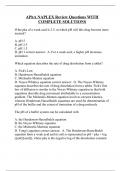
Ashford University psy101 week 1 QUIZ WEEK 1: What is Psychology? Readings & Resources Week 1 Required Reading: Chapter 1 What is Psychology Additional Resources Week 1 Lecture Power Point WEEK 1: What is Psychology? PSYC101 Introduction to Psychology Week 1 Lesson Defining Psychology Psychology is the scientific study of mental functions and behaviors, such as behavior, cognition and brain function, emotion, personality, and cultural norms. There are many different branches of psychology, such as social, cognitive, biological, and psychodynamic psychology. Psychologists fill a variety of roles, including therapists, researchers, and teachers. Psychology and the Scientific Method The scientific method is a process of developing and testing theories, which may be used in conceptualizing problems. A hypothesis, in turn, is a testable prediction that is arrived at logically from a theory. There are several types of studies that follow the scientific method— experiments, descriptive studies, case studies, surveys, and non-descriptive studies. Critical thinking is a key component of the scientific method. Without it, you cannot use logic to come to conclusions. Subfields of Psychology There are a variety of subfields within the larger discipline of psychological study, including behavioral, clinical, cognitive, developmental, educational, social, forensic, evolutionary, and industrial/organizational psychology. These various subfields differ in many ways, including in their subjects (individuals or groups), their environments (at home, at work, or in a clinical setting), and their orientations (more or less research-driven). Although all of these subfields are connected by the general goal of learning more about human beings, each attempts to look at different aspects of human life and thought processes. History of Psychology Early Roots From approximately 600 to 300 BCE, Greek philosophers such as Socrates, Plato, and Aristotle conjectured on topics such as pleasure, pain, knowledge, motivation, rationality, and mental illness—topics often discussed in psychology today. In the 1600s, French mathematician and philosopher René Descartes theorized that the body and mind are separate entities. This concept came to be known as dualism. Thomas Hobbes and John Locke were English philosophers from the 17th century who disagreed with the concept of dualism, arguing instead that sensations, images, thoughts, and feelings are physical processes that occur within the brain. The first use of the term "psychology" is often attributed to the German scholastic philosopher Rudolf Göckel in 1590; however, the term did not see common usage until German philosopher Christian Wolff popularized it in 1732–1734. Psychology was largely considered a branch of philosophy until the mid-1800s, when it developed as an independent scientific discipline in Germany and the United States. Early Frameworks: Structuralism and Functionalism The late 19th century marked the start of psychology as a scientific enterprise. Wilhelm Wundt, often considered the founder of psychology, started the first laboratory dedicated exclusively to psychological research in 1879. Wilhelm Wundt is considered by many to be the founder of psychology. He laid the groundwork for what would later become the theory of structuralism Edward B. Titchener studied under Wundt and expanded upon his ideas to found the theory of structuralism. Structuralism attempted to understand the mind as the sum of varying underlying parts, classifying mental structures much as chemists classified the elements of nature into the periodic table. Functionalism, founded by William James as an alternative to structuralism, focused more attention on the functions of the mind and the ways in which it adapts to changing situations and environments. The Psychodynamic Perspective on Human Behavior The psychodynamic perspective focuses on the dynamic relations between the conscious and unconscious mind and explores how these psychological forces might relate to early childhood experiences which, in turn, influence adult psychological health. Psychodynamic psychology originated with Sigmund Freud in the late 19th century. Freud suggested that psychological processes are flows of psychological energy (libido) within a complex brain. Freud's theory of psychoanalysis holds two major assumptions: (1) that much of mental life is unconscious, and (2) that past experiences, especially those from early childhood, shape how a person feels and behaves throughout life. Freud's structural model of personality divides the personality into three parts: the id, the ego, and the superego. When these parts are in conflict, the imbalance manifests as psychological distress
École, étude et sujet
- Établissement
-
Chamberlain College Of Nursing
- Cours
-
PSY 101
Infos sur le Document
- Publié le
- 4 mars 2022
- Nombre de pages
- 13
- Écrit en
- 2021/2022
- Type
- Examen
- Contient
- Questions et réponses
Sujets
-
ashford university psy101 week 1 quiz

Document également disponible en groupe