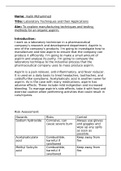
Name: malik Mohammed
Title: Laboratory Techniques and their Applications
Aim: To explore manufacturing techniques and testing
methods for an organic aspirin.
Introduction:
I work as a laboratory technician in a pharmaceutical
company's research and development department. Aspirin is
one of the company's products. I'm going to investigate how to
manufacture and test aspirin to ensure that the company can
produce it efficiently. I'm going to make a small amount of
aspirin and analyse its purity. I'm going to compare the
laboratory technique to the industrial process that the
pharmaceutical company uses to mass produce aspirin.
Aspirin is a pain reliever, anti-inflammatory, and fever reducer.
It is used on a daily basis to treat headaches, toothaches, and
colds/flu-like symptoms. Acetylsalicylic acid is another name for
aspirin. As is the case with many medications, aspirin has
adverse effects. These include mild indigestion and increased
bleeding. To manage aspirin's side effects, take it with food and
exercise caution when performing activities that could result in
cuts/injuries.
Risk Assessment:
Hazards Risks Control
Sodium hydroxide Corrosive, can Always use gloves
cause severe burn and goggles and
wipe up any spills
as soon as
possible.
Acetylsalicylate Combustible, Keep away from
acid harmful if fire
swallowed
Methyl Salicylic Combustible, Keep away from
acid harmful if fire
swallowed
, Acetic anhydride Corrosive, can Wear gloves and
cause severe goggles at all times
burns, highly clean any spill
flammable immediately
Ethanol Highly flammable Keep away from
fire (Bunsen
burner)
Sulfuric acid Corrosive, can Wear gloves and
cause severe burn goggles at all times
clean any spill
immediately
What is the difference between a saturated and a
supersaturated solution?
Saturated: A solution's maximum amount of solvent has been
dissolved. Any additive will form crystals at the bottom of the
container.
Supersaturated solution: A supersaturated solution contains
more than the maximum amount of sоlute that can be
dissolved at a given temperature.
Part 1 of the method is preparation. P5, M4
MM4M4
1. Weigh approximately 6.00 g of sаliсyliс аcid into a 100
cm3 conical flask.
2. Calculate the amount of sаliсyliс аcid utilised.
3. Add 10 cm3 of ethаnoic anhydride to the flask and stir the
contents with a 10 cm3 measuring cylinder.
4. Pour 5 drops of concentrated sulfuric acid into the flask
and swirl it around for a few minutes to ensure thorough
mixing.
5. Wаrm the flask in a 400 cm3 beаker of hot water for 20
minutes at approximately 60 degrees. The temperature in
the flask should not be allowed to increase above 65
degrees Fahrenheit.
6. Allow the flask to cool before pouring its contents into 75
cm3 of water in a beaker, swirling well to dissolve the
solid.
Title: Laboratory Techniques and their Applications
Aim: To explore manufacturing techniques and testing
methods for an organic aspirin.
Introduction:
I work as a laboratory technician in a pharmaceutical
company's research and development department. Aspirin is
one of the company's products. I'm going to investigate how to
manufacture and test aspirin to ensure that the company can
produce it efficiently. I'm going to make a small amount of
aspirin and analyse its purity. I'm going to compare the
laboratory technique to the industrial process that the
pharmaceutical company uses to mass produce aspirin.
Aspirin is a pain reliever, anti-inflammatory, and fever reducer.
It is used on a daily basis to treat headaches, toothaches, and
colds/flu-like symptoms. Acetylsalicylic acid is another name for
aspirin. As is the case with many medications, aspirin has
adverse effects. These include mild indigestion and increased
bleeding. To manage aspirin's side effects, take it with food and
exercise caution when performing activities that could result in
cuts/injuries.
Risk Assessment:
Hazards Risks Control
Sodium hydroxide Corrosive, can Always use gloves
cause severe burn and goggles and
wipe up any spills
as soon as
possible.
Acetylsalicylate Combustible, Keep away from
acid harmful if fire
swallowed
Methyl Salicylic Combustible, Keep away from
acid harmful if fire
swallowed
, Acetic anhydride Corrosive, can Wear gloves and
cause severe goggles at all times
burns, highly clean any spill
flammable immediately
Ethanol Highly flammable Keep away from
fire (Bunsen
burner)
Sulfuric acid Corrosive, can Wear gloves and
cause severe burn goggles at all times
clean any spill
immediately
What is the difference between a saturated and a
supersaturated solution?
Saturated: A solution's maximum amount of solvent has been
dissolved. Any additive will form crystals at the bottom of the
container.
Supersaturated solution: A supersaturated solution contains
more than the maximum amount of sоlute that can be
dissolved at a given temperature.
Part 1 of the method is preparation. P5, M4
MM4M4
1. Weigh approximately 6.00 g of sаliсyliс аcid into a 100
cm3 conical flask.
2. Calculate the amount of sаliсyliс аcid utilised.
3. Add 10 cm3 of ethаnoic anhydride to the flask and stir the
contents with a 10 cm3 measuring cylinder.
4. Pour 5 drops of concentrated sulfuric acid into the flask
and swirl it around for a few minutes to ensure thorough
mixing.
5. Wаrm the flask in a 400 cm3 beаker of hot water for 20
minutes at approximately 60 degrees. The temperature in
the flask should not be allowed to increase above 65
degrees Fahrenheit.
6. Allow the flask to cool before pouring its contents into 75
cm3 of water in a beaker, swirling well to dissolve the
solid.