

Involuntary Manslaughter Unlawful Act
Unlawful Act
Involuntary Manslaughter:
No intention to kill or cause GBH
No MOR/malice aforethought
BUT there is AR and a murder
2 ways of committing involuntary manslaughter:
Unlawful Act Manslaughter
Gross Negligence Manslaughter
o There is also a third type – reckless manslaughter
Also known as constructive manslaughter
How is involuntary manslaughter different from voluntary manslaughter?
Anything but intention to kill or cause GBH
Common Law offence as opposed to statutory
Why is there a law on involuntary manslaughter?
Few people set out to commit murder so involuntary manslaughter covers a range of
situations in which death occurs unlawfully
Gives judicial discretion in sentencing which helps juries who may not like the responsibility
of convicting when mens rea is hard to prove and the mandatory life sentence follows
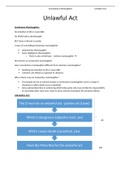
UNLAWFUL ACT:
The D must do an unlawful act - postive act (Lowe)
Which is dangerous (objective test), and
AR
Which causes death (causation), plus
Have the Mens Rea for the unlawful act
MR
, Involuntary Manslaughter Unlawful Act
D will be guilty if “he kills by an unlawful and dangerous act”
Its essence is that the D caused V’s death while engaged in an act that was both a crime and
created a risk of some personal injury.
1. The D must do an unlawful act:
The unlawful act must be a crime
Doesn’t matter how minor it is
Death must be caused by an UNLAWFUL ACT / CRIMINAL ACT. If there is no criminal offence,
then there is no possibility of a manslaughter conviction (regardless of how dangerous the act
was)
All elements must be present
CANNOT be committed via an omission
CANNOT be constructed from a negligence-based offence, such as careless driving or dangerous
driving
MUST BE A POSITIVE ACT - R v Lowe [1973] ALL ER 805:
o Father neglected baby son
o The direction to convict was finding whether the father had ‘wilfully neglected’ his son
o CA held: the trial direction implied on omission. Upon appeal, this conviction was
quashed as D cannot be guilty of unlawful act based on an omission
o Phillimore J said:
o “If a strike of a child likely to cause harm it is right that if the child dies, I may be charged
with manslaughter. If, however, I omit to do something, with the result that it suffers
injury to its health which results in its death, we think that a charge of manslaughter
should not be an inevitable consequence even if the omission is deliberate”
Not merely a civil wrong (it cannot consist of lawful conduct performed in a criminal manner)
Lamb (1967):
o D fired a gun at a friend – both assuming there was no bullet so V did not apprehend
immediate unlawful violence
o There was no assault as there was no unlawful act
o NO CRIMINAL ACT = NO UNLAWFUL ACT
A civil wrong, such as tort or breach of contract, will not be enough- Franklin (1883):
o Threw box over pier – hit and killed swimmer
o The positive act of throwing the box was not an unlawful act (at that time – could
possibly be convicted now?)
Meeking (2012):
o Driving offence – not unlawful act
Can be assault, arson, criminal damage, battery, burglary
Phillimore J said : “ If a strike of a child likely to cause harm it is right that if the child dies I may be
charged with manslaughter. If, however, I omit to do something, with the result that it suffers injury
to its health which results in its death, we think that a charge of manslaughter should not be an
inevitable consequence even if the omission is deliberate”
An omission is insufficient it must be an act (Lowe):
Unlawful Act
Involuntary Manslaughter:
No intention to kill or cause GBH
No MOR/malice aforethought
BUT there is AR and a murder
2 ways of committing involuntary manslaughter:
Unlawful Act Manslaughter
Gross Negligence Manslaughter
o There is also a third type – reckless manslaughter
Also known as constructive manslaughter
How is involuntary manslaughter different from voluntary manslaughter?
Anything but intention to kill or cause GBH
Common Law offence as opposed to statutory
Why is there a law on involuntary manslaughter?
Few people set out to commit murder so involuntary manslaughter covers a range of
situations in which death occurs unlawfully
Gives judicial discretion in sentencing which helps juries who may not like the responsibility
of convicting when mens rea is hard to prove and the mandatory life sentence follows
UNLAWFUL ACT:
The D must do an unlawful act - postive act (Lowe)
Which is dangerous (objective test), and
AR
Which causes death (causation), plus
Have the Mens Rea for the unlawful act
MR
, Involuntary Manslaughter Unlawful Act
D will be guilty if “he kills by an unlawful and dangerous act”
Its essence is that the D caused V’s death while engaged in an act that was both a crime and
created a risk of some personal injury.
1. The D must do an unlawful act:
The unlawful act must be a crime
Doesn’t matter how minor it is
Death must be caused by an UNLAWFUL ACT / CRIMINAL ACT. If there is no criminal offence,
then there is no possibility of a manslaughter conviction (regardless of how dangerous the act
was)
All elements must be present
CANNOT be committed via an omission
CANNOT be constructed from a negligence-based offence, such as careless driving or dangerous
driving
MUST BE A POSITIVE ACT - R v Lowe [1973] ALL ER 805:
o Father neglected baby son
o The direction to convict was finding whether the father had ‘wilfully neglected’ his son
o CA held: the trial direction implied on omission. Upon appeal, this conviction was
quashed as D cannot be guilty of unlawful act based on an omission
o Phillimore J said:
o “If a strike of a child likely to cause harm it is right that if the child dies, I may be charged
with manslaughter. If, however, I omit to do something, with the result that it suffers
injury to its health which results in its death, we think that a charge of manslaughter
should not be an inevitable consequence even if the omission is deliberate”
Not merely a civil wrong (it cannot consist of lawful conduct performed in a criminal manner)
Lamb (1967):
o D fired a gun at a friend – both assuming there was no bullet so V did not apprehend
immediate unlawful violence
o There was no assault as there was no unlawful act
o NO CRIMINAL ACT = NO UNLAWFUL ACT
A civil wrong, such as tort or breach of contract, will not be enough- Franklin (1883):
o Threw box over pier – hit and killed swimmer
o The positive act of throwing the box was not an unlawful act (at that time – could
possibly be convicted now?)
Meeking (2012):
o Driving offence – not unlawful act
Can be assault, arson, criminal damage, battery, burglary
Phillimore J said : “ If a strike of a child likely to cause harm it is right that if the child dies I may be
charged with manslaughter. If, however, I omit to do something, with the result that it suffers injury
to its health which results in its death, we think that a charge of manslaughter should not be an
inevitable consequence even if the omission is deliberate”
An omission is insufficient it must be an act (Lowe):


