The Origin of Psychology:
Wundt:
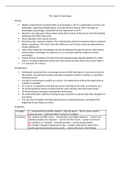
Widely considered the founding father of psychology in 1879 (a combination of science and
philosophy: experimental philosophy). He wrote the first book in 1873: Principles of
physiological psychology; completed the first experiment in 1879.
Devised a new approach: Structuralism: Study the structure of the human mind by breaking
behaviours into their basic parts.
Drew inspiration from various sources:
Rene Descartes: Cartesian dualism: The material body and the immaterial mind are separate
distinct substances. The mind is therefore different, and its state cannot be determined by
simply looking at it.
John Locke: Empiricism: Knowledge can only be obtained through the senses, and humans
inherit neither knowledge nor experience. (I.e. you need empirical evidence to know
something.)
Charles Darwin: Evolution: Survival of the best-adapted genes. Explains phobias for which
there is no logical explanation (those who were afraid survived, those who weren't didn't.)
17th and early 19th century.
Introspection:
Participants examined their own thought process whilst listening to a metronome beep for
30 seconds, and afterwards would write down whatever emotions, feelings, or sensations
they had noticed.
In order for psychology to qualify as a science, he endeavoured to keep the experiment as
scientific as possible:
(1) It was in a completely controlled lab environ (nothing on the walls, no windows, etc(
(2) All introspections where recorded with the same stimulus (30s metronome beep)
(3) All participants were given standardised instructions
He claimed that after sufficient training his top researchers could describe their thoughts for
two hours).
This was the first highly controlled experiment for studying behaviour and marked the
beginning of psychology as science.
Evaluation:
Strengths S1. Introduced the scientific method – used lab expers – this has been used by
everyone since – profound effect on psych as a subject
Limitations W1. Despite scientific claims – introspection was highly subjective – couldn't tell
whether people were lying/not – cannot trust the results – cannot trust theory
W2. Studied 12-15 people – nonrepresentative – cannot be generalised
W3. People's thoughts change day to day – couldn't replicate the study with a
week's gap and receive the same results – reduces the trust in the findings
, The Psychodynamic approach:
Devised by Fraud and contains wildly controversial and contested ideas about everything. He was
one of the first (well-known) psychologists after Wundt and was also famous for being the first
person to believe that a person's childhood would affect their later behaviour.
Key assumptions:
1. The unconscious mind: The driving force behind all behaviour, and the root of all
psychological conditions.
2. Instincts/drives: They motivate behaviour and you are born with these.
3. Early childhood experiences: The first five years are the most crucial for determining a
person's behaviour as an adult. (Deterministic, but contrasted with previous psychologists'
views)
The structure of the mind:
According to Freud, the human mind is like an iceberg. The tip: the conscious. Under the
water at the top: the preconscious. The largest part at the bottom: the unconscious.
Conscious mind Everyday thoughts that you are aware of and can consciously access.
E.g. Thoughts, perceptions and feelings.
Pre-conscious Thoughts that can surface and come into the conscious mind. They can be
accessed at any time but aren't stored at the forefront of the mind.
E.g. Memories, stored knowledge
Unconscious All thoughts that are too unpleasant/traumatic to be stored in the other stores,
and will never/very rarely be accessed, despite the fact that they motivate all
behaviour. These are repressed memories.
E.g. Violent motives, unaccepted sexual desires, irrational wishes, immoral
urges, selfish needs, and shameful experiences.
The structure of the personality:
Freud argued a tri-partite theory of the personality, with the parts known as the: Id, Ego, and
superego.
Id This is your instincts/drives, operating according to the pleasure principle. It is
present from birth and is the most selfish/ego-centric part of the personality. Freud
argued that this part of the personality controlled criminals and led them to commit
crime.
Ego This is your sense of reality, operating according to the realty principle. It develops
between the age of 18 months and 3 years. It tells you what you could realistically do,
acts as a mediator between the id and the superego, and has the power to intervene
and delay the id's pleasure drive and stop the superego from putting everyone else
first.
Superego This is your morality/consciousness, operating according to the morality principle. It
develops between 3 and 6 years and is the most selfless part of the personality. It
may feel guilt and stop a person from doing wrong/lead a person to what is right.
In a situation:
Summary of motives: If you found a wallet with cash in it:
Id To benefit the self. Would keep the wallet & cash
Ego To find a medium. May take the wallet to a lost and found or help desk. May
keep some of the money/may not.
Wundt:
Widely considered the founding father of psychology in 1879 (a combination of science and
philosophy: experimental philosophy). He wrote the first book in 1873: Principles of
physiological psychology; completed the first experiment in 1879.
Devised a new approach: Structuralism: Study the structure of the human mind by breaking
behaviours into their basic parts.
Drew inspiration from various sources:
Rene Descartes: Cartesian dualism: The material body and the immaterial mind are separate
distinct substances. The mind is therefore different, and its state cannot be determined by
simply looking at it.
John Locke: Empiricism: Knowledge can only be obtained through the senses, and humans
inherit neither knowledge nor experience. (I.e. you need empirical evidence to know
something.)
Charles Darwin: Evolution: Survival of the best-adapted genes. Explains phobias for which
there is no logical explanation (those who were afraid survived, those who weren't didn't.)
17th and early 19th century.
Introspection:
Participants examined their own thought process whilst listening to a metronome beep for
30 seconds, and afterwards would write down whatever emotions, feelings, or sensations
they had noticed.
In order for psychology to qualify as a science, he endeavoured to keep the experiment as
scientific as possible:
(1) It was in a completely controlled lab environ (nothing on the walls, no windows, etc(
(2) All introspections where recorded with the same stimulus (30s metronome beep)
(3) All participants were given standardised instructions
He claimed that after sufficient training his top researchers could describe their thoughts for
two hours).
This was the first highly controlled experiment for studying behaviour and marked the
beginning of psychology as science.
Evaluation:
Strengths S1. Introduced the scientific method – used lab expers – this has been used by
everyone since – profound effect on psych as a subject
Limitations W1. Despite scientific claims – introspection was highly subjective – couldn't tell
whether people were lying/not – cannot trust the results – cannot trust theory
W2. Studied 12-15 people – nonrepresentative – cannot be generalised
W3. People's thoughts change day to day – couldn't replicate the study with a
week's gap and receive the same results – reduces the trust in the findings
, The Psychodynamic approach:
Devised by Fraud and contains wildly controversial and contested ideas about everything. He was
one of the first (well-known) psychologists after Wundt and was also famous for being the first
person to believe that a person's childhood would affect their later behaviour.
Key assumptions:
1. The unconscious mind: The driving force behind all behaviour, and the root of all
psychological conditions.
2. Instincts/drives: They motivate behaviour and you are born with these.
3. Early childhood experiences: The first five years are the most crucial for determining a
person's behaviour as an adult. (Deterministic, but contrasted with previous psychologists'
views)
The structure of the mind:
According to Freud, the human mind is like an iceberg. The tip: the conscious. Under the
water at the top: the preconscious. The largest part at the bottom: the unconscious.
Conscious mind Everyday thoughts that you are aware of and can consciously access.
E.g. Thoughts, perceptions and feelings.
Pre-conscious Thoughts that can surface and come into the conscious mind. They can be
accessed at any time but aren't stored at the forefront of the mind.
E.g. Memories, stored knowledge
Unconscious All thoughts that are too unpleasant/traumatic to be stored in the other stores,
and will never/very rarely be accessed, despite the fact that they motivate all
behaviour. These are repressed memories.
E.g. Violent motives, unaccepted sexual desires, irrational wishes, immoral
urges, selfish needs, and shameful experiences.
The structure of the personality:
Freud argued a tri-partite theory of the personality, with the parts known as the: Id, Ego, and
superego.
Id This is your instincts/drives, operating according to the pleasure principle. It is
present from birth and is the most selfish/ego-centric part of the personality. Freud
argued that this part of the personality controlled criminals and led them to commit
crime.
Ego This is your sense of reality, operating according to the realty principle. It develops
between the age of 18 months and 3 years. It tells you what you could realistically do,
acts as a mediator between the id and the superego, and has the power to intervene
and delay the id's pleasure drive and stop the superego from putting everyone else
first.
Superego This is your morality/consciousness, operating according to the morality principle. It
develops between 3 and 6 years and is the most selfless part of the personality. It
may feel guilt and stop a person from doing wrong/lead a person to what is right.
In a situation:
Summary of motives: If you found a wallet with cash in it:
Id To benefit the self. Would keep the wallet & cash
Ego To find a medium. May take the wallet to a lost and found or help desk. May
keep some of the money/may not.