Joana Inês da Costa Santos
Student number: 2732721
Conflict and Crimes
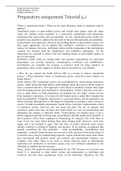
Preparatory assignment Tutorial 5.1
▪What is transitional justice? What are the main dilemmas states in transition need to
address?
Transitional justice in post-conflict justice and usually takes palace when the states
where the conflict occurs transition to a democratic organization with democratic
institutions that seek justice and accountability. In sum, transitional justice studies the
possible ways possible to address the atrocities of the past through truth, accountability,
reconciliation, and reparation, which are the building blocks of post-conflict justice. For
that, many approaches can be applied like retributive, restorative or rehabilitative
justice, for instance. However, individual culture and the weakening of the international
criminal law threaten both the rehabilitative and retributive approaches. All the
dimensions are essential to achieve the four building blocks of post-conflict justice of
the TAAR system.
Retributive justice looks for factual truth, and criminal responsibility for individual
perpetrators can provide monetary compensation, restitution and rehabilitation.
Nevertheless are incapable for creating a collective truth for large numbers of
perpetrators, their victim's support is limited, and reconciliation is very unlikely,
▪ How do you evaluate the South African TRC as a means to achieve transitional
justice? ▪ What alternative forms of transitional justice could have been effective in
South Africa?
South African TRC transitional justice was accomplished by truth-seeking restorative
justice, which means that both parties could dialogue about the events with the intent to
write a common narrative. This approach is more likely to establish a shared truth, helps
with the healing process and contributes to reconciliation. I believe that this is not just a
way to make justice or hold perpetrators accountable but also helps victims recover
from traumatic experiences. It is easier for the blamed party to admit their mistakes but
lacks accountability. Ultimately forgiveness is a personal choice, but the institution can
always promote although there is the danger of forgetting or creating a softer version of
events. To hold accountable perpetrators, South Africa could have implemented a form
of retributive justice. However, this was never the plan. The use of amnesty and
restorative justice may have its flaws but works better as a tool to reconciliation and
diminishes the number of different truths. Truth-seeking, the method used, is not a
perfect approach and did not bring total reconciliation, but that might not be possible. It
had a positive effect when compared to Nuremberg, for instance. The work done in
Cape Town was more about healing than about finding guilt. However, some may
argue, and I am inclined to agree, that this form of justice absolved some crimes
unfairly, leading to a feeling of impunity and injustice. In my opinion, an approach that
equally considered the four principles - truth, accountability, reconciliation and
reparation - would fit better because one can not be fully achieved without the others. It
is hard for one to forgive without being repaired. I agree with the first article that claims
that non-judicial and judicial means and national and international instances can
complete each other; there is no need to choose between local or international
institutions nor retributive or restorative justice, they have different contributes to the
aftermath of conflicts but all necessary.
Some victims felt neglected and disappointed by the TRC because not everyone was
heard. It is important to think about victims and perpetuators as individual and
collective and how these mechanisms focus on the individual. Therefore, the "the
Student number: 2732721
Conflict and Crimes
Preparatory assignment Tutorial 5.1
▪What is transitional justice? What are the main dilemmas states in transition need to
address?
Transitional justice in post-conflict justice and usually takes palace when the states
where the conflict occurs transition to a democratic organization with democratic
institutions that seek justice and accountability. In sum, transitional justice studies the
possible ways possible to address the atrocities of the past through truth, accountability,
reconciliation, and reparation, which are the building blocks of post-conflict justice. For
that, many approaches can be applied like retributive, restorative or rehabilitative
justice, for instance. However, individual culture and the weakening of the international
criminal law threaten both the rehabilitative and retributive approaches. All the
dimensions are essential to achieve the four building blocks of post-conflict justice of
the TAAR system.
Retributive justice looks for factual truth, and criminal responsibility for individual
perpetrators can provide monetary compensation, restitution and rehabilitation.
Nevertheless are incapable for creating a collective truth for large numbers of
perpetrators, their victim's support is limited, and reconciliation is very unlikely,
▪ How do you evaluate the South African TRC as a means to achieve transitional
justice? ▪ What alternative forms of transitional justice could have been effective in
South Africa?
South African TRC transitional justice was accomplished by truth-seeking restorative
justice, which means that both parties could dialogue about the events with the intent to
write a common narrative. This approach is more likely to establish a shared truth, helps
with the healing process and contributes to reconciliation. I believe that this is not just a
way to make justice or hold perpetrators accountable but also helps victims recover
from traumatic experiences. It is easier for the blamed party to admit their mistakes but
lacks accountability. Ultimately forgiveness is a personal choice, but the institution can
always promote although there is the danger of forgetting or creating a softer version of
events. To hold accountable perpetrators, South Africa could have implemented a form
of retributive justice. However, this was never the plan. The use of amnesty and
restorative justice may have its flaws but works better as a tool to reconciliation and
diminishes the number of different truths. Truth-seeking, the method used, is not a
perfect approach and did not bring total reconciliation, but that might not be possible. It
had a positive effect when compared to Nuremberg, for instance. The work done in
Cape Town was more about healing than about finding guilt. However, some may
argue, and I am inclined to agree, that this form of justice absolved some crimes
unfairly, leading to a feeling of impunity and injustice. In my opinion, an approach that
equally considered the four principles - truth, accountability, reconciliation and
reparation - would fit better because one can not be fully achieved without the others. It
is hard for one to forgive without being repaired. I agree with the first article that claims
that non-judicial and judicial means and national and international instances can
complete each other; there is no need to choose between local or international
institutions nor retributive or restorative justice, they have different contributes to the
aftermath of conflicts but all necessary.
Some victims felt neglected and disappointed by the TRC because not everyone was
heard. It is important to think about victims and perpetuators as individual and
collective and how these mechanisms focus on the individual. Therefore, the "the