Andreas Savva 6A
Discuss the factors that determine a firm’s average cost of production in both the short run and
long run
The short run implies that producers have the problem that at least one of the factors of production is
fixed in supply. Whereas, the long run means that all factors of production are variable. It is
controversial what the average costs are in the short run and the long run.
On the one hand, there are short run average costs. Initially, in the short run, at least one factor of
production is fixed. So, if a firm uses one of the factors of production such as labour more and more, in
the beginning output will rise. But there will be a point where output will start to fall. There is a best
level of production which is most efficient. This phenomenon is called the Law of Diminishing Returns.
The Law of Diminishing Returns states that if increasing quantities of a variable input are combined with
a fixed input, eventually the
eventually the marginal
product and then the average
product of the variable input
will decline. Adding onto that,
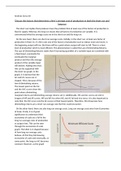
this can be supported with
the short run graph. In the
graph, it is obvious that the
AC and Mc curves are U-
shaped. This is because of the
law of diminishing returns.
The lowest point on the Mc
and the AVC curves show the
point where diminishing
marginal returns and diminishing average returns set in. Additionally, MC and AC curves are mirror
images of MP and AP curves. MP and AP rise when MC and AC fall and vice versa. It is also important to
note that, the MC curve cuts the AC curves at their lowest points. Therefore, this showcases how
diminishing returns are a short run average cost the firm could encounter.
On the other hand, there are also long run average costs. Long run average costs arise from Economies
of Scale. Firstly, it is of great
significance to understand that
economies of scale are a fall in the
long-run average costs of production
as output rises. This can be seen
through the economies of scale
graph. The LRAC is U-shaped because
of how long run average costs
behave. At first they fall showing
economies of scale and eventually, at
some point, the long run AC becomes
constant. However, as the graph
Discuss the factors that determine a firm’s average cost of production in both the short run and
long run
The short run implies that producers have the problem that at least one of the factors of production is
fixed in supply. Whereas, the long run means that all factors of production are variable. It is
controversial what the average costs are in the short run and the long run.
On the one hand, there are short run average costs. Initially, in the short run, at least one factor of
production is fixed. So, if a firm uses one of the factors of production such as labour more and more, in
the beginning output will rise. But there will be a point where output will start to fall. There is a best
level of production which is most efficient. This phenomenon is called the Law of Diminishing Returns.
The Law of Diminishing Returns states that if increasing quantities of a variable input are combined with
a fixed input, eventually the
eventually the marginal
product and then the average
product of the variable input
will decline. Adding onto that,
this can be supported with
the short run graph. In the
graph, it is obvious that the
AC and Mc curves are U-
shaped. This is because of the
law of diminishing returns.
The lowest point on the Mc
and the AVC curves show the
point where diminishing
marginal returns and diminishing average returns set in. Additionally, MC and AC curves are mirror
images of MP and AP curves. MP and AP rise when MC and AC fall and vice versa. It is also important to
note that, the MC curve cuts the AC curves at their lowest points. Therefore, this showcases how
diminishing returns are a short run average cost the firm could encounter.
On the other hand, there are also long run average costs. Long run average costs arise from Economies
of Scale. Firstly, it is of great
significance to understand that
economies of scale are a fall in the
long-run average costs of production
as output rises. This can be seen
through the economies of scale
graph. The LRAC is U-shaped because
of how long run average costs
behave. At first they fall showing
economies of scale and eventually, at
some point, the long run AC becomes
constant. However, as the graph