Lecture notes: Qualitative Methods
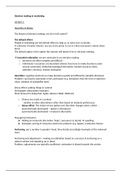
Lecture 1: Introduction – Frameworks and Assumptions
Assumptions:
Ontology
o = nature of reality = questions of existence
o What is it to be in reality?
o Nature of society society = material or cognitive
o Marx: studied society in terms of capital and resources (materialist ontology)
o Foucault: studied society as set of discourse, words, power structures
(cognitive/institutional ontology)
o single or multiple realities? => dominant view is that there are multiple
realities
Epistemology
o = knowing abt what counts as knowledge
o What knowledge is better
o Dominant view: knowledge is based on subjective experiences of ppl
Axiology
o = study of values = role of values in research
o Values: justice, sustainability, hierarchy and power
o Creswell: dominant view research is value-laden, researchers also have values
throughout their lives w/ experiences and in their discipline
o Post-positivists: researchers should be objective, explicate their values, make it
explicit, use rigorous scientific methods
Methodology
o = study of research procedures and methods
o Views qualitative research
Inductive to reductive
Inductive: Starts from observation patterns hypothesis
theory
Deductive: Theory hypothesis test hypo in the field to
confirm or disconfirm
Topic in context
Bc most knowledge based on subjective experiences so have to
get close to them and go into context
Emergent in research design
Important bc study topic in context particular plan in context
does not work have to change plan
1
,Interpretive Frameworks:
= frames that contextualize the research approach
Creswell and Poth stated 5 frameworks:
o Postpositivism
Ontology
Single reality exists beyond ourselves
Researchers may not be able to understand that perfectly
Epistemology
Reality is approximated
People have not complete knowledge of reality
Reveal reality that exists outside ourselves through research and
statistic
Get best knowledge if limit interaction w/ research subjects
nonbiased
Validity comes from peers not participants (ie: scientists not
common people)
Axiology
Researchers need to control their biases
No need to explicate them (if biases are controlled)
Methodology
Rigorous scientific methods important
Deductive start from theory
o Social constructivism
Ontology
Multiple realities constructed through lived experiences and
interactions with others
People live in different realities and researchers try to understand
their subjective experiences
Epistemology
Important is to understand how ppl construct reality rather than
facts
Knowledge abt reality co-constructed between researcher and
subjects
Axiology
Different value sets individual values should be honored and
negotiated among individuals
Methodology
Aimed at reconstructing subjecting meanings of subjects
2
, Researchers understanding is different than participants’
Develop new knowledge from participants’ experiences
Inductive and emergent
o Post modernism
Ontology
Multiple realities
Reality defined by experiences AND concepts no reality
beyond that meaning there are no brute facts
o (ex:) a screen is a concept, but quarks & molecules also
represent a screen many realities your
understanding of that reality is always embedded within a
concept
Epistemology
Knowledge is defined by concepts, by one’s position and by
power structures
o Power structure examples
In past neoliberal view markets important
In NL police were not allowed to register ethnicity
so now have no info on that
Truth is relative to a certain frame of reference
Multiple ways of knowing
Axiology
Respect for multiple value systems (indigenous values)
Values need to be problematized and interrogated bc no
absolute truth
Methodology
Questioning of methods
Any method would lead to specific understanding bc any method
has specific concepts no absolute truth and science cannot
determine that either
Stress transparency in methodological work by highlighting issues
and concerns others can understand concepts used and
knowledge
o Joined transformative & postmodern
Transformative = aim to transform society (emancipatory)
Ontology
Multiple realities
Reality defined through interaction researcher/ communities
3
Lecture 1: Introduction – Frameworks and Assumptions
Assumptions:
Ontology
o = nature of reality = questions of existence
o What is it to be in reality?
o Nature of society society = material or cognitive
o Marx: studied society in terms of capital and resources (materialist ontology)
o Foucault: studied society as set of discourse, words, power structures
(cognitive/institutional ontology)
o single or multiple realities? => dominant view is that there are multiple
realities
Epistemology
o = knowing abt what counts as knowledge
o What knowledge is better
o Dominant view: knowledge is based on subjective experiences of ppl
Axiology
o = study of values = role of values in research
o Values: justice, sustainability, hierarchy and power
o Creswell: dominant view research is value-laden, researchers also have values
throughout their lives w/ experiences and in their discipline
o Post-positivists: researchers should be objective, explicate their values, make it
explicit, use rigorous scientific methods
Methodology
o = study of research procedures and methods
o Views qualitative research
Inductive to reductive
Inductive: Starts from observation patterns hypothesis
theory
Deductive: Theory hypothesis test hypo in the field to
confirm or disconfirm
Topic in context
Bc most knowledge based on subjective experiences so have to
get close to them and go into context
Emergent in research design
Important bc study topic in context particular plan in context
does not work have to change plan
1
,Interpretive Frameworks:
= frames that contextualize the research approach
Creswell and Poth stated 5 frameworks:
o Postpositivism
Ontology
Single reality exists beyond ourselves
Researchers may not be able to understand that perfectly
Epistemology
Reality is approximated
People have not complete knowledge of reality
Reveal reality that exists outside ourselves through research and
statistic
Get best knowledge if limit interaction w/ research subjects
nonbiased
Validity comes from peers not participants (ie: scientists not
common people)
Axiology
Researchers need to control their biases
No need to explicate them (if biases are controlled)
Methodology
Rigorous scientific methods important
Deductive start from theory
o Social constructivism
Ontology
Multiple realities constructed through lived experiences and
interactions with others
People live in different realities and researchers try to understand
their subjective experiences
Epistemology
Important is to understand how ppl construct reality rather than
facts
Knowledge abt reality co-constructed between researcher and
subjects
Axiology
Different value sets individual values should be honored and
negotiated among individuals
Methodology
Aimed at reconstructing subjecting meanings of subjects
2
, Researchers understanding is different than participants’
Develop new knowledge from participants’ experiences
Inductive and emergent
o Post modernism
Ontology
Multiple realities
Reality defined by experiences AND concepts no reality
beyond that meaning there are no brute facts
o (ex:) a screen is a concept, but quarks & molecules also
represent a screen many realities your
understanding of that reality is always embedded within a
concept
Epistemology
Knowledge is defined by concepts, by one’s position and by
power structures
o Power structure examples
In past neoliberal view markets important
In NL police were not allowed to register ethnicity
so now have no info on that
Truth is relative to a certain frame of reference
Multiple ways of knowing
Axiology
Respect for multiple value systems (indigenous values)
Values need to be problematized and interrogated bc no
absolute truth
Methodology
Questioning of methods
Any method would lead to specific understanding bc any method
has specific concepts no absolute truth and science cannot
determine that either
Stress transparency in methodological work by highlighting issues
and concerns others can understand concepts used and
knowledge
o Joined transformative & postmodern
Transformative = aim to transform society (emancipatory)
Ontology
Multiple realities
Reality defined through interaction researcher/ communities
3