Name: Date:
Student Exploration: Big Bang Theory – Hubble’s Law
Vocabulary: absolute brightness, absorption spectrum, apparent brightness, Big Bang theory,
blueshift, Cepheid variable, Doppler shift, Hubble constant, Hubble’s law, luminosity,
megaparsec, period, redshift, spectrograph
Prior Knowledge Questions (Do these BEFORE using the Gizmo.)
Standing by the side of a lonely highway at night, you see two motorcycle headlights, one in
each direction. The headlight on your left appears brighter than the one on your right.
1. If the headlights are equally bright, which motorcycle is closer? The one on the left side
Explain: If it is brighter than that means its going to be closer because the light particles are traveling
less and there is more.
2. Suppose the dim-looking headlight on the right is actually a small light on the front of a
bicycle. What can you conclude about the distance of the motorcycle and bicycle?
If I know the light source is smaller, then the bicycle is closer than it is shown.
Gizmo Warm-up
In 1912, an astronomer named Henrietta Swan Leavitt
studied a class of stars called Cepheid variables. These
stars change from bright to dim to bright again. Her
discoveries led to a method of measuring distances to
other galaxies and eventually helped to support the Big
Bang theory of the origin of the universe.
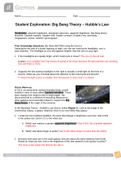
In the Big Bang Theory – Hubble’s Law Gizmo, select Region A. Look at the image of the
Andromeda Galaxy, a galaxy relatively close to our own Milky Way galaxy.
1. Locate the two Cepheid variables, the stars that change in brightness over time. Star A-091
is the yellow star, and A-171 is the white star.
A. Which star reaches a greater apparent brightness? Star A-091 has a greater apparent
brightness
B. Which star takes longer to pulse? Star A-091 takes longer to pulse than the others.
2. Because both stars are in the same galaxy, they are about the same distance from Earth.
Based on what you see, how is the brightness of the star related to how quickly it pulses?
The more a star pulses the dimmer the star is .
2018
, Get the Gizmo ready:
Activity A:
On the STARS tab, check that Region A: NGC
Period and
224 (Andromeda Galaxy) is selected. If not, click
brightness Return to map and select Region A.
Introduction: Two factors determine how bright a star appears to an observer: its luminosity,
or absolute brightness, and its distance from the observer. A star may appear bright because
it is a large, luminous star, or because it is very close. It is only possible to use a star’s apparent
brightness to determine its distance if you know the star’s luminosity. Henrietta Leavitt’s work on
Cepheids provided the key to solving this problem.
Question: How do Cepheids allow astronomers to measure intergalactic distances?
1. Collect data: Locate and select the yellow Cepheid variable star (A-091) in the lower left
section of the Andromeda Galaxy. Click the Collect data button. You will see a graph of the
apparent brightness of the star over time.
A. How does the star’s apparent brightness change over time? It decreases, then increases, and
decreases again. Its like a pattern.
B. Turn on Show time probes. Set the left probe at the first brightness peak, and the
right probe at the second brightness peak. List the time represented by each
probe:
Left probe time: 1.0 d Right probe time: 13.3 d
C. What is the time difference between the two brightness peaks? 12.3 days
This is the period of the Cepheid.
D. In the DATA tab, record the name of this star and its period. Do the same on your
paper Data worksheet, located on the last page of this document.
2. Collect data: The apparent brightness of the star is shown on the y-axis of the graph. The
brightness is given as the ratio of the star’s brightness to the Sun’s brightness if viewed from
a standard distance of one megaparsec (1 Mpc), which is about 3.26 million light years. For
example, a brightness of “4,000” means that the star appears 4,000 times as bright as the
Sun would appear if observed from a distance of 1 Mpc.
A. What is your estimate of the mean apparent brightness of star A-091? 7004
B. Turn on Show mean brightness. What is the mean brightness of A-091? 7004
Record this value in the Gizmo and on your Data worksheet.
(Activity A continued on next page)
Student Exploration: Big Bang Theory – Hubble’s Law
Vocabulary: absolute brightness, absorption spectrum, apparent brightness, Big Bang theory,
blueshift, Cepheid variable, Doppler shift, Hubble constant, Hubble’s law, luminosity,
megaparsec, period, redshift, spectrograph
Prior Knowledge Questions (Do these BEFORE using the Gizmo.)
Standing by the side of a lonely highway at night, you see two motorcycle headlights, one in
each direction. The headlight on your left appears brighter than the one on your right.
1. If the headlights are equally bright, which motorcycle is closer? The one on the left side
Explain: If it is brighter than that means its going to be closer because the light particles are traveling
less and there is more.
2. Suppose the dim-looking headlight on the right is actually a small light on the front of a
bicycle. What can you conclude about the distance of the motorcycle and bicycle?
If I know the light source is smaller, then the bicycle is closer than it is shown.
Gizmo Warm-up
In 1912, an astronomer named Henrietta Swan Leavitt
studied a class of stars called Cepheid variables. These
stars change from bright to dim to bright again. Her
discoveries led to a method of measuring distances to
other galaxies and eventually helped to support the Big
Bang theory of the origin of the universe.
In the Big Bang Theory – Hubble’s Law Gizmo, select Region A. Look at the image of the
Andromeda Galaxy, a galaxy relatively close to our own Milky Way galaxy.
1. Locate the two Cepheid variables, the stars that change in brightness over time. Star A-091
is the yellow star, and A-171 is the white star.
A. Which star reaches a greater apparent brightness? Star A-091 has a greater apparent
brightness
B. Which star takes longer to pulse? Star A-091 takes longer to pulse than the others.
2. Because both stars are in the same galaxy, they are about the same distance from Earth.
Based on what you see, how is the brightness of the star related to how quickly it pulses?
The more a star pulses the dimmer the star is .
2018
, Get the Gizmo ready:
Activity A:
On the STARS tab, check that Region A: NGC
Period and
224 (Andromeda Galaxy) is selected. If not, click
brightness Return to map and select Region A.
Introduction: Two factors determine how bright a star appears to an observer: its luminosity,
or absolute brightness, and its distance from the observer. A star may appear bright because
it is a large, luminous star, or because it is very close. It is only possible to use a star’s apparent
brightness to determine its distance if you know the star’s luminosity. Henrietta Leavitt’s work on
Cepheids provided the key to solving this problem.
Question: How do Cepheids allow astronomers to measure intergalactic distances?
1. Collect data: Locate and select the yellow Cepheid variable star (A-091) in the lower left
section of the Andromeda Galaxy. Click the Collect data button. You will see a graph of the
apparent brightness of the star over time.
A. How does the star’s apparent brightness change over time? It decreases, then increases, and
decreases again. Its like a pattern.
B. Turn on Show time probes. Set the left probe at the first brightness peak, and the
right probe at the second brightness peak. List the time represented by each
probe:
Left probe time: 1.0 d Right probe time: 13.3 d
C. What is the time difference between the two brightness peaks? 12.3 days
This is the period of the Cepheid.
D. In the DATA tab, record the name of this star and its period. Do the same on your
paper Data worksheet, located on the last page of this document.
2. Collect data: The apparent brightness of the star is shown on the y-axis of the graph. The
brightness is given as the ratio of the star’s brightness to the Sun’s brightness if viewed from
a standard distance of one megaparsec (1 Mpc), which is about 3.26 million light years. For
example, a brightness of “4,000” means that the star appears 4,000 times as bright as the
Sun would appear if observed from a distance of 1 Mpc.
A. What is your estimate of the mean apparent brightness of star A-091? 7004
B. Turn on Show mean brightness. What is the mean brightness of A-091? 7004
Record this value in the Gizmo and on your Data worksheet.
(Activity A continued on next page)