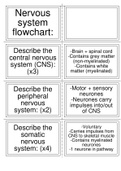
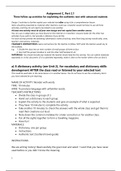
Nervous
system
flowchart:
Describe the -Brain + spinal cord
central nervous -Contains grey matter
(non-myelinated)
system (CNS): -Contains white
(x3) matter (myelinated)
Describe the -Motor + sensory
peripheral neurones
-Neurones carry
nervous impulses into/out
system: (x2) of CNS
Describe the -Voluntary
-Carries impulses from
somatic CNS to skeletal muscle
nervous -Contains myelinated
neurones
system: (x4) -1 neurone in pathway
, -Self-governing (involuntary)
Describe the -Carries impulses from CNS to
cardiac/smooth muscle/glands
autonomic -Contains non-myelinated
neurones
nervous -At least 2 neurones
(connected at ganglion) in
system: (x4) pathway to effectors
1) Stimulus
2) Sensory neurone in cornea
Go through the detect stimulus + transmit AP
along relay neurone in brain
blinking/corneal 3) Relay neurone transmits AP
to motor neurone = causes
reflex: (x3) orbicularis oculi muscles to
contract = eyelid blinks
-Protective reflex
Describe the -Cranial reflex =
blinking/corneal passes through
reflex: (x2) brain but not
conscious parts
Compare -Active in stress + exercise / sleep + relaxation
-Noradrenaline / acetylcholine
sympathetic + -Many nerves out of CNS to separate effector /
few nerves out of CNS dividing to different
parasympathetic effector
-Ganglia just outside CNS / ganglia inside
effector
nervous systems: -Short pre-ganglionic neurones / long
-Increases heart rate, dilates pupils, increases
(x6) ventilation rate / (antagonistic)
system
flowchart:
Describe the -Brain + spinal cord
central nervous -Contains grey matter
(non-myelinated)
system (CNS): -Contains white
(x3) matter (myelinated)
Describe the -Motor + sensory
peripheral neurones
-Neurones carry
nervous impulses into/out
system: (x2) of CNS
Describe the -Voluntary
-Carries impulses from
somatic CNS to skeletal muscle
nervous -Contains myelinated
neurones
system: (x4) -1 neurone in pathway
, -Self-governing (involuntary)
Describe the -Carries impulses from CNS to
cardiac/smooth muscle/glands
autonomic -Contains non-myelinated
neurones
nervous -At least 2 neurones
(connected at ganglion) in
system: (x4) pathway to effectors
1) Stimulus
2) Sensory neurone in cornea
Go through the detect stimulus + transmit AP
along relay neurone in brain
blinking/corneal 3) Relay neurone transmits AP
to motor neurone = causes
reflex: (x3) orbicularis oculi muscles to
contract = eyelid blinks
-Protective reflex
Describe the -Cranial reflex =
blinking/corneal passes through
reflex: (x2) brain but not
conscious parts
Compare -Active in stress + exercise / sleep + relaxation
-Noradrenaline / acetylcholine
sympathetic + -Many nerves out of CNS to separate effector /
few nerves out of CNS dividing to different
parasympathetic effector
-Ganglia just outside CNS / ganglia inside
effector
nervous systems: -Short pre-ganglionic neurones / long
-Increases heart rate, dilates pupils, increases
(x6) ventilation rate / (antagonistic)