100% tevredenheidsgarantie Direct beschikbaar na je betaling Lees online óf als PDF Geen vaste maandelijkse kosten 4.2 TrustPilot
logo-home
Tentamen (uitwerkingen)

BCHE 5180/6180 Exam Final

Beoordeling
-
Verkocht
-
Pagina's
10
Cijfer
A+
Geüpload op
10-02-2022
Geschreven in
2022/2023

BCHE 5180/6180 Exam Final BCHE 5180/6180 Exam Final. 100% Give the general Henderson-Hasselbalch equation and sketch the plot it describes (pH against amount of NaOH added to a weak acid). On your curve label the pKa for the weak acid, and indicate the region in which the buffering capacity of the system is greatest. [ A ] pH  pKa  log [HA] The inflection point, which occurs when the weak acid has been exactly one half titrated with NaOH, occurs at a pH equal to the pKa of the weak acid. The region of greatest buffering capacity (where the titration curve is flattest) occurs at pH values of pKa ±1. Name and briefly define four types of noncovalent interactions that occur between biological molecules. (1) Hydrogen bonds: weak electrostatic attractions between one electronegative atom (such as oxygen or nitrogen) and a hydrogen atom covalently linked to a second electronegative atom; (2) electrostatic interactions: relatively weak charge-charge interactions (attractions of opposite charges, repulsions of like charges) between two ionized groups; (3) hydrophobic interactions: the forces that tend to bring two hydrophobic groups together, reducing the total area of the two groups that is exposed to surrounding molecules of the polar solvent (water); (4) van der Waals interactions: weak interactions between the electric dipoles that two close-spaced atoms induce in each other. Draw the structure of alanine, leucine, isoleucine, tyrosine, lysine and histidine (At pH 7.0). Give also the three-letter and the one-letter codes. Indicate the pKa of the side groups. (Draw 1 amino acid completely, draw only the R group for the other amino acids) H +H3N C COO- CH3 Alanine (Ala, A) CH2 OH Tyrosine (Tyr, Y) pKa = 10.07 CH2 CH CH3 CH3 Leucine (Leu, L) CH2 CH2 CH2 CH2 NH3+ Lysine (Lys, K) pKa = 10.53 CH CH3 CH2 CH3 Isoleucine (Ile, I) H C N CH2 C N CH H Histidine (His, H) pKa = 6.00 Explain the differences between common and uncommon amino acids The 22 common or coded amino acids are used to make proteins. The proteins are synthesized on the ribosome where the sequence of amino acids are dictated by the sequence of codons on an mRNA molecule. The codons are recognized by the anti- codon on a tRNA molecules that have the amino acid attached. Each coded amino acid has its own set of tRNA molecules. Uncommon amino acids include the modified common amino acids as a result of post- translational modifications, and the group of amino acids that are 1) part of small polypeptides, 2) are metabolic or 3) are synthetic intermediates. 5 Given below is the structure of the polypeptide Glu-Gly-Leu-Ser-Leu-Ser-Lys. Glu Gly Leu Ser Leu Ser Lys pKa ~2.0 pKa ~9.6 H O H O H O H O H O H O H O- H3N+ C C N C C N C C N C C N C C N C C N C C H H CH2 CH2 C O O- H H3C H CH2 CH CH3 CH2 OH H H3C H CH2 CH CH3 CH2 OH H O CH2 CH2 CH2 CH2 pKa = 4.25 NH + pKa = 10.53 5a 6 points 5b 2 points What is the charge of the peptide at pH 3.0, pH 8.0, and pH 12? pH +H3N/H2N COOH/COO- +H3N/H2N COOH/COO- charge 3 + 0 + - +1 8 + - + - 0 12 0 - 0 - -2 What is the pI of the peptide? pI is in between pH 4.25 and 9.6: 4.25 9.6  6.93 2 6 A student has purified a protein. The table below describes the followed procedure: Step Volume Total Total Spec. activity protein Act. (ml) (U) (mg) Cell Extract 500 3,000 15,000 0.2 DEAE-Sepharose column (weak ion-exchange) 100 2,400 4,000 0.6 Mono-Q column (strong ion-exchange) 45 1,440 500 2.88 Phenyl-Sepharose column (hydrophic interaction) 50 1,000 125 8.0 The student also prepared an SDS-PAGE gel: Lane 1: Cell extract Lane 2: Sample after DEAE-Sepharose column Lane 3: After Mono-Q column Lane 4: After Phenyl-Sepharose column Lane M: Marker proteins 6a 6 points Explain the SDS-PAGE technique In this technique all proteins present in the mixture will be unfolded and separated into their respective subunits in a pre-treatment with SDS and mercaptoethanol. The now highly negatively charges peptide chain can be separated on size on the gel existing of a cross-linked network of acrylamide polymers. For the separation a voltage is applied over the gel. After every purification step a sample can be collected that is separated on the gel. When the protein is highly pure only one band should be detected on the gel, or a set of bands in case it is a multimeric protein 6b 6 points Can you use this information to tell whether the purification was successful? Note that there are different answers possible. What would be the next logical step to discern between these possibilities? To get an idea about the progress of the purification procedure the specific activity has to be calculated (total activity / total protein). These values show that the purity of the protein is increasing in every step. From this data, however, it is not clear if the enzyme is completely pure or whether more purification steps are needed. The gel would indicate that we either have a protein with three different subunits or that we have maximal three different proteins present. The most logic step would be to do another column based on the differences in the sizes of the three potential proteins: a size-exclusion column Describe the principle of ion-exchange chromatography Proteins can be separated on charge using ion-exchange chromatography. The column can either be a cation exchanger or an anion exchanger. In the first case negatively charged proteins will bind. In the second case positively charged proteins will bind. By using an anion exchanger all the negatively charged proteins will bind to the column and will be separated from the positively charged proteins that will not bind but run through the column. In the next step bound proteins will be eluted by using an increasing salt concentration. The salt will compete with the bound protein for the binding sites on the column. Proteins with a small negative overall charge will be eluted first. Highly charged proteins will be eluted last. The protein bands will be collected as separate fractions. Explain in detail the different steps of sequencing a peptide/protein and their purpose. 1) Amino acid analysis: Which amino acids are present and in what ratio. 2) Reaction with FDNB: Label N-terminus. Establish if more than one subunit is present with different N-terminal residues 3) Break disulfide bonds 4) Reaction with first fragmenting agent and sequencing of the fragments 5) Reaction with different fragmenting agent and sequencing of the fragment 6) Try two fit all pieces together 7) Repeat (5) with another fragmenting reagent if necessary What can we learn from sequence alignments 1) Within a gene family it shows which amino acids are conserved. These residues play and important role in the function and stability of the protein 2) Even if there is not a complete match it could show similarities to proteins with known functions, for example it could indicate the presence of a specific domain with a specific function, like an ATP-binding domain 3) Specific sequences might indicate the presence of a certain binding site for a coenzyme or the presence of a prosthetic group 10 6 points A biochemist purified a polypeptide containing 8 amino acids. Amino acid analysis showed the following composition: Ala, Glu, Leu, (Lys)2, Met, Tyr, Val The native peptide was incubated with 1-fluoro-2,4-dinitrobenzene (FDNB) and then hydrolyzed; 2,4-dinitrophenylglutamate was identified by HPLC. Incubation of the native peptide with trypsin gave a tripeptide, a tetrapeptide and a single Ala. Incubation with FDNB found a Glu residue for the tripeptide, a Met residue for the tetra peptide. When the native peptide was exposed to cyanogen bromide (CNBr), two tetrapeptides were obtained. Incubation with FDNB found both 2,4-dinitrophenylglutamate and 2,4- dinitrophenyltyrosine. The amino acid composition of one of the pentapeptides was Ala, Lys, Tyr, Val. What is the sequence of the polypeptide? Glu-x-x-x-x-x-x-x Trypsin cuts at Lys-C: Glu-x-Lys, Met-x-x-Lys, Ala CNBr cuts at Met-C Glu-x-x-Met Tyr-x-x-x Glu-x-Lys-Met Tyr-x-Lys-Ala Tyr-Val-Lys-Ala Glu-Leu-Lys-Met-Tyr-Val-Lys-Ala 11 The picture on the right shows the ribbon model of a protein. a 4 points Explain what the ribbon represents. The ribbon represents the position of the six-atom that lye in the same plane as the peptide bond: The intermediate resonance structure imparts a partial double bond characteristic to the C—N bond, thereby prohibiting rotation. As a result all 6 atom in the drawing are in the same plane. The peptide chain can therefore be thought of as a chain of small rectangles that are connected at via the Ca atoms at the opposite corners of the rectangle. In the ribbon model the flow of this chain of rectangles can be indicated by a ribbon, the surface of which is parallel to that of the surface of the rectangles b 2 points What do you see? What is the main type of secondary structure present in this figure? The long stretches of ribbon indicate that the main type of secondary structure is of the -sheet type. (The sheets are organized as a -barrel). The remaining structure has a ”random” structure. No α-helices are present c 2 points Explain what properties give this type of secondary structure its stability. The long stretches of amino acid chains are interconnected by multiple hydrogen bonds between C=O group of one chain to N-H groups in neighboring chains. d 2 points Can you tell if this is a globular, fibrous or membrane protein? Explain your answer. The protein structure is definitely not globular. It also does not look like a coiled coil found in fibrous proteins. A -barrel is a common structure for a protein to be embedded into a membrane. Therefore the enzyme is most likely a membrane protein, Why are glycine and proline often found within a β turn? A β turn results in a tight 180° reversal in the direction of the polypeptide chain. Glycine is the smallest and thus most flexible amino acid, and proline can readily assume the cis configuration, which facilitates a tight turn 13 10 points Explain the differences between subunit, domain and fold. Explain the difference between protein families and protein super families. A subunit of a protein is a separate amino acid chain. Proteins can be built up of several identical of different subunits. A domain is a part of a subunit that if separated (for example by the action of a protease) from the rest of the subunit, still forms a structurally stable unit. A fold is the combination of certain secondary structural features like  helices and  sheets that can be found in several proteins, forming a protein family. Typical examples are / barrels, / sandwiches,  propellers. Protein families have a high level of sequence and structure similarity and show identical activities. Protein super families are a group of proteins that have very similar 3D structures but very little or no sequence similarity.

Meer zien Lees minder
Instelling
Vak


Oeps! We kunnen je document nu niet laden. Probeer het nog eens of neem contact op met support.

Geschreven voor

Vak

Documentinformatie

Geüpload op
10 februari 2022
Aantal pagina's
10
Geschreven in
2022/2023
Type
Tentamen (uitwerkingen)
Bevat
Vragen en antwoorden

Onderwerpen

Voorbeeld van de inhoud

BCHE 5180/6180 Exam Final. 100%
Give the general Henderson-Hasselbalch equation and sketch the plot it describes (pH
against amount of NaOH added to a weak acid). On your curve label the pKa for the
weak acid, and indicate the region in which the buffering capacity of the system is
1 greatest.
8 points


[ A ]
pH  pKa  log
[HA]

The inflection point, which occurs when
the weak acid has been exactly one half
titrated with NaOH, occurs at a pH equal
to the pKa of the weak acid.

The region of greatest buffering capacity
(where the titration curve is flattest)
occurs at pH values of pKa ±1.


2 Name and briefly define four types of noncovalent interactions that occur between
8 points biological molecules.

(1) Hydrogen bonds: weak electrostatic attractions between one electronegative atom
(such as oxygen or nitrogen) and a hydrogen atom covalently linked to a second
electronegative atom;

(2) electrostatic interactions: relatively weak charge-charge interactions (attractions of
opposite charges, repulsions of like charges) between two ionized groups;

(3) hydrophobic interactions: the forces that tend to bring two hydrophobic groups
together, reducing the total area of the two groups that is exposed to surrounding
molecules of the polar solvent (water);

(4) van der Waals interactions: weak interactions between the electric dipoles that two
close-spaced atoms induce in each other.

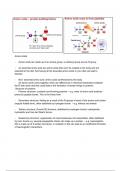
, 3 Draw the structure of alanine, leucine, isoleucine, tyrosine, lysine and histidine (At pH
8 points 7.0). Give also the three-letter and the one-letter codes. Indicate the pKa of the side
groups.
(Draw 1 amino acid completely, draw only the R group for the other amino acids)


H
+
H3N C COO-
CH2 OH Tyrosine (Tyr, Y)
CH3 pKa = 10.07
Alanine (Ala, A)

CH3 CH2 CH2 CH2 CH2 NH3+
CH2 CH Leucine (Leu,
CH3 L) Lysine (Lys, K)
pKa = 10.53

CH3 H
CH CH2 CH3 CN
Isoleucine (Ile, I)
CH2 C
CH Histidine (His, H)
N pKa = 6.00
H


4 Explain the differences between common and uncommon amino acids
6 points


The 22 common or coded amino acids are used to make proteins. The proteins are
synthesized on the ribosome where the sequence of amino acids are dictated by the
sequence of codons on an mRNA molecule. The codons are recognized by the anti-
codon on a tRNA molecules that have the amino acid attached. Each coded amino acid
has its own set of tRNA molecules.

Uncommon amino acids include the modified common amino acids as a result of post-
translational modifications, and the group of amino acids that are 1) part of small
polypeptides, 2) are metabolic or 3) are synthetic intermediates.


2

Maak kennis met de verkoper

Seller avatar
De reputatie van een verkoper is gebaseerd op het aantal documenten dat iemand tegen betaling verkocht heeft en de beoordelingen die voor die items ontvangen zijn. Er zijn drie niveau’s te onderscheiden: brons, zilver en goud. Hoe beter de reputatie, hoe meer de kwaliteit van zijn of haar werk te vertrouwen is.
brainsmaster Walden University
Volgen Je moet ingelogd zijn om studenten of vakken te kunnen volgen
Verkocht
27
Lid sinds
3 jaar
Aantal volgers
25
Documenten
948
Laatst verkocht
11 maanden geleden

3.8

8 beoordelingen

5
4
4
1
3
1
2
1
1
1

Recent door jou bekeken

Waarom studenten kiezen voor Stuvia

Gemaakt door medestudenten, geverifieerd door reviews

Kwaliteit die je kunt vertrouwen: geschreven door studenten die slaagden en beoordeeld door anderen die dit document gebruikten.

Niet tevreden? Kies een ander document

Geen zorgen! Je kunt voor hetzelfde geld direct een ander document kiezen dat beter past bij wat je zoekt.

Betaal zoals je wilt, start meteen met leren

Geen abonnement, geen verplichtingen. Betaal zoals je gewend bent via iDeal of creditcard en download je PDF-document meteen.

Student with book image

“Gekocht, gedownload en geslaagd. Zo makkelijk kan het dus zijn.”

Alisha Student

Veelgestelde vragen