NUR 265 Exam 3 Study Guide & Exam Questions and Answers
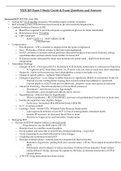
NUR 265 Exam 3 Study Guide & Exam Questions and Answers Increased ICP (939-940, chart 941) • Normal ICP 10-15 mmHg, pressures >20 mmHg impair cerebral circulation • IICP is leading cause of death from head trauma in pts who reach the hospital alive. • Cerebral Perfusion Pressure (CPP) o Blood flow required to provide adequate oxygenation & glucose for brain metabolism o Maintenance above 70 mmHg o CPP= MAP-ICP ▪ MAP= (2xD) + S MAP NEEDS TO BE ATLEAST 80 3 • Compensation o First Response – CSF is shunted or displaced into the spine (compliance) o Next – Reduction of blood volume in the brain (autoregulation) o As ICP continues to increase cerebral perfusion decreases leading to brain tissue ischemia, edema, vasodilation then acidosis which causes further increases ICP o In edema remains untreated the brain may herniate into spinal canal – death from brain stem compression • Assessment Findings o Changes in LOC – First sign of IICP is declining LOC & includes restlessness or confusion to Stuporous ▪ W/o glucose & 02, brain shuts down. Ex. Pt knew who you were in am & now don’t remember o Headache – Quite environment may have photophobia so keep room lights very low. o Change in speech pattern – Aphasia, Slurred Speech o Changes in pupil size – 2 cm change in either direction is significant, dilated or constricted, Notify Dr ▪ Normal is 6 mm. Getting better if going back toward normal from dilated or constricted ▪ Uneven pupils tx as IICP until proven otherwise; pinpoint - brain stem (pons) dysfunction o Abnormal Posturing – Decorticate (flexion) or Decerebrate (extensor) ▪ Decorticate – arms drawn to core, legs straight ▪ Decerebrate – arms straight and stiff, pts rarely survive o Hyperthermia – followed later by hypothermia ▪ When hypothermic – BE CONCERNED, pressure on hypothalamus located next to brain stem o Cardiac & respiratory rate/rhythm changes ▪ Tachy first – Increased HR & RR before brady HR & RR o N/V – Common in IICP o Cushing’s Triad – Severe HTN, Widened Pulse Pressure, Bradycardia ▪ Late response & indicates severe IICP w/loss of autoregulation, Imminent death ▪ Systolic BP increases bc decreased blood flow to brain ▪ Pressure on Vagus nerve and brainstem = bradycardia • Managing IICP o Elevate HOB 30-45 degrees (unless contraindicated) ▪ If hypotension, elevate HOB where CPP >70 o Maintain head in a midline neutral position o Avoid sudden and acute hip or neck flexion during positioning – Log roll pt o Avoid clustering of care (bath followed by linen change) o Coughing and suctioning increase ICP o Decrease cerebral edema – osmotic diuretics (mannitol) & fluid restriction ▪ Mannitol is hypertonic- pulling fluid into vascular space- will inc. fluid output & monitor BP for HTN ▪ Furosemide used in adjunct to reduce incidence of rebound from mannitol. Helps reduce edema & blood volume, decrease Na uptake by the brain, & decrease production of CSF at choroid plexus. o LOW CSF using intraventricular drain system o Control fever w/antipyretics or cooling blanket – do not allow pt to shiver as will increase ICP ▪ When febrile every cell in body needs more 02 and glucose o Oxygenation – Hyperventilate on a vent to decrease CO2 which causes vasodilation o Reduce cellular metabolic demands – barbiturates (-bital, -barbital) and/or sedation (coma) Traumatic Brain Injury (946-957) • Primary Brain Injury o Occurs at time of injury o Open – Head fractured or penetrated; Closed – Blunt trauma, shaken baby o Open Head Injuries ▪ Skull Fractures • Linear Fx – thin line on x-ray, no tx unless underlying brain tissue damaged • Depressed Fx – Brain damage from bruising (contusion), laceration from bone fragments • Basilar skull Fx – Fx of bones of the base of skull & results in CSF leak from nose & ears. o May not be seen on plain x-ray, R/F Infection w/ CSF leak o Manifested by bruises around eyes(raccoon eyes) or behind ears (Battle’s sign) o Has potential for hemorrhage if it damages the internal carotid o Closed Head Injuries ▪ Caused by blunt force trauma ▪ Contusion – Bruising to brain tissue @ site of impact (coup) or opposite (contercoup) ▪ Laceration – tearing of the cortical surface vessels, lead to secondary hemorrhage, cerebral edema and inflammation ▪ Diffuse Axonal Injury (DAI) – Tissue of entire brain from high speed acel/decel MVC • Impaired cognitive functioning, results in disorganization, impaired memory • Severe will present with immediate coma, survivors require lone-term care o Classified as ▪ Mild – GCS 13-15 (concussion) • Blow to head, transient confusion, or feeling dazed or disoriented • Loss of consciousness for up to 30 min, loss of memory before and after accident • No evidence of brain damage, sx resolve w/i 72 hrs • Sx: HA, N/V, Fatigue, Foggy, Balance off, Irritable, Sad, Nervous, Emotional, Visual probs ▪ Moderate – GCS 9-12 • Loss of consciousness 30 min – 6 hrs w/ memory loss up to 24 hrs. • Short hospital stay to prevent secondary injury • Memory loss up to 24 hrs. ▪ Severe – GCS 3-8 • Loss of consciousness >6 hrs • High risk for secondary brain injury from cerebral edema, hemorrhage, reduced perfusion • Pupil changes, Bradycardia, Papilledema, HTN w/wide PP, Nuchal rigidity if CSF leak o Glasgow Coma Scale ▪ Score from 3-15; score 3-8 in a coma ▪ A change of 2 points requires immediate notification to HCP • Secondary Brain Injury o Any process that occurs after the initial injury and worsen or negatively influences patient outcomes. ▪ While trying to recover from initial event, something else happens (ex: meningitis) o Most common result from hypotension, hypoxia, IICP, & cerebral edema ▪ Damage to brain tissue due to delivery of O2 and glucose to brain is interrupted ▪ Low blood flow and hypoxemia contribute to cerebral edema o Hypotension & Hypoxia ▪ hypotension (MAP <70), hypoxia (PaO2 <80) ▪ Hypotension may be from shock & hypoxia from resp. failure, loss of airway, or impaired ventilation o Increased Intracranial Pressure (IICP) ▪ See Increased ICP section above o Hemorrhage ▪ Begins at moment of impact & potentially life threatening ▪ Epidural Hematoma – Arterial bleeding between dura and inner skull, from fx of temporal bone • Have “lucid intervals” – Pt awake & talking then momentary unconsciousness ▪ Subdural Hematoma – Venous bleeding into space beneath dura & above arachnoid • From laceration of brain tissue, bleeding is slower than epidural, Highest mortality rate • Acute SDH – w/i 48 hrs after impact • Subacute SDH – 48 hrs – 2 weeks • Chronic SDH – 2 weeks to several months ▪ A loss of consciousness from an epidural or subdural hematoma is a neurological emergency! o Hydrocephalus – abnormal increase in CSF volume ▪ Caused by impaired reabsorption or blockage with outflow of CSF, leads to IICP o Brain Herniation ▪ Uncus- dilated non-reactive pupils, ptosis, decreased LOC ▪ Central – Down shift brain stem – Cheyne-Stokes, Pinpoint & nonreactive pupils, hemodynamic instability. NOTIFY PHYSICIAL IMMEDIATELY • Etiology o Young males, play more sports, take more risks when driving (MVC), consume more alcohol o Falls most common in older adults. • Assessment/Interventions o Hx – Did pt lose consciousness? Drug or alcohol consumption? All screened for abuse/neglect o Physical ▪ First priority is assessment of ABCs - Report any sign of respiratory problems immediately! ▪ Suspect neck injury until proven otherwise, stabilize w/ C-Collar and backboard • Skin breakdown & pressure ulcer formation are concern with spine board & c-collar • Once board removed, spinal precautions maintained until HCP indicates it is safe o (1) Bedrest; (2) No neck flexion with a pillow or roll; (3)No thoracic or lumbar flexion w/HOB elevation (reverse T acceptable); (4) Manual control of C spine anytime collar removed; (5) Log roll ▪ Prevent secondary brain injury – O2 & lowering ICP, Vent if needed, do not want CO2 to rise as it causes vasodilation & IICP. o Vital Signs ▪ Monitor VS Q 1-2 hrs – May be hypotensive or hypertensive (IV fluids to maintain above 90) ▪ Central fever caused by hypothalamic damage – no sweating, high, last days-weeks • Responds better to cooling (sponge bath, cool air) • Fever from any cause is associated w/higher mortality rates ▪ Cushing’s Triad – HTN, Wide PP, & Bradycardia – late sign of IICP and indicates imminent death ▪ Hypotension and tachycardia indicate hypovolemic shock o Neuro ▪ GCS ▪ Most important variable to assess w/any brain injury is LOC ▪ Dec or change in LOC is first sign of deterioration (behavior changes, restlessness, disorientation) ▪ Assess pupils • Pinpoint - & nonresponsive – Brainstem dysfunction @ level of ponds • Asymmetric, loss of light reaction, unilateral or bilateral dialed – herniation o Late signs of IICP – severe HA, N/V, seizures, papilledema - always sign of IICP ▪ Motor response - Decorticate or Decerebrate posturing o Psychosocial ▪ Personality changes – temper outbursts, depression, risk-taking, denial, talkative, outgoing o Therapeutic Hypothermia ▪ Rapidly cool pt to 89.6 – 93.2 for 24-48 hrs after primary injury to reduce brain metabolism and reduce secondary brain injury. o Mechanical ventilation ▪ Maintain PaCO2 at 35 to 38 to prevent IICP from vasodilation from CO2 ▪ Maintain PaO2 between 80-100 to prevent secondary injury ▪ Lidocaine given IV or endotracheally to suppress cough reflex; coughing increases ICP o Drug Therapy ▪ Mannitol through a filter • Reduces edema and blood volume, dec Na uptake by brain & dec CSF production • Used with furosemide to reduce rebound from Mannitol & enhances therapeutic action • Foley catheter for strict I&O, check serum (want 310-320) and urine osmolarity daily. ▪ NO Steroids are effective ▪ Propofol & dexmedetomidine – sedative agents with short ½ life ▪ Morphine or fentanyl in vented pts to dec agitation & restlessness if caused by pain. • Fentanyl is safer. Both reversed with naloxone. ▪ Antiepileptic drugs – phenytoin to prevent seizures ▪ Acetaminophen or aspirin for fever >101 if not from central fever (cooling only) ▪ Barbiturate Coma • Pentobarbital or thiopentone - For IICP that can’t be controlled • Dec metabolic demands of brain, requires vent, hemodynamic & ICP monitoring. • Complications – dec GI motility, dysrhythmias from hypokalemia, hypotension, fluctuations in body temp • Surgical Management o Insert ICP monitoring through burr hole (key hole craniotomy) - maintain w/strict sterile technique ▪ Be sure to provide head to toe assessment even though pt ICP being invasively monitored o Decompressive Craniotomy ▪ Removal of section of the skull – allows space for edema w/o Increasing ICP ▪ DO NOT LAY PT ON THE SIDE WHERE THE SKULL FRAGMENT WAS REMOVED. ▪ Pt must wear helmet when out of bed • Pt & Family Education for self-management – MILD BRAIN INJURY o Acetaminophen for HA Q 4 hrs o Avoid sedatives, alcohol, sleeping pills for at least 24 hrs o No strenuous activity for 48 hrs o Monitor or assist movement due to balance disturbances o If these sx occur bring back to ER ▪ Severe HA; Worsening HA; Persistent or severe N/V; Blurred vision; Drainage from ear or nose; Weakness; Slurred speech; Progressive sleepiness; Unequal pupil size • Interdisciplinary Care o Rehab specialists o Speech & Language Pathologists (SLP) o Dietitian o Rehab therapists o Severe brain injury requires lone-term case management & ongoing rehab o OT, PT, SLP, & home evaluations after discharge for severe Cerebral Aneurysm (chart 940) ● Intracranial aneurysm – weakness in a cerebral blood vessel wall, Saccular or berry most common in the head ● AV Malformations – Tangled arteries and veins, blood shunted from artery to a vein, can bleed or thrombose o Pt. present with HA, seizures, or focal deficits o Once bleeds, has 25% chance of bleeding again ● Surgery o Surgical ligation or resection (Open) ▪ Surgical removal of AVM or aneurysm, care same as craniotomy o Clip (Open) ▪ Clamp over aneurysm base to isolate, movement can occur ▪ Close attention on neuro to detect early rebleeding or migration of the clip. Changes in cognition or new focal neurologic deficits must be communicated urgently to the surgeon. o Coil: with stent assist; with balloon assist ▪ Detachable coils placed under fluoroscopy to occlude aneurysm w/o interrupting main vessel flow. ▪ Due to rebleeding risk, avoid drugs that interfere with the clotting during recovery ▪ Re-evaluation at 3, 6, and 12 months w/neurosurgeon to evaluate effectiveness ▪ Frequent neurologic assessments in first 24 hrs post procedure to detect intracranial bleeding. • Flow diversion o Shifting blood flow away from the vessel defect, resulting in a thrombosed (clotted) aneurysm over 5-6 mon o Full embolization takes 5-12 months, ongoing monitoring by the neurosurgery ▪ Teach pt to avoid strenuous activity or situations that create HTN while the prolonged embolization occurs • Liquid polymer embolization o AVMs only, used prior to surgical litigation or to tx small AVMs o may not provide definitive treatment ▪ Perform frequent neuro assessment in the 24 hours post-op to detect early signs of bleeding • Stereotactic Surgery o Microwave or radio beams are directed to the defective vessels to obliterate the defect. o Swelling around beam site may alter neurologic status o Inform neurosurgeon of ant deterioration in consciousness or new focal weakness or sensory changes. Brain Tumor (957-962) • Complications o Cerebral edema/brain tissue inflammation o IICP o Neurologic deficits o Hydrocephalus o Pituitary dysfunction – pressure causing SIADH or DI • Symptoms of a Brain Tumor o HA- more severe on awakening in the AM o N/V o Visual changes, diplopia o Seizures, Aphasia o Loss of balance or dizziness o Weakness or paralysis in one part or one side of the body o Changes in mentation or personality o Difficulty thinking, speaking, or articulating o Papilledema (swelling of the optic disc) indicating IICP • Diagnosis o CT, MRI, & Skull films conducted first; identifies size, location, and extent of tumor. o EEG, Lumbar puncture, brain scan, and PET scan for further information ▪ To prevent brain herniation, LP not performed if pt has signs of IICP • Interventions o Drugs – Chemo alone or in combo w/radiation & surgery, & w/tumor progression – control tumor growth ▪ Oral Drugs – lomustine, temozolomide, procarbazine, methotrexate, and vincristine (IV) ▪ Analgesics – Codeine & acetaminophen are given for HA ▪ Dexamethasone to control cerebral edema ▪ Phenytoin or other antiepileptic drugs to prevent or treat seizure activity ▪ PPIs to prevent stress ulcers o Stereotactic Radiosurgery ▪ Alternative to traditional surgery ▪ Ionized radiation with radioisotope cobalt-60, w/o damaging surrounding healthy tissue ▪ Tx takes less than an hour and only requires overnight hospitalization ▪ Not invasive, lower risk than craniotomy, rapid recovery Craniotomy (960-962) • Pre-Operative o Provide reassurance that the surgeon will spare vital parts of brain while removing tumor o Check that the pt has not had alcohol, tobacco, anticoagulants, or NSAIDS for at least 5 days b4 surgery o NPO status for at least 8 hrs b4 surgery • Post-Operative Care o Focus is to monitor pt to detect changes in status & prevent or minimize complications (IICP) o Assess neurologic and VS @ 15-30 min for the first 4-6 hrs then Q 1 hr. If pt stable for 24 hrs checks decrease to Q 2-4 hrs. o Immediately report new neurologic deficits – Dec LOC, motor weakness or paralysis, aphasia, dec sensation, & reduced pupil reaction to light. Personality changes (agitation, aggression) can indicate worsening status o Periorbital edema and ecchymosis of one or both eyes is normal, tx w/cold compress o Irrigate affected eye w/warm saline solution or artificial tears to improve pt comfort. o Record I&O for the 1st 24 hrs & anticipate fluid restriction to 1500 mL a day if there is pituitary involvement o Do NOT reposition pt on the operative site o Supratentorial surgery – elevate HOB 30 degrees, avoid extreme hip or neck flexion & midline neutral position to prevent IICP o Infratentorial (Brainstem) craniotomy – Flat and side-lying, alternating sides Q2 for 24-48 hrs. ▪ Pt to remain NPO for 24 hrs due to edema around medulla causing vomiting and aspiration. o Check head dressing @ 1-2 hrs & mark, small or moderate amount expected (30-50 mL Q 8hrs) ▪ Report saturated head dressing or drainage > 50mL/8hrs immediately to surgeon! o Drugs Given routinely ▪ Antiepileptic drugs, H2 Blockers or PPIs for stress ulcer prophylaxis, and glucocorticoids (dexamethasone) to reduce intracranial edema ▪ Acetaminophen for fever or mild pain • Preventing Post-op Complications o IICP ▪ Severe HA, dec LOC, restlessness, irritability, & dilated or pinpoint pupils slow to react or nonreactive o Hydrocephalus – caused by obstruction of the normal CSF pathway from edema ▪ HA, decreased LOC, irritability, blurred vision, urinary incontinence o Subdural or Epidural Hematoma ▪ Severe HA, rapid dec in LOC, progressive neurologic deficits, & herniation o Respiratory complications ▪ Atelectasis, PNA, & neurologic pulmonary edema (sx same as pulmonary edema but not associated w/cardiac problem) o Wound Infections ▪ Pts w/hx of DM, long-term steroid use, obesity, and previous infections ▪ Pt may or may not be febrile, wound reddened and puffy o Meningitis o Hyponatremia - from fluid overload from SIADH or steroids (weakness, change in LOC & confusion) ▪ UOP <20 mL/hr, decreased serum Na due to dilutional effect ▪ Conivaptan and tolvaptan for severe hyponatremia <118 o Hypernatremia – Caused by meningitis, dehydration, or DI (muscle weakness, restlessness, extreme thirst, and dry mouth). Untreated can lead to seizures. ▪ Suspect DI if pt voids lg amounts of very dilute urine w/inc serum osmolarity & electrolyte concentration. Urine specific gravity <1.005, urine osmolarity dec ▪ May need vasopressin if UOP >6L/24 hrs, desmopressin for long term replacement o Cerebral Salt Wasting (CSW) ▪ Primary cause of hyponatremia in neurosurgical pts. ▪ Hyponatremia, dec serum osmolarity, and dec blood volume ▪ Vasopressin and ANF levels differentiate CSW and SIADH ▪ Tx w/ replacement of Na and isotonic fluid volume • Community Based Care/IDC o Managed at home if possible, if have hemiparesis make sure home is accessible and safe o Rehab if needed, psychologist, dietitian (if radiation or chemo) o Teach seizure precautions as can have risk for up to 1 year after surgery Brain Abscess (962-964) • Purulent infection of the brain in which puss forms • Organisms from the ear, sinus, or mastoid area enter the bran by traveling along the wall of the cerebral veins. • Lung infection, ear infection, sinus infection, bullet, knife wound, or neurosurgery • Streptococci are most common organisms, Escherichia coli, Toxoplasma gondii (opportunistic infection in AIDS) • Assessment o Manifestations begin slowly – Fever, HA, Pain, hemiplegia, Ataxia, Sensory impairment, Aphasia, Seizures o Temporal field blindness – decrease in peripheral vision laterally o Severe – S/s of IICP ( Dec LOC, severe HA, bradycardia & widened pulse pressure) o Pupils respond normal in early stages o Inflammatory process is responsible for much of the clinical presentation • D X o WBCs and ESR elevated indicating presence of infection. IF ENCAPSULATED WBC COUNT NORMAL • Interventions o Combination antibiotics and maximum dosing o Antiepileptic drugs – phenytoin to prevent seizures Meningitis (
Geschreven voor
- Instelling
- NUR 265
- Vak
- NUR 265
Documentinformatie
- Geüpload op
- 9 februari 2022
- Aantal pagina's
- 44
- Geschreven in
- 2022/2023
- Type
- Tentamen (uitwerkingen)
- Bevat
- Vragen en antwoorden
Onderwerpen
-
nur 265 exam 3 study guide amp exam questions and answers increased icp 939 940
-
chart 941 • normal icp 10 15 mmhg
-
pressures gt20 mmhg impair cerebral circulation • iicp is leading cause of dea

Ook beschikbaar in voordeelbundel