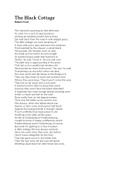
The Black Cottage
Robert Frost
We chanced in passing by that afternoon
To catch it in a sort of special picture
Among tar-banded ancient cherry trees,
Set well back from the road in rank lodged grass,
The little cottage we were speaking of,
A front with just a door between two windows,
Fresh painted by the shower a velvet black.
We paused, the minister and I, to look.
He made as if to hold it at arm's length
Or put the leaves aside that framed it in.
'Pretty,' he said. 'Come in. No one will care.'
The path was a vague parting in the grass
That led us to a weathered window-sill.
We pressed our faces to the pane. 'You see,' he said,
'Everything's as she left it when she died.
Her sons won't sell the house or the things in it.
They say they mean to come and summer here
Where they were boys. They haven't come this year.
They live so far away-one is out west-
It will be hard for them to keep their word.
Anyway they won't have the place disturbed.'
A buttoned hair-cloth lounge spread scrolling arms
Under a crayon portrait on the wall
Done sadly from an old daguerreotype.
'That was the father as he went to war.
She always, when she talked about war,
Sooner or later came and leaned, half knelt
Against the lounge beside it, though I doubt
If such unlifelike lines kept power to stir
Anything in her after all the years.
He fell at Gettysburg or Fredericksburg,
I ought to know-it makes a difference which:
Fredericksburg wasn't Gettysburg, of course.
But what I'm getting to is how forsaken
A little cottage this has always seemed;
Since she went more than ever, but before-
I don't mean altogether by the lives
That had gone out of it, the father first,
Then the two sons, till she was left alone.
(Nothing could draw her after those two sons.
, She valued the considerate neglect
She had at some cost taught them after years.)
I mean by the world's having passed it by-
As we almost got by this afternoon.
It always seems to me a sort of mark
To measure how far fifty years have brought us.
Why not sit down if you are in no haste?
These doorsteps seldom have a visitor.
The warping boards pull out their own old nails
With none to tread and put them in their place.
She had her own idea of things, the old lady.
And she liked talk. She had seen Garrison
And Whittier, and had her story of them.
One wasn't long in learning that she thought
Whatever else the Civil War was for
It wasn't just to keep the States together,
Nor just to free the slaves, though it did both.
She wouldn't have believed those ends enough
To have given outright for them all she gave.
Her giving somehow touched the principle
That all men are created free and equal.
And to hear her quaint phrases-so removed
From the world's view to-day of all those things.
That's a hard mystery of Jefferson's.
What did he mean? Of course the easy way
Is to decide it simply isn't true.
It may not be. I heard a fellow say so.
But never mind, the Welshman got it planted
Where it will trouble us a thousand years.
Each age will have to reconsider it.
You couldn't tell her what the West was saying,
And what the South to her serene belief.
She had some art of hearing and yet not
Hearing the latter wisdom of the world.
White was the only race she ever knew.
Black she had scarcely seen, and yellow never.
But how could they be made so very unlike
By the same hand working in the same stuff?
She had supposed the war decided that.
What are you going to do with such a person?
Strange how such innocence gets its own way.
I shouldn't be surprised if in this world
It were the force that would at last prevail.
Do you know but for her there was a time
When to please younger members of the church,
Robert Frost
We chanced in passing by that afternoon
To catch it in a sort of special picture
Among tar-banded ancient cherry trees,
Set well back from the road in rank lodged grass,
The little cottage we were speaking of,
A front with just a door between two windows,
Fresh painted by the shower a velvet black.
We paused, the minister and I, to look.
He made as if to hold it at arm's length
Or put the leaves aside that framed it in.
'Pretty,' he said. 'Come in. No one will care.'
The path was a vague parting in the grass
That led us to a weathered window-sill.
We pressed our faces to the pane. 'You see,' he said,
'Everything's as she left it when she died.
Her sons won't sell the house or the things in it.
They say they mean to come and summer here
Where they were boys. They haven't come this year.
They live so far away-one is out west-
It will be hard for them to keep their word.
Anyway they won't have the place disturbed.'
A buttoned hair-cloth lounge spread scrolling arms
Under a crayon portrait on the wall
Done sadly from an old daguerreotype.
'That was the father as he went to war.
She always, when she talked about war,
Sooner or later came and leaned, half knelt
Against the lounge beside it, though I doubt
If such unlifelike lines kept power to stir
Anything in her after all the years.
He fell at Gettysburg or Fredericksburg,
I ought to know-it makes a difference which:
Fredericksburg wasn't Gettysburg, of course.
But what I'm getting to is how forsaken
A little cottage this has always seemed;
Since she went more than ever, but before-
I don't mean altogether by the lives
That had gone out of it, the father first,
Then the two sons, till she was left alone.
(Nothing could draw her after those two sons.
, She valued the considerate neglect
She had at some cost taught them after years.)
I mean by the world's having passed it by-
As we almost got by this afternoon.
It always seems to me a sort of mark
To measure how far fifty years have brought us.
Why not sit down if you are in no haste?
These doorsteps seldom have a visitor.
The warping boards pull out their own old nails
With none to tread and put them in their place.
She had her own idea of things, the old lady.
And she liked talk. She had seen Garrison
And Whittier, and had her story of them.
One wasn't long in learning that she thought
Whatever else the Civil War was for
It wasn't just to keep the States together,
Nor just to free the slaves, though it did both.
She wouldn't have believed those ends enough
To have given outright for them all she gave.
Her giving somehow touched the principle
That all men are created free and equal.
And to hear her quaint phrases-so removed
From the world's view to-day of all those things.
That's a hard mystery of Jefferson's.
What did he mean? Of course the easy way
Is to decide it simply isn't true.
It may not be. I heard a fellow say so.
But never mind, the Welshman got it planted
Where it will trouble us a thousand years.
Each age will have to reconsider it.
You couldn't tell her what the West was saying,
And what the South to her serene belief.
She had some art of hearing and yet not
Hearing the latter wisdom of the world.
White was the only race she ever knew.
Black she had scarcely seen, and yellow never.
But how could they be made so very unlike
By the same hand working in the same stuff?
She had supposed the war decided that.
What are you going to do with such a person?
Strange how such innocence gets its own way.
I shouldn't be surprised if in this world
It were the force that would at last prevail.
Do you know but for her there was a time
When to please younger members of the church,