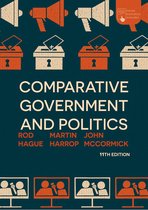
Summary of the material for the final exam (2022) for Introduction to Comparative Politics.
INCLUDES notes from (Total: 69 pages):
● Rod Hague, Martin Harrop and John McCormick’s book (11th edition, 2019) “Comparative
Government and Politics”, chapters 1, 3-13 and 15-18.
1
Introduction to Comparative Politics Notes on Readings
Table of Contents
“Comparative Government and Politics” 2
1. Key Concepts 2
3. Comparative Methods 4
4. The State 8
5. Democratic Rule 13
6. Authoritarian Rule 19
7. Constitutions and Courts 22
8. Executives 26
9. Legislatures 30
10. Bureaucracies 35
11. Sub-National Governments 39
12. Political Culture 43
13. Political Participation 47
15. Elections 51
16. Political Parties 55
17. Voters 59
18. Interest Groups 64
, 2
“Comparative Government and Politics”
1. Key Concepts
Overview
Democracy: A political system where the government is based on a fair and open mandate from all
qualified citizens of a state.
Political Science: The study of the theory and practice of government and politics, focusing on the
structure and dynamics of institutions, political processes, and political behaviour. Consists of the
following sub-fields:
● Comparative politics
● International relations (IR)
● National politics
● Political philosophy
● Political theory
● Public policy
Social Science: The study of human society and its structured interactions.
Government and Governance
Government: The entire institutions and offices through which societies are governed.
➔ Institutions: A formal organisation or practise with a political purpose or effect, marked by
durability and internal complexity.
➔ English philosopher Thomas Hobbes argued that the government provides security and
predictability, transforming anarchy into order.
➔ The government is influenced by surrounding forces that make up a political system.
◆ Political System: The interactions and organisations through which a society reaches
and successfully enforces collective decisions.
Governance: The process of collective decision-making and public regulation.
➔ Good governance is accountable, transparent, efficient, responsive, and inclusive,
HOWEVER, all systems have flaws.
Politics and Power
Politics: A collective negotiation between or among people executing shared decisions. Part of the
social nature of humans with compromises and different opinions. It is a competition for acquiring
and keeping power.
➔ Public authority is used to implement collective policy.
Power: The capacity to bring about intended effects and achieve goals. Steven Luke’s (2005) three
dimensions of power in determining a certain group’s power:
1. Prevailing preferences; decisions are made on issues over which there is an observable
conflict of interests.
2. Expressed preferences; decisions are prevented from being taken on potential issues over
which there is an observable conflict of interests.
, 3
3. Shaped preferences; potential issues are kept out of politics, whether through social forces,
institutional practices, or the decisions of individuals.
The State, Authority, and Legitimacy
State: A population living within a defined territory, and each recognized by its residents and by
other states as having the right to rule that territory. They provide the legal mandate for a
government’s authority.
➔ Authority: The right to rule, creating power, as long as people accept the person in charge in
taking decisions. Max Weber’s (1922) three ways of validating political power:
1. Tradition; the accepted way of doing things.
2. Charisma; intense commitment to a leader and their message.
3. Appeal to legal/rational norms, based on the rule-governed powers of an office.
➔ Legitimacy: The condition of being legitimate; a system based on authority, and those subject
to its rule recognize its right to make decisions.
Ideology
Ideology: A system of connected beliefs for how politics, economics, and society should be
structured. Major ideologies include:
1. Anarchism; all forms of governmental authority are unnecessary, and society is best
structured around voluntary cooperation and free association.
2. Marxism; elimination of the state system and private property will lead to the creation of a
classless, non-exploitive, and self-governing society.
3. Liberalism; individuals are the best judges of their interests, advocating a tolerant society
that maximises personal freedom, and favours a freely-elected but limited government.
4. Conservatism; traditional institutions and practises work best, the free market is the most
efficient at meeting societal needs, and the government should be as decentralised as possible.
5. Fascism; supports the achievement of national unity through an authoritarian state, strong
leadership, mass mobilisation, and an emphasis on nationalism and militarism.
‘Left’ (Socialists and Communists) ‘Right’ (Conservatives)
● Peace ● Armed forces
● Global outlook ● National priorities
● Democracy ● Authority, morality and the constitution
● Planning and public ownership ● Free market
● Trade protection ● Free trade
● Social security ● Social harmony
● Education ● Law and order
● Collectivist ● Individualist
Comparative Politics
Comparative Politics: The systematic study of government and politics in different countries, drawing
out their contrasts and similarities. Aims to:
● Broaden understanding/interpretation of the dynamics and character of political systems.
● Predict political outcomes (theoretically) through the creation of generalisations. Although
results depend on the strength and detail used within comparisons.
Classifying Political Systems
INCLUDES notes from (Total: 69 pages):
● Rod Hague, Martin Harrop and John McCormick’s book (11th edition, 2019) “Comparative
Government and Politics”, chapters 1, 3-13 and 15-18.
1
Introduction to Comparative Politics Notes on Readings
Table of Contents
“Comparative Government and Politics” 2
1. Key Concepts 2
3. Comparative Methods 4
4. The State 8
5. Democratic Rule 13
6. Authoritarian Rule 19
7. Constitutions and Courts 22
8. Executives 26
9. Legislatures 30
10. Bureaucracies 35
11. Sub-National Governments 39
12. Political Culture 43
13. Political Participation 47
15. Elections 51
16. Political Parties 55
17. Voters 59
18. Interest Groups 64
, 2
“Comparative Government and Politics”
1. Key Concepts
Overview
Democracy: A political system where the government is based on a fair and open mandate from all
qualified citizens of a state.
Political Science: The study of the theory and practice of government and politics, focusing on the
structure and dynamics of institutions, political processes, and political behaviour. Consists of the
following sub-fields:
● Comparative politics
● International relations (IR)
● National politics
● Political philosophy
● Political theory
● Public policy
Social Science: The study of human society and its structured interactions.
Government and Governance
Government: The entire institutions and offices through which societies are governed.
➔ Institutions: A formal organisation or practise with a political purpose or effect, marked by
durability and internal complexity.
➔ English philosopher Thomas Hobbes argued that the government provides security and
predictability, transforming anarchy into order.
➔ The government is influenced by surrounding forces that make up a political system.
◆ Political System: The interactions and organisations through which a society reaches
and successfully enforces collective decisions.
Governance: The process of collective decision-making and public regulation.
➔ Good governance is accountable, transparent, efficient, responsive, and inclusive,
HOWEVER, all systems have flaws.
Politics and Power
Politics: A collective negotiation between or among people executing shared decisions. Part of the
social nature of humans with compromises and different opinions. It is a competition for acquiring
and keeping power.
➔ Public authority is used to implement collective policy.
Power: The capacity to bring about intended effects and achieve goals. Steven Luke’s (2005) three
dimensions of power in determining a certain group’s power:
1. Prevailing preferences; decisions are made on issues over which there is an observable
conflict of interests.
2. Expressed preferences; decisions are prevented from being taken on potential issues over
which there is an observable conflict of interests.
, 3
3. Shaped preferences; potential issues are kept out of politics, whether through social forces,
institutional practices, or the decisions of individuals.
The State, Authority, and Legitimacy
State: A population living within a defined territory, and each recognized by its residents and by
other states as having the right to rule that territory. They provide the legal mandate for a
government’s authority.
➔ Authority: The right to rule, creating power, as long as people accept the person in charge in
taking decisions. Max Weber’s (1922) three ways of validating political power:
1. Tradition; the accepted way of doing things.
2. Charisma; intense commitment to a leader and their message.
3. Appeal to legal/rational norms, based on the rule-governed powers of an office.
➔ Legitimacy: The condition of being legitimate; a system based on authority, and those subject
to its rule recognize its right to make decisions.
Ideology
Ideology: A system of connected beliefs for how politics, economics, and society should be
structured. Major ideologies include:
1. Anarchism; all forms of governmental authority are unnecessary, and society is best
structured around voluntary cooperation and free association.
2. Marxism; elimination of the state system and private property will lead to the creation of a
classless, non-exploitive, and self-governing society.
3. Liberalism; individuals are the best judges of their interests, advocating a tolerant society
that maximises personal freedom, and favours a freely-elected but limited government.
4. Conservatism; traditional institutions and practises work best, the free market is the most
efficient at meeting societal needs, and the government should be as decentralised as possible.
5. Fascism; supports the achievement of national unity through an authoritarian state, strong
leadership, mass mobilisation, and an emphasis on nationalism and militarism.
‘Left’ (Socialists and Communists) ‘Right’ (Conservatives)
● Peace ● Armed forces
● Global outlook ● National priorities
● Democracy ● Authority, morality and the constitution
● Planning and public ownership ● Free market
● Trade protection ● Free trade
● Social security ● Social harmony
● Education ● Law and order
● Collectivist ● Individualist
Comparative Politics
Comparative Politics: The systematic study of government and politics in different countries, drawing
out their contrasts and similarities. Aims to:
● Broaden understanding/interpretation of the dynamics and character of political systems.
● Predict political outcomes (theoretically) through the creation of generalisations. Although
results depend on the strength and detail used within comparisons.
Classifying Political Systems