
Histology
The study of tissues
Week 1)
4 Types of basic tissue types
1. Epitelial tissue;
Covers exposed surfaces, lines internal pathways and chambers---forms glands
2. Connective tissue
Fills internal spaces, provides structural support for other tissues, transports materials within
the body and stores energy.
3. Muscle tissue
Specialized for contraction and includes the skeletal muscle, heart, muscular walls of hollow
organs
4. Nervous tissue
Carries information from one part of the body to another through electrical impulses.
Embryology & Germ layers
- Ectoderm= nervous, skin
- Endoderm= digestive tissue
- Mesoderm= muscle connective tissue
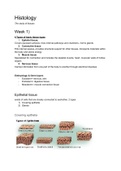
Epithelial tissue
exists of cells that are closely connected to eachother. 2 types
1) Covering epithelia
2) Glands
Covering epithelia
, Apical Domain
● microvilli--- increase surface area
● Cilia; movement and sensory function
Intercellular connections
● Cell junction; specialized areas in membrane that adhere one cell to the other
○ Gap junctions
- Intercellular transport via transmembrane proteins;; connexins.
- Two aligned connexons form a passageway that transport ions
○ Tight junctions ( Zonula occludens)
- Round the whole cell---function like a
zipper
- prevent transport between cells
○ Desmosomes
- Make strongest connection between cells
- connected with intermediate filaments
- can resist bending and twisting, providing
stability.
1. Spot desmosomes; small discs
connected to bands of intermediate
filaments---stabilize the shape of
the cell.
2. Hemidesmosomes (½ spot
desmosomes) Intergrins; connect
the cells with connective tissue
○ Adhesion belt (zonula adhaerens)
- Round the whole cell, adhesion between two cells
- made by transmembrane linker proteins; cadherins
- Intercellular; widened
- Intracellular; connected with actin
● Basal domain
- Hemidesmosomes
- Basal lamina - Plasma membrane - -
invaginations - Mitochondria
- surface are increase
Gland tissue
Invagination of gland tissue, Parenchyma and stroma, often secretion vesicles
Exocrine glands; release vua duct to epithelial surface
Endocrine glads; Release of hormones directly to the lumen, blood or lymph
The study of tissues
Week 1)
4 Types of basic tissue types
1. Epitelial tissue;
Covers exposed surfaces, lines internal pathways and chambers---forms glands
2. Connective tissue
Fills internal spaces, provides structural support for other tissues, transports materials within
the body and stores energy.
3. Muscle tissue
Specialized for contraction and includes the skeletal muscle, heart, muscular walls of hollow
organs
4. Nervous tissue
Carries information from one part of the body to another through electrical impulses.
Embryology & Germ layers
- Ectoderm= nervous, skin
- Endoderm= digestive tissue
- Mesoderm= muscle connective tissue
Epithelial tissue
exists of cells that are closely connected to eachother. 2 types
1) Covering epithelia
2) Glands
Covering epithelia
, Apical Domain
● microvilli--- increase surface area
● Cilia; movement and sensory function
Intercellular connections
● Cell junction; specialized areas in membrane that adhere one cell to the other
○ Gap junctions
- Intercellular transport via transmembrane proteins;; connexins.
- Two aligned connexons form a passageway that transport ions
○ Tight junctions ( Zonula occludens)
- Round the whole cell---function like a
zipper
- prevent transport between cells
○ Desmosomes
- Make strongest connection between cells
- connected with intermediate filaments
- can resist bending and twisting, providing
stability.
1. Spot desmosomes; small discs
connected to bands of intermediate
filaments---stabilize the shape of
the cell.
2. Hemidesmosomes (½ spot
desmosomes) Intergrins; connect
the cells with connective tissue
○ Adhesion belt (zonula adhaerens)
- Round the whole cell, adhesion between two cells
- made by transmembrane linker proteins; cadherins
- Intercellular; widened
- Intracellular; connected with actin
● Basal domain
- Hemidesmosomes
- Basal lamina - Plasma membrane - -
invaginations - Mitochondria
- surface are increase
Gland tissue
Invagination of gland tissue, Parenchyma and stroma, often secretion vesicles
Exocrine glands; release vua duct to epithelial surface
Endocrine glads; Release of hormones directly to the lumen, blood or lymph


