Pharmacology Hesi Practice Exam With All Complete Questions & Answers (Rationales) A Graded
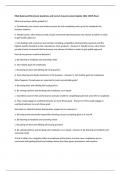
Pharmacology Hesi Practice Exam With All Complete Questions & Answers (Rationales) A Graded PHARMACOLOGY 100 PHARMACOLOGY HESI PRACTICE EXAM. The health care provider prescribes carbamazepine for a child whose tonic-clonic seizures have been poorly controlled. The nurse informs the mother that the child must have blood tests every week. The mother asks why so many blood tests are necessary. Which complication is assessed through frequent laboratory testing that the nurse should explain to this mother? Myelosuppression Rationale: Myelosuppression is the highest priority complication that can potentially affect clients managed with carbamazepine therapy. The client requires close monitoring for this condition by weekly laboratory testing. Hepatic function may be altered, but this complication does not have as great a potential for occurrence as Myelosupression A client is prescribed a cholinesterase inhibitor, and a family member asks the nurse how this medication works. Which pharmacophysiologic explanation should the nurse use to describe this class of drug? Improves nerve impulse transmission Rationale: Cholinesterase inhibitors work to increase the availability of acetylcholine at cholinergic synapses, which aids in neuronal transmission and assists in memory formation. A client is ordered 22 mg of gentamicin by IM injection. The drug is available in 20 mg/2 mL. How many milliliters should be administered? 2.2 mL Rationale: (22 mg/20 mg) × (x mL/2 mL) = 22x = 40 x = 2.2 mL In addition to nitrate therapy, a client is receiving nifedipine, 10 mg PO every 6 hours. The nurse should plan to observe for which common side effect of this treatment regimen? Hypotension Rationale: Nifedipine reduces peripheral vascular resistance and nitrates produce vasodilation, so concurrent use of nitrates with nifedipine can cause hypotension with the initial administration of these agents. Which response best supports the observations that the nurse identifies in a client who is experiencing a placebo effect? Psychological response to inert medication Rationale: The placebo effect is a response in the client that is caused by the psychological impact of taking an inert drug that has no biochemical properties. A placebo effect can be therapeutic, negative, or ineffective but provides no cure or benefit to the client's progress. The placebo effect may evoke behavioral changes but does not affect neurochemical psychotropic changes. Malingering and drug seeking are behaviors that a client exhibits to obtain treatment for nonexistent disorders or obtain prescription medications. A 42-year-old client is admitted to the emergency department after taking an overdose of amitriptyline in a suicide attempt. Which drug should the nurse plan to administer to reverse the cardiac and central nervous system effects of amitriptyline? Sodium bicarbonate Rationale: Sodium bicarbonate is an effective treatment for an overdose of tricyclic antidepressants such as amitriptyline to reverse QRS prolongation. A 67-year-old client is discharged from the hospital with a prescription for digoxin, 0.25 mg daily. Which instruction should the nurse include in this client's discharge teaching plan? Take and record radial pulse rate daily. Rationale: Monitoring pulse rate is very important when taking digoxin. The client should be further instructed to report pulse rates <60 or >110 beats/min and to withhold the dosage until consulting with the health care provider in such a case. Vision change is an indication of drug toxicity, and the client should be instructed to report this immediately. A 55-year-old client was diagnosed with schizophrenia 5 years earlier. Numerous hospitalizations have occurred since the diagnosis because of noncompliance with the prescribed medication regimen. Which drug might work best for this particular client?
Written for
- Institution
-
Chamberlain College Of Nursing
- Course
-
PHARM 100
Document information
- Uploaded on
- February 5, 2022
- Number of pages
- 40
- Written in
- 2021/2022
- Type
- Exam (elaborations)
- Contains
- Questions & answers
Subjects
- pharmacology 100
-
the health care provider prescribes carbamazepine for a child whose tonic clonic seizures have been poorly controlled the nurse informs the mother that the child must have blood test