From Molecule to Mind – Essential Cell Biology + models
C. elegans
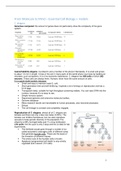
Genomes compared: the amount of genes does not particularly show the complexity of the gene
system.
Caenorhabditis elegans: roundworm and a member of the phylum Nematoda. It is small and grows
to about 1.5 mm in length. It lives in the soil in many parts of the world where it survives by feeding on
microbes, such as bacteria. It is of no economic importance. C. elegans has 959 cells of which 302
neurons. These cells are always there. Humans never have the same amount of cells.
It is a good model system, because:
Small and easy to maintain (eats E. coli).
Short generation time and self-fertilizing. It spends a lot of energy on reproduction and has a
lot of eggs.
Transparent body: suitable for high-throughput screening models. You can inject DNA into the
nucleus, because it’s so easy to see.
Simple nervous system.
Sequenced genome and extensive molecular toolbox.
Genome database
Many research results are translatable to human processes, also neuronal processes.
Ethical.
The cell lineage is constant and completely mapped.
Reproduction of C. elegans: almost all of C. elegans are
females and there are only a few rare males (0.05%). The
females can fertilize themselves, but can also reproduce
sexually to keep genetic diversity in the population.The
offspring is 99% hermaphrodite and 1% cross fertilization.
Life cycle: the life cycle is only 3 days and this is ideal for lab
experiments.
The fertilized oocyte goes through a number of so-
called assymetric cleavages (cells of different sizes)
that generate founder cells. These are the basis of
the formation of different tissues.
The entire route of the founder cells is known.
Apoptosis (programmed cell death) is also strictly
regulated and invariant (131 cells).
1
, The C. elegans genome:
6 chromosomes: 5 autosomes and 1X chromosome.
97 million base pairs that are completely sequences.
First multi-cellular genome project completed.
~20.470 genes compared to ~23.000 in humans.
~40% of the genes have human equivalents (orthologs).
www.wormbase.org
Sophisticated behavior: C. elegans has complex behavior.
Moves forward and backward.
Responds to odors, chemicals, pheromones, temperature differences of 0.1 degrees and
tactile and mechinical stimuli.
Associate learning and habituation.
Forward genetics:
Random mutagenesis:
o Random mutagen to generate point mutations or small deletions.
o Analysis of F2 for the selected phenotypes.
o Mapping using visible markers and polymorphic DNA sequences.
Transposons: discrete segments of DNA moving in the genome, encoding a transposase.
o Normally present in C. elegans in different copies (strain-dependent).
o Activated by forced expression of transposases.
o Most common is Tc1 (cut and past mechanism).
o Insertional mutagenesis with Tc1 will generate mutant alleles tagged by the
transposon that can be used for identifying the mutated gene.
Reverse genetics: Making knock-outs is very difficult, are made by knocking out the gene by RNA
interference. The gene is not completely deleted!
1. Makes use of antisense RNA, has been designed so that it can complementary bind to
endogenous RNA. The antisense RNA will induce a system that gets rid of dubble stranded
RNA, sits at where the ribosome enters and starts translation.
2. RISC proteins break down dubble-stranded RNA (dsRNA). Always searches for
complementary RNA, forms a RISC complex and rapidly degrades it. Small RNA molecules
(siRNA) will also be cleaved by RISC proteins.
3. If these small RNAs are sitting on a transcript, the RISC complex will also break down the
endogenous RNA.
Use RNA interference: can take place by:
Injection of dsRNA in gonads.
Soaking animals in dsRNA
Feeding animals with bacteria producing dsRNA survive the metabolism and act as
inhibitors of expression.
Usually works fine, small pieces have to find the complementary RNA.
It is a transient KO. It can give rise to interesting phenotypes when the full KO is lethal.
2
C. elegans
Genomes compared: the amount of genes does not particularly show the complexity of the gene
system.
Caenorhabditis elegans: roundworm and a member of the phylum Nematoda. It is small and grows
to about 1.5 mm in length. It lives in the soil in many parts of the world where it survives by feeding on
microbes, such as bacteria. It is of no economic importance. C. elegans has 959 cells of which 302
neurons. These cells are always there. Humans never have the same amount of cells.
It is a good model system, because:
Small and easy to maintain (eats E. coli).
Short generation time and self-fertilizing. It spends a lot of energy on reproduction and has a
lot of eggs.
Transparent body: suitable for high-throughput screening models. You can inject DNA into the
nucleus, because it’s so easy to see.
Simple nervous system.
Sequenced genome and extensive molecular toolbox.
Genome database
Many research results are translatable to human processes, also neuronal processes.
Ethical.
The cell lineage is constant and completely mapped.
Reproduction of C. elegans: almost all of C. elegans are
females and there are only a few rare males (0.05%). The
females can fertilize themselves, but can also reproduce
sexually to keep genetic diversity in the population.The
offspring is 99% hermaphrodite and 1% cross fertilization.
Life cycle: the life cycle is only 3 days and this is ideal for lab
experiments.
The fertilized oocyte goes through a number of so-
called assymetric cleavages (cells of different sizes)
that generate founder cells. These are the basis of
the formation of different tissues.
The entire route of the founder cells is known.
Apoptosis (programmed cell death) is also strictly
regulated and invariant (131 cells).
1
, The C. elegans genome:
6 chromosomes: 5 autosomes and 1X chromosome.
97 million base pairs that are completely sequences.
First multi-cellular genome project completed.
~20.470 genes compared to ~23.000 in humans.
~40% of the genes have human equivalents (orthologs).
www.wormbase.org
Sophisticated behavior: C. elegans has complex behavior.
Moves forward and backward.
Responds to odors, chemicals, pheromones, temperature differences of 0.1 degrees and
tactile and mechinical stimuli.
Associate learning and habituation.
Forward genetics:
Random mutagenesis:
o Random mutagen to generate point mutations or small deletions.
o Analysis of F2 for the selected phenotypes.
o Mapping using visible markers and polymorphic DNA sequences.
Transposons: discrete segments of DNA moving in the genome, encoding a transposase.
o Normally present in C. elegans in different copies (strain-dependent).
o Activated by forced expression of transposases.
o Most common is Tc1 (cut and past mechanism).
o Insertional mutagenesis with Tc1 will generate mutant alleles tagged by the
transposon that can be used for identifying the mutated gene.
Reverse genetics: Making knock-outs is very difficult, are made by knocking out the gene by RNA
interference. The gene is not completely deleted!
1. Makes use of antisense RNA, has been designed so that it can complementary bind to
endogenous RNA. The antisense RNA will induce a system that gets rid of dubble stranded
RNA, sits at where the ribosome enters and starts translation.
2. RISC proteins break down dubble-stranded RNA (dsRNA). Always searches for
complementary RNA, forms a RISC complex and rapidly degrades it. Small RNA molecules
(siRNA) will also be cleaved by RISC proteins.
3. If these small RNAs are sitting on a transcript, the RISC complex will also break down the
endogenous RNA.
Use RNA interference: can take place by:
Injection of dsRNA in gonads.
Soaking animals in dsRNA
Feeding animals with bacteria producing dsRNA survive the metabolism and act as
inhibitors of expression.
Usually works fine, small pieces have to find the complementary RNA.
It is a transient KO. It can give rise to interesting phenotypes when the full KO is lethal.
2