Financial Economics Samenvatting
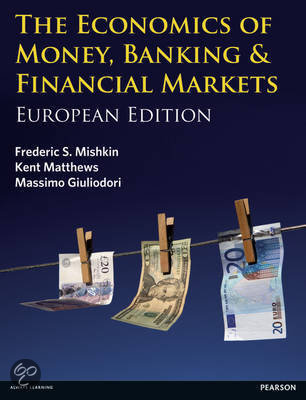
The economics of money, banking & financial markets (Mishkin, Matthews,
Giuliodori)
Chapter 1
Financial markets are markets in which are transferred from people who
have an excess of available funds to people who have a shortage.
Objective is to promoting greater economic efficiency.
A security (financial instrument) is a claim on the issuer’s future income
or assets (financial claim that is subject to ownership). A bond is a debt
security that promises to make payments periodically for a specified
period of time.
An interest rate is the cost of borrowing or the price paid for the rental of
funds.
A common stock represents a share of ownership in a corporation.
When funds are transferred from one country to another, the prices are
adjusted to the country’s currency. This conversion takes place in the
foreign exchange market. The price at which one currency is
exchanged for another is known as the foreign exchange rate.
Financial intermediaries are institutions that borrow funds from people
who have saved and in turn make loans to others.
Financial crises are major disruptions in financial markets that are
characterized by sharp declines in asset prices and the failures of many
financial and non-financial firms.
Banks are financial institutions that accept deposits and make loans.
Banks are most frequently used as financial intermediaries.
Money (money supply) is defined as anything that is generally accepted
in payment for goods or services or in the repayment of debts.
Total production of goods and services (aggregate output).
Unemployment rate is the percentage of the available labour force
unemployed.
Money plays an important role in generating business cycles, the upward
and downward movement of aggregate output produced in the economy.
Recessions are periods of declining aggregate output.
Monetary theory relates changes in the quantity of money to changes in
aggregate economic activity and the price level.
Price level is the average price of goods and services in an economy.
Inflation is a continual increase in the price level.
Monetary policy is the management of money and interest rates.
Fiscal policy involves decisions about government spending and taxation.
A budget deficit is the excess of government expenditures over tax
revenues for a particular time period. A budget surplus arises when tax
, revenues exceed government expenditures.
Chapter 2: An overview of the financial system
The principal lender-savers are households.
The most important borrower-spenders are business and the government.
In direct finance borrowers borrow funds directly from lenders in financial
markets by selling them securities (claims on the borrower’s future income
or assets).
Securities are assets for the person who buys them but liabilities for the
individual or firm that sells them.
Financial markets allow funds to move from people who lack productive
investment opportunities to people who have such opportunities. Financial
markets are critical for producing an efficient allocation of capital, which
contributes to higher production and efficiency for the overall economy.
The most common method is to issue a debt instrument, such as a bond or
a mortgage, which is a contractual agreement by the borrower to pay the
holder of the instrument fixed amounts of euros at regular intervals
(interest and principal payments) until a specified date (the maturity
date).
Short-term < 1 year
Long-term is longer than 1 year.
Second method of raising funds is issuing equities. Here the periodic
payments are dividends. Considered long-term securities since they don’t
have maturity dates.
Residual claimant: the corporation must pay all its debt holders before it
pays its equity holders.
A primary market is a financial market in which new issues of a security
are sold to initial buyers by the corporation or government agency
borrowing the funds.
A secondary market is a financial market in which securities that have
been previously issued can be resold.
Investment banks (important in primary market) underwrite
securities: it guarantees a price for a corporation’s securities and then
sells them to the public.
Brokers are agents of investors who match buyers with sellers of
securities.
Dealers link buyers and sellers by buying and selling securities at stated
prices.
Secondary market has two important functions:
- Make firms more liquid.
- They determine the price of a security.
Secondary markets can be organized in two ways:
- Organize exchanges, one meeting point where trades are conducted.
- Over-the-counter (OTC) market, inventory of securities are standing
by for sell.
The economics of money, banking & financial markets (Mishkin, Matthews,
Giuliodori)
Chapter 1
Financial markets are markets in which are transferred from people who
have an excess of available funds to people who have a shortage.
Objective is to promoting greater economic efficiency.
A security (financial instrument) is a claim on the issuer’s future income
or assets (financial claim that is subject to ownership). A bond is a debt
security that promises to make payments periodically for a specified
period of time.
An interest rate is the cost of borrowing or the price paid for the rental of
funds.
A common stock represents a share of ownership in a corporation.
When funds are transferred from one country to another, the prices are
adjusted to the country’s currency. This conversion takes place in the
foreign exchange market. The price at which one currency is
exchanged for another is known as the foreign exchange rate.
Financial intermediaries are institutions that borrow funds from people
who have saved and in turn make loans to others.
Financial crises are major disruptions in financial markets that are
characterized by sharp declines in asset prices and the failures of many
financial and non-financial firms.
Banks are financial institutions that accept deposits and make loans.
Banks are most frequently used as financial intermediaries.
Money (money supply) is defined as anything that is generally accepted
in payment for goods or services or in the repayment of debts.
Total production of goods and services (aggregate output).
Unemployment rate is the percentage of the available labour force
unemployed.
Money plays an important role in generating business cycles, the upward
and downward movement of aggregate output produced in the economy.
Recessions are periods of declining aggregate output.
Monetary theory relates changes in the quantity of money to changes in
aggregate economic activity and the price level.
Price level is the average price of goods and services in an economy.
Inflation is a continual increase in the price level.
Monetary policy is the management of money and interest rates.
Fiscal policy involves decisions about government spending and taxation.
A budget deficit is the excess of government expenditures over tax
revenues for a particular time period. A budget surplus arises when tax
, revenues exceed government expenditures.
Chapter 2: An overview of the financial system
The principal lender-savers are households.
The most important borrower-spenders are business and the government.
In direct finance borrowers borrow funds directly from lenders in financial
markets by selling them securities (claims on the borrower’s future income
or assets).
Securities are assets for the person who buys them but liabilities for the
individual or firm that sells them.
Financial markets allow funds to move from people who lack productive
investment opportunities to people who have such opportunities. Financial
markets are critical for producing an efficient allocation of capital, which
contributes to higher production and efficiency for the overall economy.
The most common method is to issue a debt instrument, such as a bond or
a mortgage, which is a contractual agreement by the borrower to pay the
holder of the instrument fixed amounts of euros at regular intervals
(interest and principal payments) until a specified date (the maturity
date).
Short-term < 1 year
Long-term is longer than 1 year.
Second method of raising funds is issuing equities. Here the periodic
payments are dividends. Considered long-term securities since they don’t
have maturity dates.
Residual claimant: the corporation must pay all its debt holders before it
pays its equity holders.
A primary market is a financial market in which new issues of a security
are sold to initial buyers by the corporation or government agency
borrowing the funds.
A secondary market is a financial market in which securities that have
been previously issued can be resold.
Investment banks (important in primary market) underwrite
securities: it guarantees a price for a corporation’s securities and then
sells them to the public.
Brokers are agents of investors who match buyers with sellers of
securities.
Dealers link buyers and sellers by buying and selling securities at stated
prices.
Secondary market has two important functions:
- Make firms more liquid.
- They determine the price of a security.
Secondary markets can be organized in two ways:
- Organize exchanges, one meeting point where trades are conducted.
- Over-the-counter (OTC) market, inventory of securities are standing
by for sell.