George Orwell
Orwell was a British journalist and author, who wrote two of the most
famous novels of the 20th century 'Animal Farm' and 'Nineteen
Eighty-Four'.
Orwell was born Eric Arthur Blair on 25 June 1903 in eastern India,
the son of a British colonial civil servant. He was educated in England
and, after he left Eton, joined the Indian Imperial Police in Burma,
then a British colony. He resigned in 1927 and decided to become a
writer. In 1928, he moved to Paris where lack of success as a writer
,forced him into a series of menial jobs. He described his experiences in
his first book, 'Down and Out in Paris and London', published in 1933.
He took the name George Orwell, shortly before its publication. This
was followed by his first novel, 'Burmese Days', in 1934.
An anarchist in the late 1920s, by the 1930s he had begun to consider
himself a socialist. In 1936, he was commissioned to write an account
of poverty among unemployed miners in northern England, which
resulted in 'The Road to Wigan Pier' (1937). Late in 1936, Orwell
travelled to Spain to fight for the Republicans against Franco's
Nationalists. He was forced to flee in fear of his life from
Soviet-backed communists who were suppressing revolutionary socialist
dissenters. The experience turned him into a lifelong anti-Stalinist.
Between 1941 and 1943, Orwell worked on propaganda for the BBC. In
1943, he became literary editor of the Tribune, a weekly left-wing
magazine. By now he was a prolific journalist, writing articles, reviews
and books.
In 1945, Orwell's 'Animal Farm' was published. A political fable set in a
farmyard but based on Stalin's betrayal of the Russian Revolution, it
made Orwell's name and ensured he was financially comfortable for the
first time in his life. 'Nineteen Eighty-Four' was published four years
later. Set in an imaginary totalitarian future, the book made a deep
impression, with its title and many phrases - such as 'Big Brother is
watching you', 'newspeak' and 'doublethink' - entering popular use. By
, now Orwell's health was deteriorating and he died of tuberculosis on 21
January 1950.
Plot Overview
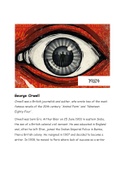
Winston Smith is a low-ranking member of the ruling Party in London, in the nation
of Oceania. Everywhere Winston goes, even his own home, the Party watches him
through telescreens; everywhere he looks he sees the face of the Party’s
seemingly omniscient leader, a figure known only as Big Brother. The Party controls
everything in Oceania, even the people’s history and language. Currently, the Party
is forcing the implementation of an invented language called Newspeak, which
attempts to prevent political rebellion by eliminating all words related to it. Even
thinking rebellious thoughts is illegal. Such thoughtcrime is, in fact, the worst of
all crimes.
As the novel opens, Winston feels frustrated by the oppression and rigid control
of the Party, which prohibits free thought, sex, and any expression of individuality.
Winston dislikes the party and has illegally purchased a diary in which to write his
criminal thoughts. He has also become fixated on a powerful Party member named
O’Brien, whom Winston believes is a secret member of the Brotherhood—the
mysterious, legendary group that works to overthrow the Party.
Winston works in the Ministry of Truth, where he alters historical records to fit
the needs of the Party. He notices a coworker, a beautiful dark-haired girl, staring
at him, and worries that she is an informant who will turn him in for his
thoughtcrime. He is troubled by the Party’s control of history: the Party claims
that Oceania has always been allied with Eastasia in a war against Eurasia, but
Winston seems to recall a time when this was not true. The Party also claims that
Emmanuel Goldstein, the alleged leader of the Brotherhood, is the most dangerous
man alive, but this does not seem plausible to Winston. Winston spends his evenings
wandering through the poorest neighborhoods in London, where the proletarians, or
proles, live squalid lives, relatively free of Party monitoring.
One day, Winston receives a note from the dark-haired girl that reads “I love you.”
She tells him her name, Julia, and they begin a covert affair, always on the lookout
for signs of Party monitoring. Eventually they rent a room above the secondhand
store in the prole district where Winston bought the diary. This relationship lasts
Orwell was a British journalist and author, who wrote two of the most
famous novels of the 20th century 'Animal Farm' and 'Nineteen
Eighty-Four'.
Orwell was born Eric Arthur Blair on 25 June 1903 in eastern India,
the son of a British colonial civil servant. He was educated in England
and, after he left Eton, joined the Indian Imperial Police in Burma,
then a British colony. He resigned in 1927 and decided to become a
writer. In 1928, he moved to Paris where lack of success as a writer
,forced him into a series of menial jobs. He described his experiences in
his first book, 'Down and Out in Paris and London', published in 1933.
He took the name George Orwell, shortly before its publication. This
was followed by his first novel, 'Burmese Days', in 1934.
An anarchist in the late 1920s, by the 1930s he had begun to consider
himself a socialist. In 1936, he was commissioned to write an account
of poverty among unemployed miners in northern England, which
resulted in 'The Road to Wigan Pier' (1937). Late in 1936, Orwell
travelled to Spain to fight for the Republicans against Franco's
Nationalists. He was forced to flee in fear of his life from
Soviet-backed communists who were suppressing revolutionary socialist
dissenters. The experience turned him into a lifelong anti-Stalinist.
Between 1941 and 1943, Orwell worked on propaganda for the BBC. In
1943, he became literary editor of the Tribune, a weekly left-wing
magazine. By now he was a prolific journalist, writing articles, reviews
and books.
In 1945, Orwell's 'Animal Farm' was published. A political fable set in a
farmyard but based on Stalin's betrayal of the Russian Revolution, it
made Orwell's name and ensured he was financially comfortable for the
first time in his life. 'Nineteen Eighty-Four' was published four years
later. Set in an imaginary totalitarian future, the book made a deep
impression, with its title and many phrases - such as 'Big Brother is
watching you', 'newspeak' and 'doublethink' - entering popular use. By
, now Orwell's health was deteriorating and he died of tuberculosis on 21
January 1950.
Plot Overview
Winston Smith is a low-ranking member of the ruling Party in London, in the nation
of Oceania. Everywhere Winston goes, even his own home, the Party watches him
through telescreens; everywhere he looks he sees the face of the Party’s
seemingly omniscient leader, a figure known only as Big Brother. The Party controls
everything in Oceania, even the people’s history and language. Currently, the Party
is forcing the implementation of an invented language called Newspeak, which
attempts to prevent political rebellion by eliminating all words related to it. Even
thinking rebellious thoughts is illegal. Such thoughtcrime is, in fact, the worst of
all crimes.
As the novel opens, Winston feels frustrated by the oppression and rigid control
of the Party, which prohibits free thought, sex, and any expression of individuality.
Winston dislikes the party and has illegally purchased a diary in which to write his
criminal thoughts. He has also become fixated on a powerful Party member named
O’Brien, whom Winston believes is a secret member of the Brotherhood—the
mysterious, legendary group that works to overthrow the Party.
Winston works in the Ministry of Truth, where he alters historical records to fit
the needs of the Party. He notices a coworker, a beautiful dark-haired girl, staring
at him, and worries that she is an informant who will turn him in for his
thoughtcrime. He is troubled by the Party’s control of history: the Party claims
that Oceania has always been allied with Eastasia in a war against Eurasia, but
Winston seems to recall a time when this was not true. The Party also claims that
Emmanuel Goldstein, the alleged leader of the Brotherhood, is the most dangerous
man alive, but this does not seem plausible to Winston. Winston spends his evenings
wandering through the poorest neighborhoods in London, where the proletarians, or
proles, live squalid lives, relatively free of Party monitoring.
One day, Winston receives a note from the dark-haired girl that reads “I love you.”
She tells him her name, Julia, and they begin a covert affair, always on the lookout
for signs of Party monitoring. Eventually they rent a room above the secondhand
store in the prole district where Winston bought the diary. This relationship lasts