Physiology notes
Lymphoid tissue is a defence mechanism. 80% of our lymphocytes are in the small intestine:
‘gut-associated lymphoid tissue’ (GALT).
Chyme = digestive product, already in stomach when food enters. Chyme is released bit by
bit into the small intestine.
Fundus = thin layered part, causes the dilation of stomach mostly.
The further we get in the stomach more muscles in stomach wall.
Epithelial cells aligned with the gastric glands produce a lot of enzymes, acid, hormones.
Surface of the stomach is covered with a mucus layer (salty, for protection)
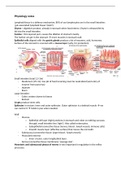
Small intestine (total 2,5-3m)
- Duodenum (25 cm): low pH of food incoming must be neutralized (and entry of
enzyme from pancreas)
- Jejunum
- Ileum
Large intestine:
- Colon: watery chyme to faeces
- Rectum
Crypts produce stem cells.
Sphincter in rectum: inner and outer sphincter. Outer sphincter is a skeletal muscle we
can control it holds in poo when needed.
Wall
- Mucosa
o Epithelial cell layer (tight junctions in stomach and colon so nothing can pass
through, small intestine less ‘tight’). Also called enterocytes.
o Subepithelial connective tissue (nerves, blood-, lymph vessels, immune cells)
o Smooth muscle layer (effective surface) that moves the microvilli.
- Submucosa (connective tissue: larger blood-, lymph vessels)
- Muscularis externa
o Inner circular, outer longitudinal layer.
- Serosa (connective tissue membrane) ‘sausage skin’.
Myenteric and submucosal plexus of nerves is very important in regulation in the reflex
processes.
, Motility (= beweeglijkheid)
- Spontaneous reactions
o Tonic = sustained contraction of different groups of fibres within a muscle to
maintain continual muscular tension.
o Phasic = waves of contraction.
When slow wave potentials reach threshold muscle contraction. Force and duration of
muscle contraction are directly related to the amplitude and frequency of action potentials.
Interstitial cells of Cajal: pacemaker cells. When eating, frequency gets higher.
3 waves/min stomach wall, 12 waves/min duodenum.
Peristaltic & segmental contraction
Migrating motor complex (MMC) series of contractions that begin in the empty stomach and end in the large
intestine. MMC is regulated by the hormone motilin. This wave takes 1,5-2 hrs.
Long and short reflexes:
- Sight/smell of food integrate in the CNS neurons of myenteric and submucosal plexuses
smooth muscles/endocrine cells, pancreas, intestine enzymes release, pancreatic secretions etc.
- Local stimuli by presence of food enteric NS same effect. Or: cause hunger/satiety
Long neural reflexes modulate ENS
- CNS
o Feedforward (cephalic: see, smell and emotional: diarrhea/stress-constipation)
- ANS
o Parasympathetic (stimulates)
o Sympathetic (inhibits)
Short reflexes
- Little brain = ENS in gut: local
o Motility and secretion (ENS: from sensory detection to neuronal response)
Reflexes with aid of GI-hormones (gastro-intestinal hormone)
- Peptides acting like hormones or paracrine signals
o Stimulate/inhibit motility and secretion
o Some GI peptides act on the brain
o (CCK (satiety); Ghrelin (hunger)
ENS has a diffusion barrier in gut capillaries like the blood-brain barrier. They have intrinsic neurons like
interneurons in the brain.
Gut hormones
Gastrin in stomach, produced in G cells. Stimulates formation of gastric acid by parietal and ECL cells.
ECL cells also produce histamine. Somatostatin inhibits the release of gastrin.
In intestine:
- Cholecystokinin (CCK) release stimulated by FFA’s and some AA’s. CCK stimulates the gallbladder to
contract, pancreas, and stomach to release enzymes. Also acts as a satiety factor and inhibits gastric
emptying.
- Secretin (nature’s antacid = neutralizing acid) release stimulated by acid in small intestine. Primary
target: pancreas and stomach. Stimulates HCO- release and inhibits gastric emptying.
- Motilin stimulates MMC, inhibited by eating a meal.
Lymphoid tissue is a defence mechanism. 80% of our lymphocytes are in the small intestine:
‘gut-associated lymphoid tissue’ (GALT).
Chyme = digestive product, already in stomach when food enters. Chyme is released bit by
bit into the small intestine.
Fundus = thin layered part, causes the dilation of stomach mostly.
The further we get in the stomach more muscles in stomach wall.
Epithelial cells aligned with the gastric glands produce a lot of enzymes, acid, hormones.
Surface of the stomach is covered with a mucus layer (salty, for protection)
Small intestine (total 2,5-3m)
- Duodenum (25 cm): low pH of food incoming must be neutralized (and entry of
enzyme from pancreas)
- Jejunum
- Ileum
Large intestine:
- Colon: watery chyme to faeces
- Rectum
Crypts produce stem cells.
Sphincter in rectum: inner and outer sphincter. Outer sphincter is a skeletal muscle we
can control it holds in poo when needed.
Wall
- Mucosa
o Epithelial cell layer (tight junctions in stomach and colon so nothing can pass
through, small intestine less ‘tight’). Also called enterocytes.
o Subepithelial connective tissue (nerves, blood-, lymph vessels, immune cells)
o Smooth muscle layer (effective surface) that moves the microvilli.
- Submucosa (connective tissue: larger blood-, lymph vessels)
- Muscularis externa
o Inner circular, outer longitudinal layer.
- Serosa (connective tissue membrane) ‘sausage skin’.
Myenteric and submucosal plexus of nerves is very important in regulation in the reflex
processes.
, Motility (= beweeglijkheid)
- Spontaneous reactions
o Tonic = sustained contraction of different groups of fibres within a muscle to
maintain continual muscular tension.
o Phasic = waves of contraction.
When slow wave potentials reach threshold muscle contraction. Force and duration of
muscle contraction are directly related to the amplitude and frequency of action potentials.
Interstitial cells of Cajal: pacemaker cells. When eating, frequency gets higher.
3 waves/min stomach wall, 12 waves/min duodenum.
Peristaltic & segmental contraction
Migrating motor complex (MMC) series of contractions that begin in the empty stomach and end in the large
intestine. MMC is regulated by the hormone motilin. This wave takes 1,5-2 hrs.
Long and short reflexes:
- Sight/smell of food integrate in the CNS neurons of myenteric and submucosal plexuses
smooth muscles/endocrine cells, pancreas, intestine enzymes release, pancreatic secretions etc.
- Local stimuli by presence of food enteric NS same effect. Or: cause hunger/satiety
Long neural reflexes modulate ENS
- CNS
o Feedforward (cephalic: see, smell and emotional: diarrhea/stress-constipation)
- ANS
o Parasympathetic (stimulates)
o Sympathetic (inhibits)
Short reflexes
- Little brain = ENS in gut: local
o Motility and secretion (ENS: from sensory detection to neuronal response)
Reflexes with aid of GI-hormones (gastro-intestinal hormone)
- Peptides acting like hormones or paracrine signals
o Stimulate/inhibit motility and secretion
o Some GI peptides act on the brain
o (CCK (satiety); Ghrelin (hunger)
ENS has a diffusion barrier in gut capillaries like the blood-brain barrier. They have intrinsic neurons like
interneurons in the brain.
Gut hormones
Gastrin in stomach, produced in G cells. Stimulates formation of gastric acid by parietal and ECL cells.
ECL cells also produce histamine. Somatostatin inhibits the release of gastrin.
In intestine:
- Cholecystokinin (CCK) release stimulated by FFA’s and some AA’s. CCK stimulates the gallbladder to
contract, pancreas, and stomach to release enzymes. Also acts as a satiety factor and inhibits gastric
emptying.
- Secretin (nature’s antacid = neutralizing acid) release stimulated by acid in small intestine. Primary
target: pancreas and stomach. Stimulates HCO- release and inhibits gastric emptying.
- Motilin stimulates MMC, inhibited by eating a meal.