SECTION: Multi Store Memory Model
TOPIC: Memory
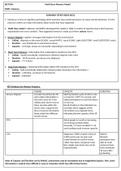
SUMMARY OF KEY IDEAS (K/U)
1. Memory is a form of cognitive psychology which examines how mental processes can cause certain behaviour. It is the
process in which we retain information about events that have happened.
2. Multi store model = Atkinson and Shiffrin developed this model in 1968, it consists of separate stores which process
sequentially from one to another. They suggested memory is made up of three unitary stores:
3. Sensory Register = gathers messages/information from the environment
Coding – depends on the sense (ECHOIC, sound HAPTIC, touch ICONIC, sight OLFACTORY, smell GUSTATORY, taste)
Duration – very limited due to spontaneous decay
Capacity – very high, senses are constantly responding to environment
4. Short Term Memory = information that is attended to transfers to the STM
Coding – mostly acoustically, maintenance rehearsal requires inner voice
Duration – 18-30 seconds, can decay or be displaced
Capacity – 7+/-2 items
5. Long Term Memory = rehearsed information within STM transfers to the LTM
Coding - Held semantically (elaborative rehearsal adds meaning to the information.)
Duration – unlimited, can decay or fail retrieval
Capacity - Unlimited
KEY Evidence for Memory Features.
CODING CAPACITY DURATION
Sensory Register Crowder found that the SR Sperling flashed a grid of letters onto
only retains information in a screen for 1/20th of a second, and
the iconic store for a few asked participants to recall the letters
milliseconds, but for two to of one row.
three seconds within the Recall of letters in the indicated row
echoic store, supports the was high, which suggests all the
idea of sensory information information was originally there,
being coded into different indicating that the capacity of the SR
sensory stores.
STM Asked people to recall an increasing
set of string numbers/letter.
Generally, 5-9 were recalled (7+/-2)
and chunking could increase capacity.
LTM Wagenaar (1986) created a diary of Bahrick
‘ 2,400 events over six years and Showed
tested himself on recall of events participant were
rather than dates, had great recall. able to recall
But a single case study may not be names to faces
representative. from yearbooks
50 years after
graduating.
Ideas of Capacity and Duration can be limited, assessments may be incomplete due to longitudinal aspects. Also, some
information is natural more difficult or easy to remember which may effect these factors.
TOPIC: Memory
SUMMARY OF KEY IDEAS (K/U)
1. Memory is a form of cognitive psychology which examines how mental processes can cause certain behaviour. It is the
process in which we retain information about events that have happened.
2. Multi store model = Atkinson and Shiffrin developed this model in 1968, it consists of separate stores which process
sequentially from one to another. They suggested memory is made up of three unitary stores:
3. Sensory Register = gathers messages/information from the environment
Coding – depends on the sense (ECHOIC, sound HAPTIC, touch ICONIC, sight OLFACTORY, smell GUSTATORY, taste)
Duration – very limited due to spontaneous decay
Capacity – very high, senses are constantly responding to environment
4. Short Term Memory = information that is attended to transfers to the STM
Coding – mostly acoustically, maintenance rehearsal requires inner voice
Duration – 18-30 seconds, can decay or be displaced
Capacity – 7+/-2 items
5. Long Term Memory = rehearsed information within STM transfers to the LTM
Coding - Held semantically (elaborative rehearsal adds meaning to the information.)
Duration – unlimited, can decay or fail retrieval
Capacity - Unlimited
KEY Evidence for Memory Features.
CODING CAPACITY DURATION
Sensory Register Crowder found that the SR Sperling flashed a grid of letters onto
only retains information in a screen for 1/20th of a second, and
the iconic store for a few asked participants to recall the letters
milliseconds, but for two to of one row.
three seconds within the Recall of letters in the indicated row
echoic store, supports the was high, which suggests all the
idea of sensory information information was originally there,
being coded into different indicating that the capacity of the SR
sensory stores.
STM Asked people to recall an increasing
set of string numbers/letter.
Generally, 5-9 were recalled (7+/-2)
and chunking could increase capacity.
LTM Wagenaar (1986) created a diary of Bahrick
‘ 2,400 events over six years and Showed
tested himself on recall of events participant were
rather than dates, had great recall. able to recall
But a single case study may not be names to faces
representative. from yearbooks
50 years after
graduating.
Ideas of Capacity and Duration can be limited, assessments may be incomplete due to longitudinal aspects. Also, some
information is natural more difficult or easy to remember which may effect these factors.