SECTION: Localisation of Functions
TOPIC: Biopsychology
KEY IDEAS (K/U)
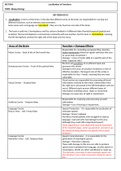
1. Localisation, in terms of the brain, is the idea that different areas of the brain are responsible for carrying out
different functions, such as memory and movement.
Some areas such as language are lateralised = they are only found on one side of the brain.
2. The brain is split into 2 hemispheres and the cortex is divided in 4 different lobes (frontal/temporal/parietal and
occipital.) The two hemispheres communicate constantly with one another, but the brain is contralateral, meaning
the left hemisphere controls the right side of the body and vice versa.
Area of the Brain Function + Damage Effects
Responsible for controlling and generating voluntary
Motor Cortex – Back of the of the frontal lobe motor movements (electrical signals stimulate this area
to cause body movement.)
Damage = a loss of motor skills to a specific part of the
body, (opposite side.)
Receives all sensations of an afferent input and
Somatosensory Cortex – Front of the parietal lobe processes the senses.
Damage to this area can produce numbness or lack of
effective receptors, the largest area of the cortex is
responsible for face + hands, meaning they are most
vulnerable.
Visual centres are responsible for processing all visual
Visual Centres – Occipital lobe information received by the retina. (Information from
the right eye is processed in the left hemisphere and vice
versa.) Different parts process different types of
information including colour, shape or movement.
Damage can cause loss of sight or impairment.
Responsible for analysing and processing acoustic
Auditory Centre – Temporal lobe information.
Damage = loss of hearing or impairment.
Language Centre: Speech Production – it is responsible for production of
Broca’s Area – Left, Frontal lobe articulate speech.
Damage = Broca’s Aphasia
Paul Broca found patients who struggled to express
language, read and write had damage to this area.
Although they could still comprehend speech.
Some argue Broca’s area deals with muscle movement
of the mouth/tongue, some say grammar, and some say
the verbal working memory (no specific link to exact
function.)
Language Centre: Speech Comprehension – it is responsible for the
Wernicke’s Area – Left, Temporal lobe generation of meaningful speech.
Damage = Wernicke’s Aphasia
Those with damage to this area are able to produce
speech that resembles their language, but the speech is
meaningless. Words are often substituted or made up.
‘The Wernicke’s area works to plan meaningful speech and
then the Broca’s area create movements needed to express
this.
TOPIC: Biopsychology
KEY IDEAS (K/U)
1. Localisation, in terms of the brain, is the idea that different areas of the brain are responsible for carrying out
different functions, such as memory and movement.
Some areas such as language are lateralised = they are only found on one side of the brain.
2. The brain is split into 2 hemispheres and the cortex is divided in 4 different lobes (frontal/temporal/parietal and
occipital.) The two hemispheres communicate constantly with one another, but the brain is contralateral, meaning
the left hemisphere controls the right side of the body and vice versa.
Area of the Brain Function + Damage Effects
Responsible for controlling and generating voluntary
Motor Cortex – Back of the of the frontal lobe motor movements (electrical signals stimulate this area
to cause body movement.)
Damage = a loss of motor skills to a specific part of the
body, (opposite side.)
Receives all sensations of an afferent input and
Somatosensory Cortex – Front of the parietal lobe processes the senses.
Damage to this area can produce numbness or lack of
effective receptors, the largest area of the cortex is
responsible for face + hands, meaning they are most
vulnerable.
Visual centres are responsible for processing all visual
Visual Centres – Occipital lobe information received by the retina. (Information from
the right eye is processed in the left hemisphere and vice
versa.) Different parts process different types of
information including colour, shape or movement.
Damage can cause loss of sight or impairment.
Responsible for analysing and processing acoustic
Auditory Centre – Temporal lobe information.
Damage = loss of hearing or impairment.
Language Centre: Speech Production – it is responsible for production of
Broca’s Area – Left, Frontal lobe articulate speech.
Damage = Broca’s Aphasia
Paul Broca found patients who struggled to express
language, read and write had damage to this area.
Although they could still comprehend speech.
Some argue Broca’s area deals with muscle movement
of the mouth/tongue, some say grammar, and some say
the verbal working memory (no specific link to exact
function.)
Language Centre: Speech Comprehension – it is responsible for the
Wernicke’s Area – Left, Temporal lobe generation of meaningful speech.
Damage = Wernicke’s Aphasia
Those with damage to this area are able to produce
speech that resembles their language, but the speech is
meaningless. Words are often substituted or made up.
‘The Wernicke’s area works to plan meaningful speech and
then the Broca’s area create movements needed to express
this.