SECTION: Hemispheric Lateralisation and Split-Brain Research
TOPIC: Biopsychology
KEY IDEAS (K/U)
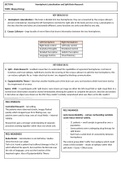
1. Hemispheric Lateralisation = the brain is divided into two hemispheres, they are connected by the corpus callosum
and are contralateral, meaning the left hemisphere controls the right side of the body and vice versa. Lateralisation is
the idea that the two halves are functionally different, some functions are only controlled by one side.
2. Corpus Callosum = large bundle of nerve fibres that shares information between the two hemispheres.
Left Hemisphere Right Hemisphere
Right body control Left body control
Analytical thoughts Emotional Control
Detailed Perception Holistic Perception
Language Centres Visual Memory
RELEVENT EVIDENCE KEY IDEAS (K/U)
3. Split – Brain Research = enabled researchers to understand the capabilities of separated hemispheres, test lateral
functions and treat epilepsy. Split Brains involve the severing of the corpus callosum to split the two hemispheres, this
can reduce epileptic fits as ‘major electrical storms’ are stopped by blocking communication.
4. Equipotentiality Theory = idea that another healthy part of the brain can carry out functions which have been lost by
the impairment of an area.
Sperry 1968 – 11 participants with ‘split brains’ were shown an image on either the left visual field or right visual field. In a
normal brain information would be shared immediately allowing the patient to complete the picture, describe and analyse
it. But when an object was shown on the RVF they couldn’t verbally comprehend what was there as the RH couldn’t
communicate with the LH language centres but they could draw/pick up a similar object with their left hand. When shown
PEEL STRENGTH
Controlled Research – lab setting
The patients were observed closely, images flashed PEEL WEAKNESS
quickly which stopped eyes from flicking over, eye
patches were used to stop cross of visual fields. = Internal Lacks Generalisability – various confounding variables
Validity could reduce internal validity.
Researchers gain a stronger understanding of separate - 11 patients = small sample to generalise over a
processes working together rather than one whole unit. population.
- Some patients were undergoing drug therapy for
split brains
PEEL WEAKENESS - Each had a varied level of connectivity between
hemispheres
Reductionist – lateralisation is not definitive. Studies
show the brain can adapt. The control group didn’t suffer from epilepsy which could
Turk et al. found a patient had suffered damage in the LH create a third variable – results of epilepsy rather than
which affected his speech, but overtime his RH took over split brain = Cause + Effect Issues
the role of language, carry out the function of the
impaired region. Idea of Equipotentiality Theory.
TOPIC: Biopsychology
KEY IDEAS (K/U)
1. Hemispheric Lateralisation = the brain is divided into two hemispheres, they are connected by the corpus callosum
and are contralateral, meaning the left hemisphere controls the right side of the body and vice versa. Lateralisation is
the idea that the two halves are functionally different, some functions are only controlled by one side.
2. Corpus Callosum = large bundle of nerve fibres that shares information between the two hemispheres.
Left Hemisphere Right Hemisphere
Right body control Left body control
Analytical thoughts Emotional Control
Detailed Perception Holistic Perception
Language Centres Visual Memory
RELEVENT EVIDENCE KEY IDEAS (K/U)
3. Split – Brain Research = enabled researchers to understand the capabilities of separated hemispheres, test lateral
functions and treat epilepsy. Split Brains involve the severing of the corpus callosum to split the two hemispheres, this
can reduce epileptic fits as ‘major electrical storms’ are stopped by blocking communication.
4. Equipotentiality Theory = idea that another healthy part of the brain can carry out functions which have been lost by
the impairment of an area.
Sperry 1968 – 11 participants with ‘split brains’ were shown an image on either the left visual field or right visual field. In a
normal brain information would be shared immediately allowing the patient to complete the picture, describe and analyse
it. But when an object was shown on the RVF they couldn’t verbally comprehend what was there as the RH couldn’t
communicate with the LH language centres but they could draw/pick up a similar object with their left hand. When shown
PEEL STRENGTH
Controlled Research – lab setting
The patients were observed closely, images flashed PEEL WEAKNESS
quickly which stopped eyes from flicking over, eye
patches were used to stop cross of visual fields. = Internal Lacks Generalisability – various confounding variables
Validity could reduce internal validity.
Researchers gain a stronger understanding of separate - 11 patients = small sample to generalise over a
processes working together rather than one whole unit. population.
- Some patients were undergoing drug therapy for
split brains
PEEL WEAKENESS - Each had a varied level of connectivity between
hemispheres
Reductionist – lateralisation is not definitive. Studies
show the brain can adapt. The control group didn’t suffer from epilepsy which could
Turk et al. found a patient had suffered damage in the LH create a third variable – results of epilepsy rather than
which affected his speech, but overtime his RH took over split brain = Cause + Effect Issues
the role of language, carry out the function of the
impaired region. Idea of Equipotentiality Theory.