Neurotransmitter systems (H6)
Explain what the difference is between ionotropic and metabotropic neurotransmitter receptors and
you can explain their function.
Name the different classes of neurotransmitter and explain their main function in the brain.
Analyse the action of different drugs or poisons on the nervous system.
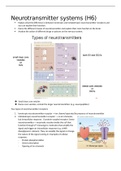
Small clear core vesicles
Dense core vesicles; contain the larger neurotransmitters (e.g. neuropeptides)
Two types of neurotransmitter receptors
1. Ionotropic neurotransmitter receptor -> ion channel operated by presence of neurotransmitter
2. Metabotropic neurotransmitter receptor -> no ion channels,
but intracellular response. G-protein-coupled receptor. Sense
neurotransmitter -> enzymatic reaction inside the cell that
function through 2nd messengers; molecules that amplify the
signal and trigger an intracellular response (e.g. cAMP,
diacylglycerol, calcium). They can amplify the signal or change
the nature of the signal coming in. Examples of cellular
response:
- Protein phosphorylation
- Gene transcription
- Opening of ion channels
, Second messengers amplify the neurotransmitter
signal. Upon activation of receptor a handful of G-
proteins are activated (first amplification), these G-
proteins will activate enzyme (no amplification). This
enzyme will produce a lot of cAMP per enzyme
(amplification). cAMP binds to protein kinases (no
amplification), but this protein kinase can activate a
lot of other parts (use amplification of
neurotransmitter signal.
Metabotropic receptors initiate multiple cascades
simultaneously e.g. NGF dimer activation TrkA.
Metabotropic receptors are often longer lived then
the changes evoked by ionotropic receptors.
Acetylcholine -> released by neuromuscular junction (neuron is activation a skeletal muscle). Postsynapse is
also other shaped then in other junctions, it has a waves shape, cause then a lot of receptors can be on the
post-synapse. Acetylcholine has many functions
Most known for contraction of skeletal muscle cells.
In the heart muscle cells, acetylcholine relaxes the smooth muscle cells -> decreased rate and force
of contraction.
In salivary gland cell then you evoke a release response of saliva (secretion).
Acetylcholine is synthesized out of choline and acetyl-coA (Kreb cycle
mitochondria) (acetylcholine is very easy to make), and locally
concentrated in vesicles by VAChT. VAChT, transports one acetylcholine
into cell and 2 H+ out of cell. Proton gradient is used to selectively recruit
acetylcholine into the vesicles and concentrate it there.
Action potential reaches synapse -> opens the voltage gated calcium
channels, so calcium flows in, will recognise synaptotagmin and the
docked (and primed) vesicles will fuse with plasma membrane. So
acetylcholine is released in the cleft.
The signal is terminated by acetylcholine breakdown by acetylcholinesterase. Recycling membrane and
neurotransmitters. Choline is recycled back into the pre-synapse. Acetylcholine breakdown is essential to
have effective neurotransmission. AChE blockers used as poison. AChE blocker -> acetylcholine longer
present in cleft -> longer activate post-synapse -> paralysis.
Nicotinic acetylcholine receptor
(ionotropic) => ion pore. 5 subunits.
Acetylcholine binds receptor ->
conformational change that allows flow of
specific ions. Typically sodium into cell
which leads to depolarization of
membrane. Changes subunits of receptor
you also change aspects of receptor e.g.
Explain what the difference is between ionotropic and metabotropic neurotransmitter receptors and
you can explain their function.
Name the different classes of neurotransmitter and explain their main function in the brain.
Analyse the action of different drugs or poisons on the nervous system.
Small clear core vesicles
Dense core vesicles; contain the larger neurotransmitters (e.g. neuropeptides)
Two types of neurotransmitter receptors
1. Ionotropic neurotransmitter receptor -> ion channel operated by presence of neurotransmitter
2. Metabotropic neurotransmitter receptor -> no ion channels,
but intracellular response. G-protein-coupled receptor. Sense
neurotransmitter -> enzymatic reaction inside the cell that
function through 2nd messengers; molecules that amplify the
signal and trigger an intracellular response (e.g. cAMP,
diacylglycerol, calcium). They can amplify the signal or change
the nature of the signal coming in. Examples of cellular
response:
- Protein phosphorylation
- Gene transcription
- Opening of ion channels
, Second messengers amplify the neurotransmitter
signal. Upon activation of receptor a handful of G-
proteins are activated (first amplification), these G-
proteins will activate enzyme (no amplification). This
enzyme will produce a lot of cAMP per enzyme
(amplification). cAMP binds to protein kinases (no
amplification), but this protein kinase can activate a
lot of other parts (use amplification of
neurotransmitter signal.
Metabotropic receptors initiate multiple cascades
simultaneously e.g. NGF dimer activation TrkA.
Metabotropic receptors are often longer lived then
the changes evoked by ionotropic receptors.
Acetylcholine -> released by neuromuscular junction (neuron is activation a skeletal muscle). Postsynapse is
also other shaped then in other junctions, it has a waves shape, cause then a lot of receptors can be on the
post-synapse. Acetylcholine has many functions
Most known for contraction of skeletal muscle cells.
In the heart muscle cells, acetylcholine relaxes the smooth muscle cells -> decreased rate and force
of contraction.
In salivary gland cell then you evoke a release response of saliva (secretion).
Acetylcholine is synthesized out of choline and acetyl-coA (Kreb cycle
mitochondria) (acetylcholine is very easy to make), and locally
concentrated in vesicles by VAChT. VAChT, transports one acetylcholine
into cell and 2 H+ out of cell. Proton gradient is used to selectively recruit
acetylcholine into the vesicles and concentrate it there.
Action potential reaches synapse -> opens the voltage gated calcium
channels, so calcium flows in, will recognise synaptotagmin and the
docked (and primed) vesicles will fuse with plasma membrane. So
acetylcholine is released in the cleft.
The signal is terminated by acetylcholine breakdown by acetylcholinesterase. Recycling membrane and
neurotransmitters. Choline is recycled back into the pre-synapse. Acetylcholine breakdown is essential to
have effective neurotransmission. AChE blockers used as poison. AChE blocker -> acetylcholine longer
present in cleft -> longer activate post-synapse -> paralysis.
Nicotinic acetylcholine receptor
(ionotropic) => ion pore. 5 subunits.
Acetylcholine binds receptor ->
conformational change that allows flow of
specific ions. Typically sodium into cell
which leads to depolarization of
membrane. Changes subunits of receptor
you also change aspects of receptor e.g.