

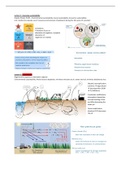
Lecture 1: Assessing sustainability
People, Planet, Profit – Environmental sustainability, Social sustainability, Economic sustainability
LCA: method to evaluate use of resources and emission of pollutants during the life cycles of a product
Limitations:
4 freedoms focus on
alleviation of negatives, complete
alleviation of
negatives not realistic
Lecture 2: Environment
Regenerative capacity vs absorptive capacity
Environmental sustainability: Avoid resource depletion, minimize emissions to air, water and soil, minimize biodiversity loss
(Aquatic) eutrophication:
nutrients → algae bloom
→ decomposition DOM
→ O2 deficiency
Freshwater acidification:
atmospheric deposition
and soil leaching of Sox
and NOx decreasing the
water pH
Ocean acidification:
dissolved CO2 decreases
the pH
, ➔ Material flow analysis: Nutrient-balance
approach, LCA, ecological footprint, water footprint,
carbon footprint, energy and emergy analysis
Ecological footprint: biologically productive area
required to produce all inputs and absorbs all
waste
People, Planet, Profit – Environmental sustainability, Social sustainability, Economic sustainability
LCA: method to evaluate use of resources and emission of pollutants during the life cycles of a product
Limitations:
4 freedoms focus on
alleviation of negatives, complete
alleviation of
negatives not realistic
Lecture 2: Environment
Regenerative capacity vs absorptive capacity
Environmental sustainability: Avoid resource depletion, minimize emissions to air, water and soil, minimize biodiversity loss
(Aquatic) eutrophication:
nutrients → algae bloom
→ decomposition DOM
→ O2 deficiency
Freshwater acidification:
atmospheric deposition
and soil leaching of Sox
and NOx decreasing the
water pH
Ocean acidification:
dissolved CO2 decreases
the pH
, ➔ Material flow analysis: Nutrient-balance
approach, LCA, ecological footprint, water footprint,
carbon footprint, energy and emergy analysis
Ecological footprint: biologically productive area
required to produce all inputs and absorbs all
waste


