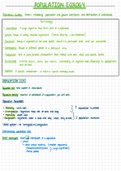
POPULATION ECOLOGY
Population Ecology Factors
influencing population size, rate / forms and distributions of individuals
:
growth .
Terminology
forms part of
Individual A
single organism that population
° :
a .
•
species Group
: of closely related
organisms ( fertile offspring i. can interbreed )
°
Population Group:
of
organisms of the same species found in a particular area and can crossbreed .
°
Community Groups :
of different species in a particular area .
0
Ecosystem : Unit of plant / animal communities that interact with each other and abiotic factors .
0
Environment :
External factors , biotic and abiotic , surrounding an
organism and influencing it 's development
and survival .
0
Habitat :
A specific environment in which a species normally occurs .
POPULATION SIZE
Population size : total number of individuals
Population density : number of individuals of a population per unit area .
Population Parameters
>
>
Nativity :
Immigration Organisms
birth rate
: move into an area and stay
} T population numbers
Mortality death rate
} d population
> :
>
Emigration organisms : leave a area and stay where they arrived .
numbers
closed system =
no
immigration / emigration
Determining population sizes
Direct techniques :
-
Count all individuals of a
population
=
census
> -
direct contact counting ( smaller organisms)
Helicopter/ vehicle / plane ( larger organisms)
}
-
Aerial photos
'
, Indirect techniques : count
only part of population → SAMPLE
'
Mark recapture
-
technique Peterson method
Total number of 1st sample
^ "
>
total number of 2 sample
Specific demarcated
-
area
P = M ✗5
Individuals caught Sample
1st
-
=
-
Released i. mix with population estimated size
'
t >
marked individuals in 2
"
sample
"
Individuals
caught 2 sample
-
=
More accurate (get average population size)
→
=
repeated more of
VALID IF :
°
Marking methods don't injure / damage organism
°
Marks clearly visible
Marking method doesn't affect
organism's movement / behaviour
°
time for marked
Enough organisms to mix with rest of population
°
.
°
Closed population
°
Brief period between samplings
=
no births / deaths .
2
Quadrats
'
→
Square frame =
1m
-
Area demarcated
Frame placed there number of individuals per unit area
-
-
Repeated in different areas of demarcated area .
Average calculated
-
Population size =
average no of
. individuals ✗
Surface area of area
surface area of
per quadrant quadrant
Reliability depends :
Exact number of
organisms in quad rat is known
°
°
Surface area of quadrant is known
°
Surface area of demarcated area is known
°
Quadrant placed randomly .
* Quad rat =
any shape
d
Size depends on
organism
Population Ecology Factors
influencing population size, rate / forms and distributions of individuals
:
growth .
Terminology
forms part of
Individual A
single organism that population
° :
a .
•
species Group
: of closely related
organisms ( fertile offspring i. can interbreed )
°
Population Group:
of
organisms of the same species found in a particular area and can crossbreed .
°
Community Groups :
of different species in a particular area .
0
Ecosystem : Unit of plant / animal communities that interact with each other and abiotic factors .
0
Environment :
External factors , biotic and abiotic , surrounding an
organism and influencing it 's development
and survival .
0
Habitat :
A specific environment in which a species normally occurs .
POPULATION SIZE
Population size : total number of individuals
Population density : number of individuals of a population per unit area .
Population Parameters
>
>
Nativity :
Immigration Organisms
birth rate
: move into an area and stay
} T population numbers
Mortality death rate
} d population
> :
>
Emigration organisms : leave a area and stay where they arrived .
numbers
closed system =
no
immigration / emigration
Determining population sizes
Direct techniques :
-
Count all individuals of a
population
=
census
> -
direct contact counting ( smaller organisms)
Helicopter/ vehicle / plane ( larger organisms)
}
-
Aerial photos
'
, Indirect techniques : count
only part of population → SAMPLE
'
Mark recapture
-
technique Peterson method
Total number of 1st sample
^ "
>
total number of 2 sample
Specific demarcated
-
area
P = M ✗5
Individuals caught Sample
1st
-
=
-
Released i. mix with population estimated size
'
t >
marked individuals in 2
"
sample
"
Individuals
caught 2 sample
-
=
More accurate (get average population size)
→
=
repeated more of
VALID IF :
°
Marking methods don't injure / damage organism
°
Marks clearly visible
Marking method doesn't affect
organism's movement / behaviour
°
time for marked
Enough organisms to mix with rest of population
°
.
°
Closed population
°
Brief period between samplings
=
no births / deaths .
2
Quadrats
'
→
Square frame =
1m
-
Area demarcated
Frame placed there number of individuals per unit area
-
-
Repeated in different areas of demarcated area .
Average calculated
-
Population size =
average no of
. individuals ✗
Surface area of area
surface area of
per quadrant quadrant
Reliability depends :
Exact number of
organisms in quad rat is known
°
°
Surface area of quadrant is known
°
Surface area of demarcated area is known
°
Quadrant placed randomly .
* Quad rat =
any shape
d
Size depends on
organism