

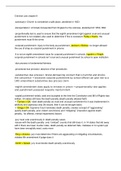
Criminal Law chapter 8
-sanctuary= Church is considered a safe place, abolished in 1623
-transportation= criminals transported from England to the colonies, abolished b/t 1853-1864
-proportionality test is used to ensure that the eighth amendment right against cruel and unusual
punishment is not violated; also used to determine if fine is excessive Pulley v Harris: the
punishment must fit the crime
-corporal punishment= injury to the body as punishment, Jackson v Bishop: no longer allowed
the use of strap as corporal punishment in prisons
-it is not an eighth amendment issue for corporal punishment in schools, Ingrahm v Wright:
corporal punishment in schools isn’t cruel and unusual punishment bc school is open institution
-due process is fundamental fairness
-procedural due process= absence of fair procedures
-substantive due process= brutal,demeaning conduct that is harmful and shocks
the conscience → excessive corporal punishment by school official can give rise to a
14th amendment substantive due process claim
-eighth amendment does apply to inmates in prison → proportionality test applies
and punishment possesed requisite mental intent
-capital punishment widely used and accepted at the time the Constitution and Bill of Rights was
written; 34 states still have the death penalty (death penalty allowed fed’l)
→ Furman v GA: ruled death penalty as cruel and unusual ounishment bc it was implemented in
arbitrary and capricious way (fix issues, then it can be brought back)
→ Gregg v GA: Supreme Court reinstates death penalty; creates concept of “aggravating”
(justify death penalty, prior violent convictions) and “mitigating” (impostion against death
penalty, 1st offense, mental impairment) factors
-jury must vote unanimously in death penalty cases
-issues with the death penalty: only “civilized” country that still does it, in 14 states that did away
with it there are lower murder rates, death penalty as deterrant fails, mistakes in CJ system ppl
have been wrongfully exed, costs more
-Ring v Arizona: jury must determine if there are aggravating or mitigating circumstances,
violates 6th amendment if judge does it
-Smith v Spisak: jury must decide death penalty unanimously
-sanctuary= Church is considered a safe place, abolished in 1623
-transportation= criminals transported from England to the colonies, abolished b/t 1853-1864
-proportionality test is used to ensure that the eighth amendment right against cruel and unusual
punishment is not violated; also used to determine if fine is excessive Pulley v Harris: the
punishment must fit the crime
-corporal punishment= injury to the body as punishment, Jackson v Bishop: no longer allowed
the use of strap as corporal punishment in prisons
-it is not an eighth amendment issue for corporal punishment in schools, Ingrahm v Wright:
corporal punishment in schools isn’t cruel and unusual punishment bc school is open institution
-due process is fundamental fairness
-procedural due process= absence of fair procedures
-substantive due process= brutal,demeaning conduct that is harmful and shocks
the conscience → excessive corporal punishment by school official can give rise to a
14th amendment substantive due process claim
-eighth amendment does apply to inmates in prison → proportionality test applies
and punishment possesed requisite mental intent
-capital punishment widely used and accepted at the time the Constitution and Bill of Rights was
written; 34 states still have the death penalty (death penalty allowed fed’l)
→ Furman v GA: ruled death penalty as cruel and unusual ounishment bc it was implemented in
arbitrary and capricious way (fix issues, then it can be brought back)
→ Gregg v GA: Supreme Court reinstates death penalty; creates concept of “aggravating”
(justify death penalty, prior violent convictions) and “mitigating” (impostion against death
penalty, 1st offense, mental impairment) factors
-jury must vote unanimously in death penalty cases
-issues with the death penalty: only “civilized” country that still does it, in 14 states that did away
with it there are lower murder rates, death penalty as deterrant fails, mistakes in CJ system ppl
have been wrongfully exed, costs more
-Ring v Arizona: jury must determine if there are aggravating or mitigating circumstances,
violates 6th amendment if judge does it
-Smith v Spisak: jury must decide death penalty unanimously


