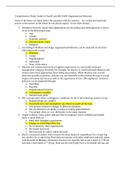
Comprehensive Study Guide to Final Exam BUS5450 Organizational Behavior (Distinction Level Test Bank. Has everything.)
Comprehensive Study Guide to Final Exam BUS5450 Organizational Behavior Some of the letters are listed below the questions with the answers… be careful and match the answer to the answer as the letters do not always match. It was older format… 1. Workforce diversity means that organizations are becoming more heterogeneous in terms of all of the following except a. Age b. Gender c. Domestic partners d. Socioeconomic status e. Religion 2. According to Robbins and Judge, organizational behavior can be analyzed on all of the following levels except a. Outcome b. Group c. Organizational d. Individual e. None of the above 3. Munwar and Jackson both work as logistics supervisors at a successful restaurant management company. Recently, the manager for District G retired and both Munwar and Jackson have been approached about filling the position. While Munwar was excited about the possible promotion, Jackson was not interested in the position because it would require relocation and travel as well as the supervision of over 200 employees. Jackson's behavior can be explained through a. Sociology b. Big data c. Organizational behavior d. Contingency variables e. Interpersonal skills 4. OB concepts must reflect contingency conditions for all of the following reasons except a. Human beings are complex b. Our predictions and assumptions are almost accurate all the time c. One person's behavior changes in different situations d. We are limited in our ability to make sweeping generalizations e. Two people often act very differently in the same situation 5. Ample evidence exists which indicates that an employee who is satisfied and treated fairly is more likely to a. Meet their managers expectations b. Engage in citizenship behaviors c. Be recruited by other organizations d. Be named team lead e. Become used by others within the team 6. Raul is a financial analyst who oversees the daily financial expenditures for a major big box retailer. On a typical day, Raul does not interact with other employees and only meets with his team on Monday afternoons; however, he typically has to run a report at 7:30 am and then a final report at 7:30 pm. Raul and his wife Emily have a six-month-old son andEmily will soon be returning to work thus requiring the couple to engage childcare. To enhance Raul's well-being at work, his manager could a. Reassign Raul to a position which requires less time b. Allow Raul to completely work from home c. Allow Raul to work from home four days a week d. Fire Raul e. None of these ideas would enhance Raul's well-being 7. Organizational behavior is constructed from all of the following disciplines except a. Physics b. Psychology c. Anthropology d. Sociology e. Social psychology 8. Which behavioral science discipline is most focused on understanding individual behavior? a. Sociology b. Social psychology c. Psychology d. Anthropology e. Organizational behavior 9. On average, managers spend the least amount of time doing which managerial activity? a. Traditional management b. Communication c. Human resource management d. Networking e. Systems 10. The purpose of organizational behavior is to a. Better understand management b. Improve an organization's effectiveness c. Balance diversity d. Create boilerplates e. Replace human resources 11. Variations in the economy, longevity, and birth rates are all forces which affect a. Organizations b. Socioeconomic conditions c. OB studies d. The workforce e. Networking conditions 12. ________ is a measure of how organizations are becoming more heterogeneous in terms of gender, race, and ethnicity. a. Globalization b. Workforce diversity c. Affirmative action d. Organizational culture e. Operational homogeneity 13. Which of the following is not an action characteristic of an organization in flux?a. Replacing temporary workers with permanent ones b. Reorganizing divisions c. Downsizing operations d. Subcontracting noncritical services and operations to other organizations e. Selling off poorly performing divisions 14. Which of the following is not a topic or concern related to OB? a. Turnover b. Leader behavior c. Productivity d. Management e. Family behavior 15. According to Luthans, if you want to be an effective manager, your time would be best spent on which managerial activity? a. Traditional management b. Communication c. Human resource management d. Networking e. Systems 16. Betty believes that it is best to take the casual or common sense approach to reading others. She needs to remember that a. The casual approach is nonsensical, and should be avoided as much as possible b. The systematic approach and the casual approach are one and the same c. Laboratory experiments on human behavior often result in unreliable findings d. The casual or common sense approach to reading others can often lead to erroneous predictions e. Behavior is unpredictable, hence there is no accurate way to analyze it 17. Martha claims that she has been assigned marginal job roles or light workloads that do not lead to promotion. Which of the following terms accurately explains the type of discrimination she has been subjected to? a. Intimidation b. Sexual harassment c. Exclusion d. Inclusion e. Insult 18. Which of the following is not a consequence of discrimination for employers? a. Reduced productivity b. Workplace diversity c. Citizenship behavior d. Negative conflicts e. Increased turnover 19. ________ can be defined as actions taken by representatives of the organization that deny equal opportunity to perform or unequal rewards for performance. a. Intimidation b. Exclusive practices c. Sexual harassment d. Discriminatory policies or practicese. Inclusive practices 20. Which of the following is not a component of comprehensive workforce programs encouraging diversity? a. Encouraging their employees to learn foreign languages and culture to promote and attract a diverse workforce b. Encouraging fair treatment of all people regardless of their demographic characteristics c. Fostering personal development practices that bring out the skills and abilities of all workers d. Teaching managers about the legal framework for equal employment opportunity e. Teaching managers how a diverse workforce will be better able to serve a diverse market of customers and clients 21. Although diversity does present many opportunities for organizations, effective diversity management means also working to eliminate a. Surface-level diversity b. Unfair discrimination c. Ethnic diversity d. Irrelevant biographical characteristics e. Discrepancies in employee performance 22. ________ is defined as the biological heritage people use to identify themselves. a. Race b. Diversity c. Culture d. Civilization e. Ethnography 23. While initial meetings may depend on surface-level diversity in making attempts to understand other individuals, studies show that after time ________ and ________ become more important to understanding the other individual. a. Stereotypes; assumptions b. Assumptions; judgments c. Values; personality d. Age; wisdom e. Gender; age 24. Research shows which form of discrimination can result in the highest levels of psychological stress? a. Intimidation b. Exclusive practices c. Sexual harassment d. Mockery e. Age discrimination 25. What refers to a positive feeling about a job, resulting from an evaluation of its characteristics? a. Job satisfaction b. Job involvement c. Job stability d. Organizational commitmente. Social investment 26. Why should managers be interested in their employees' attitudes? a. They result from behavior b. They cause problems c. They give warnings of potential problems d. They are generally low e. They result in cognitive dissonance 27. Employees' beliefs in the degree to which they influence their work environment, their competence, the meaningfulness of their job, and their perceived autonomy is termed as a. Psychological empowerment b. Organizational commitment c. Perceived organizational support d. Employee engagement e. Job satisfaction 28. How can the gaps between what managers think employees feel and what employees really feel be reduced? a. Conducting regular surveys b. Enforcing administrative policies c. Improving workplace conditions d. Providing incentives e. Training employees 29. Which of the following is not an example of organizational citizenship behavior? a. Telling your friends about the company's great work environment b. Contributing to a fund for a coworker to help with medical bills c. Discouraging a friend from applying for a job at the company d. Working over the weekend to make sure a project gets done e. Volunteering to help a colleague meet a deadline 30. Any incompatibility between two or more attitudes or between behavior and attitudes results in a. Organizational dissonance b. Cognitive dissonance c. Attitudinal clarification d. Values clarification e. Affective reactance 31. "Dissonance" means a. Reactance b. Constancy c. Resistance d. Consistency e. Inconsistency 32. In the context of employee engagement, it is observed that the highly engaged employees feel a deep connection to their company. Disengaged employees a. Feel disconnected, portraying deviant behavior at the workplace b. Put in efforts to be as good as engaged employeesc. Continue working without affecting the turnover d. Put time but no attention into their work e. Engage in productive activities to prove their worth 33. A major concern with the use of the MBTI is that it a. Has a high error rate b. Is easily manipulated through identity management c. Forces individuals into one category or another d. Is more favorable toward those in individualistic cultures e. Permits employers to racially discriminate against applicants 34. Which of the following terms describes basic convictions that "a specific mode of conduct or end-state of existence is personally or socially preferable to an opposite mode of conduct?" a. Values b. Attitudes c. Affects d. Customs e. Traditions 35. According to the Hofstede's framework, ________ indicates the degree to which people in a country prefer structured to unstructured situations. a. Collectivism b. Power distance c. Long-term orientation d. Uncertainty avoidance e. Individualism 36. Which of the following Big Five traits is most strongly related to life satisfaction, job satisfaction, and low stress levels? a. Emotional stability b. Extraversion c. Openness to experience d. Agreeableness e. Conscientiousness 37. The Myers-Briggs Type Indicator classifies people in all of the following categories except a. Extraverted/introverted b. Sensing/intuitive c. Perceiving/judging d. Independent/dependent e. Thinking/feeling 38. The "Big Five" personality traits include all but which of the following? a. Conscientiousness b. Self-confidence c. Extraversion d. Openness to experiencee. Agreeableness 39. Which dimension of the Big Five model is a measure of reliability? a. Extraversion b. Agreeableness c. Conscientiousness d. Openness to experience e. Emotional stability 40. According to the Big Five model, a highly conscientious person is most likely to be a. Gregarious, assertive, and sociable b. Nervous, anxious, depressed, and insecure c. Creative, curious, and artistically sensitive d. Responsible, organized, dependable, and persistent e. Reserved, timid, and quiet 41. According to the Myers-Briggs Type Indicator (MBTI) classification, people belonging to the "intuitive" type a. Are flexible and spontaneous b. Are outgoing, sociable, and assertive c. Rely on unconscious processes and look at the "big picture" d. Want control and prefer their world to be ordered and structured e. Rely on their personal values and emotions 42. ________ refers to an individual's belief that he or she is capable of performing a task. a. Emotional contagion b. Affect intensity c. Self-efficacy d. Cognitive dissonance e. Need for power 43. ________ involves translating the organization's overall objectives into specific objectives for each succeeding level in the organization. a. Strategic planning b. Management by objectives c. Representative participation d. Management buy-out e. Management by exception 44. According to the expectancy theory, which of the following relationships indicates the degree to which the individual believes that a particular level of output will lead to the attainment of a desired outcome? a. Performance-reward b. Effort-performance c. Rewards-personal goals d. Effort-satisfaction e. Performance-achievement 45. At its core, reinforcement theory contends that ________ condition(s) ________. a. Outcomes; motivation b. Motivation; self-fulfilling prophecy c. Self-fulfilling prophecy; reinforcement d. Reinforcement; behaviore. Behavior; outcomes 46. Which of the following statements is true regarding goals? a. Goal commitment is most likely to occur when the individual has an external locus of control b. Generalized goals produce a higher level of output as compared to specific goals c. People do better when they get feedback on how well they are progressing toward their goals d. If factors such as acceptance of the goals are held constant, the more simple the goal, the higher the level of performance e. Assigned goals appear to generate greater goal commitment in lower rather than higher power-distance cultures 47. According to the two-factor theory proposed by Herzberg, which of the following factors is considered a hygiene factor? a. Promotional opportunity b. Quality of supervision c. Achievement d. Recognition e. Responsibility 48. What sort of goals does management by objectives (MBO) emphasize? a. Tangible, verifiable, and measurable b. Achievable, controllable, and profitable c. Inspirational, verifiable, and creative d. Challenging, rewarding, and measurable e. Profitable, attainable, and verifiable 49. According to the two-factor theory, ________ is a motivating factor. a. Better company policy b. Quality of supervision c. Responsibility d. Job security e. Pay 50. Which of the following statements is true according to the two-factor theory? a. The hygiene factors tend to be intrinsic factors b. Factors that lead to job satisfaction are extrinsic factors c. Adequate hygiene factors ensure that people are not dissatisfied d. Recognition is a hygiene factor e. Hygiene factors lead to job satisfaction 51. The ASA model asserts that people tend to quit or be fire if after they are hired they “don’t fit in.” a. True b. False 52. The representations: P E and P O indicate which theory: a. Three-learned need theory b. Path-goal theory c. Expectancy Theory d. Two-Factor theory 53. Quantitative Research:a. Can be used to make general predictions about behaviors but say nothing about an individual’s behavior b. Can provide a detailed understanding of a person’s behavior but cannot be generalized to larger populations c. Is difficult to use for comparative studies d. Unknown 54. Personal beliefs regarding one’s competencies and abilities is called: a. Locus of control b. Self-efficacy c. Reciprocality d. Behavioral control 55. You have a habit of arriving late to work and your boss nags you every day until you start arriving on time. What are we talking about? a. Classical conditioning b. Positive reinforcement c. Negative reinforcement d. Punishment 56. One (of many) conceptualizations of motivation involve: a. Direction, intensity, persistence b. Learning, training, effort c. Drives, tendencies, responses d. Genes, environment, behavior 57. OB mod is based on the concept of: a. Change agency b. Lewin’s model of freezing and unfreezing c. Instrumentation d. Interpretivism 58. Some researchers have included the notion of corporate “mythology” in their definitions of culture. a. True b. False 59. Aspects of a job that involve variety, task identity, and feedback are perceptions of: a. Job range b. Job rotation c. Job content d. Quality of work life 60. Which of the following reflects logical induction: a. All circles are round. b. All trees have leaves. c. It is true by definition. d. Inductive logic is never just tentatively true: it is either true or false on its face. 61. A major difference between enculturation and socialization, in an organizational (or subcultural context), includes: a. Processes vary in form and content from organization to organization to influence behavior.b. Influences vary from organization to organization that changes employee values and beliefs. c. That people in an organization accommodate or assimilate the dominant values and beliefs or they will quit. d. That people in an organization accommodate or assimilate the dominant norms and customs, or they will quit. 62. When members of a culture feel strong desire to work together on problems and share responsibilities, this is called: a. Cohesion b. Comparative dissimilarity c. Focus group orientation d. Collectivism 63. An employee’s links with people and teams and the consequence of the employee leaving the network of relationships, this is called: a. Collectivism b. Job embeddedness c. Comparative dissimilarity d. Job design 64. In terms of Applied Behaviorism, the presentation of a stimulus immediately following behavior will increase or maintains that behavior. What is wrong with this proposition? a. In an organizational setting, the behavior does not usually immediately follow the delivery of the stimulus (whatever it happens to be), and employees usually receive reinforcements long after they have completed their tasks. b. Assuming that the “reinforcements” are powerful enough for the employee and delivered contingent upon the behavior, this is technically not reinforcement because the “goodies” didn't immediately follow the behavior. c. There are too many intervening and interacting variables in play to accurately draw the causal association between the behavior and the reinforcement. d. All of the above are accurate. 65. When members of a culture define their quality of work life and work environment as “good” and “bad,” this is called: a. Culture b. Climate c. Cohesion d. Collectivism 66. According to some researchers, cultural “knowledge” involves all but which one of the following: a. Dictionary knowledge b. Anticipatory knowledge c. Recipe knowledge d. Axiomatic knowledge 67. Where agreement means shared values, beliefs, and attitudes, and reflects the degree of assimilation or accommodation, cohesion implies homogeneity: a. True b. False68. Behaviorism alone has succeeded where other disciplines fail in accounting for the range of behaviors we see in modern organizations: a. True b. False 69. Hofstede’s model of organizational culture consists of all but which of the following: a. Processes (closely or distantly supervised) b. Relationships (employee or task focused) c. Information exchange (open or closed) d. Conscientiousness (task or time oriented) 70. There is strong agreement among researchers and practitioners that the substance of culture can be changed in an organizational setting: a. True b. False 71. The two major forms of workforce diversity are ________ and ________. 72. Differences in characteristics like education, ethnicity, regional background, and gender form part of ________. 73. Differences in characteristics such as personality, values, and beliefs form part of ________. 74. While initial meetings may depend on surface-level diversity in making attempts to understand other individuals, studies show that after time ________ and ________ become more important to understanding the other individual. 75. Which of the following statements is true regarding surface-level diversity? 76. Differences in characteristics like education, financial status, ethnicity, regional background, and gender constitute surface-level diversity. 77. Although discrimination has come under great legal and public scrutiny over the past years, still thousands of cases of discrimination occur every year. Which action would not be considered a form of discrimination? 78. Although diversity does present many opportunities for organizations, effective diversity management means also working to eliminate ________. 79. Martha claims that she has been assigned marginal job roles or light workloads that do not lead to promotion. Which of the following terms accurately explains the type of discrimination she has been subjected to? 80. Which is the best manner in which to deal with racial and ethnic diversity in the workplace? 81. When one creates a stereotype, they are using judgements on ________. 82. Employee performance is not influenced by age, gender, race, ethnicity, and ability. 83. Which of the following statements represents findings from studies of the age-turnover relationship? 84. Despite misperceptions, the majority of studies have shown virtually no relationship between ________. 85. One of the most controversial aspects of the ADA is the provision that requires employers to make reasonable accommodations for people with ________. 86. Which of the following is not an example of a physical or mental impairment that substantially limits one or more major life activities? 87. Most studies show a direct relationship between older workers and absenteeism.88. United States federal law does not allow any exceptions to allow employers to discriminate against employees based on their religion. 89. Thadius works as a Police Officer at the U.S. Capitol Building in Washington, D.C. Recently, at the same time Thadius and his partner Ryan announced plans to marry, he was denied a promotion to Captain. Within which doctrine can Thadius make a claim of discrimination? 90. Alton, a mid-level manager for Knockaround Clothing in charge of monthly inventory, often participates in quarterly meetings of the Cherokee Nation in Tahlequah, Oklahoma. Alton's supervisors' allowing him flex time to attend these meetings embraces Alton's ________. 91. ________ is the ability to identify visual similarities and differences quickly and accurately. 92. ________, the most widely used intelligence test in hiring decisions, takes only 12 minutes to complete. 93. With the changing nature of work suggesting the increasing importance of intellectual abilities for many jobs, the value of physical abilities is reducing. 94. In ________ cultures, similarity to peers is more important for predicting career advancement. 95. Which of the following answer choices is the best definition of attitude? 96. The emotional or feeling component of a person's attitude is called ________. 97. Which of the following is an example of an affective attitude? a. Believing that you did a good job b. The observation that most dogs have four legs c. The opinion that it is never acceptable to steal d. Anger at being unfairly accused of a wrongdoing e. The avoidance of a restaurant where one once received bad service 98. Attitudes are evaluative statements. 99. Employees who have ________ were found to have improved attitudes once they talked about their experiences with their coworkers. 100. Sheila works for a manufacturer of Styrofoam trays for school lunches. Last year her son came home from school and told her that the trays she makes go straight to the landfill where they sit for hundreds of years without ever biodegrading. Although this information bothers Sheila, she does not look for another job because she enjoys her very high salary. Which dissonance moderating factor is illustrated by this example? 101. Mrs. Jonas believes strongly that it is important that workers' rights be respected, and that one of the more important ways of doing this is to ensure that all workers be properly documented. She is supervising a contracting company that is building a new warehouse for her company. While doing this she discovers that many of the workers employed by the contractor are undocumented aliens working for well below minimum wage. Mrs. Jonas is likely experiencing ________. 102. Festinger proposed that the desire to reduce dissonance is determined by three moderating factors including the ________. 103. Your friend Leslyn has been driving a Mustang for the past few years and is very vocal about how much she likes her car. Unfortunately, she was recently in an accident and has now purchased a brand new Challenger. Now she talks about how much she likesthe Challenger and has started to criticize Mustangs! Which statement would best describe what you should say to Leslyn the next time she talks about cars? 104. According to Festinger, people seek consistency among their attitudes and their behaviors. 105. Rewards can offset dissonance. 106. In regards to job engagement, having a good manager they enjoy working for and ________ were found to be the top causations. 107. Lance recently earned his doctorate from a historic University, famous for its top academics and sports programs. While in graduate school, he was very active in student life and intramurals and maintained an active social life while earning high marks for his teaching and research. Upon graduation, he was elected "senator at large" for the alumni association and still maintains strong relationships with his faculty and mentors. After graduation, Lance was hired as an assistant professor at a metropolitan University. This University is only 30 years old, has no sports program and very little collegiality among the faculty and staff. Although his teaching evaluations are high, he gets very little positive input from his supervisors and feels that he is constantly being abused and overworked by the administration, regardless of his personal life. With which two job attitudes is Lance most likely having issues? 108. Organizational commitment is defined as ________. 109. Of the following attitudes, the best predictor of turnover is ________. 110. Guillermo's wife was recently diagnosed with breast cancer. Guillermo had to take a considerable amount of time off work to care for their children, and he was late in completing his portion of a large project. Guillermo never feared that his job was in jeopardy because of his absences or his delay in completion of work. Name the major job attitude relative to the above stated example. 111. Siddarth has a positive attitude toward his organization. He feels the management treats all employees fairly in matters concerning rewards, takes into account employees' opinions, and overall, is highly supportive. Siddarth's attitude toward his employing organization is indicative of ________. 112. What kind of relationship exists between organizational commitment and job productivity? 113. Organizational commitment is a more global response to the organization than is job satisfaction. 114. Ramiro has been a forklift driver for the local grocery store for six years. He earns $32,000 a year. He works with a nice crew. He plays softball with his coworkers on the weekends. They also volunteer together at the local food bank during the holidays, and socialize with their families at summer picnics. Ramiro is highly satisfied with his job. Which of the following is the most probable cause of Ramiro's high job satisfaction? 115. Which generational group has the highest correlation between corporate social responsibility and job satisfaction? a. Generation X b. Baby Boomers c. Millennial d. Generation Alpha e. G.I. Generation 116. Which of the following is not an example of organizational citizenship behavior?117. Work satisfaction and life satisfaction do not influence each other. 118. Employees at Acme Express are dissatisfied with the working conditions, salary, and the general attitude of the management. Mark, Susan, and Toni are good friends who work at Acme, yet each seems to be reacting differently to the problems at work. Toni has decided that she'll just get a new job and get away from the problem. Toni is dealing with her dissatisfaction through ________. 119. A satisfied workforce does not guarantee successful organizational performance. In order to improve organizational effectiveness, managers ________. 120. Munwar is dissatisfied with his job and deals with it by regularly discussing his problems with his manager. Which type of response is Joe using in this situation? a. Exit b. Voice c. Loyalty d. Negelect e. Performance 121. According to Gordon Allport, _______ is defined as "the dynamic organization within the individual of those psychophysical systems that determine his unique adjustments to his environment." a. A) cognitive dissonance b. B) emotional contagion c. C) personality d. D) emotional intelligence e. E) emotional labor Explanation: C) The definition of personality we most frequently use was produced by Gordon Allport nearly 70 years ago. He said personality is "the dynamic organization within the individualof those psychophysical systems that determine his unique adjustments to his environment." 122. ________ is the sum total of ways in which an individual reacts to and interacts with others. a. A) Talent b. B) Skill c. C) Knowledge d. D) Intelligence e. E) Personality Explanation: E) Personality is the sum total of ways in which an individual reacts to and interacts with others. 123. Which of the following statements is true about personality?a. A) Personality is independent of the environmental factors. b. B) Personality is static. c. C) The most common means of measuring personality is through personal interviews. d. D) Personality is not affected by hereditary factors. e. E) Personality is the sum total of ways in which an individual reacts to and interacts with others. Explanation: E) Personality is the sum total of ways in which an individual reacts to and interacts with others. Personality appears to be a result of both hereditary and environmental factors and it changes over time. We most often describe personality in terms of the measurable traits a person exhibits. The most common means of measuring personality is through self-report surveys. 124. The most common means of measuring personality is through ________. a. A) in-depth interview b. B) self-report surveys c. C) focus group d. D) case studies e. E) factor analysis Explanation: B) The most common means of measuring personality is through selfreport surveys. 125. According to research, which of the following factors is most likely to influence personality than others? a. A) education b. B) heredity c. C) friends d. D) moods e. E) economic background 126. Explanation: B) Personality appears to be a result of both hereditary and environmental factors. However, research has tended to support the importance of heredity over the environment. 127. According to the Myers-Briggs Type Indicator (MBTI) classification, people belonging to the "________" type are practical and prefer routine and order. a. A) sensing b. B) introvertedc. C) feeling d. D) perceiving e. E) extraverted 128. Explanation: A) According to the Myers-Briggs Type Indicator (MBTI) classification, people belonging to the sensing type are practical and prefer routine and order. Feeling types rely on their personal values and emotions while handling problems. Perceiving types are flexible and spontaneous. Extraverted individuals are outgoing, sociable, and assertive. Introverts are quiet and shy. 129. According to the Myers-Briggs Type Indicator (MBTI) classification, people belonging to the "________" type are flexible and spontaneous. a. A) thinking b. B) extraverted c. C) introverted d. D) feeling e. E) perceiving Explanation: E) According to the Myers-Briggs Type Indicator (MBTI) classification, people blonging to the perceiving type are flexible and spontaneous. Feeling types rely on their personal values and emotions while handling problems. Extraverted individuals are outgoing, sociable, and assertive. Introverts are quiet and shy. Thinking types use reason and logic to handle problems. 130. According to the Myers-Briggs Type Indicator (MBTI) classification, people belonging to the "judging" type ________. a. A) are quiet and shy b. B) rely on unconscious processes and look at the "big picture" c. C) want control and prefer their world to be ordered and structured d. D) are outgoing, sociable, and assertive e. E) rely on their personal values and emotions Explanation: C) According to the Myers-Briggs Type Indicator (MBTI) classification, people belonging to the judging type want control and prefer their world to be ordered and structured. 131. According to the Myers-Briggs Type Indicator (MBTI) classification, people belonging to the "intuitive" type ________. a. A) are flexible and spontaneous b. B) are outgoing, sociable, and assertivec. C) rely on unconscious processes and look at the "big picture" d. D) want control and prefer their world to be ordered and structured e. E) rely on their personal values and emotions Explanation: C) According to the Myers-Briggs Type Indicator (MBTI) classification, people belonging to the intuitive type rely on unconscious processes and look at the "big picture."132. According to the Myers-Briggs Type Indicator (MBTI) classification, people belonging to the ________ type are visionaries. They usually have original minds and great drive for their own ideas and purposes. They are skeptical, critical, independent, determined, and often stubborn. a. A) ESTJ b. B) INTJ c. C) ENTP d. D) ISTJ e. E) ESFP Explanation: B) According to the Myers-Briggs Type Indicator (MBTI) classification, people belonging to the INTJ (Introverted, Intuitive, Thinking, Judging) type are visionaries. They usually have original minds and great drive for their own ideas and purposes. They are skeptical, critical, independent, determined, and often stubborn. 133. The Myers-Briggs Type Indicator classifies people in all of the following categories except ________. a. A) extroverted/introverted b. B) sensing/intuitive c. C) perceiving/judging d. D) independent/dependent e. E) thinking/feeling Explanation: D) In the Myers-Briggs Type Indicator, individuals are classified as extroverted or introverted (E or I), sensing or intuitive (S or N), thinking or feeling (T or F), and judging or perceiving ( J or P). Therefore, independent/dependent is not an MBTI classification. 134. What does the Myers-Briggs Type Indicator classification of "E or I" stand for? a. A) extroverted/intuitive b. B) emotional/introverted c. C) extroverted/introverted d. D) emotional/intuitive e. E) empathetic/innovative Explanation: C) In the Myers-Briggs Type Indicator, individuals are classified as extroverted or introverted (E or I), sensing or intuitive (S or N), thinking or feeling (T or F), and judging or perceiving ( J or P). Therefore independent/dependent is not an MBTI classification.135. What does the Myers-Briggs Type Indicator classification of "S or N" stand for? a. A) sensing/intuitive b. B) social/thinking c. C) stable/intuitive d. D) sensing/thinking e. E) stable/innovative 136. Explanation: A) In the Myers-Briggs Type Indicator, individuals are classified as extroverted or introverted (E or I), sensing or intuitive (S or N), thinking or feeling (T or F), and judging or perceiving ( J or P). Therefore independent/dependent is not an MBTI classification. 137. An individual who is described as an ESTJ (Extraverted, Sensing, Thinking, Judging) on the Myers-Briggs Type Indicator can be best described as a(n) ________. a. A) visionary b. B) conceptualizer c. C) innovator d. D) organizer e. E) leader 138. Explanation: D) ESTJs (extroverted, sensing, thinking, judging), are organizers. They are realistic, logical, analytical, and decisive and have a natural head for business or mechanics. They like to organize and run activities. 139. You wish to hire a person who is innovative, individualistic, versatile, and entrepreneurial. Candidates for this position would ideally have ________ classification on the Myers-Briggs Type Indicator. a. A) INTJ b. B) ESTJ c. C) ENTP d. D) ISFP e. E) ESTP 140. Explanation: C) The ENTP (Extraverted, Intuitive, Thinking, Perceiving) type is a conceptualizer, innovative, individualistic, versatile, and attracted to entrepreneurial ideas. This person tends to be resourceful in solving challenging problems. 141. The ________ is the most widely used personality assessment instrument in the world. a. A) Rokeach value surveyb. B) Raymond Cattell's 16 Personality Factors c. C) Thematic Apperception test d. D) Big Five personality model e. E) Myers-Briggs Type Indicator Explanation: E) The Myers-Briggs Type Indicator (MBTI) is the most widely used personality assessment instrument in the world. It is a 100-question personality test that asks people how they usually feel or act in particular situations. 142. What is the major problem with the Myers-Briggs Type Indicator as a measure of personality? a. A) It is very difficult to administer. b. B) It forces a person to be categorized as either one type or another. c. C) It does not include enough dimensions to differentiate all the variety of human personality. d. D) It tends to overemphasize intuitive personality traits over analytical personality traits. e. E) It is very difficult to accurately interpret. Explanation: B) Evidence is mixed about the MBTI's validity as a measure of personality, with most of the evidence suggesting it is not a good indicator. One problem is that the test forces a person into either one type or another (that is, you're either introverted or extroverted). There is no in-between, though people can be both extroverted and introverted to some degree. 143. Which of the following is not one of the five factors included in the Big Five model? a. A) agreeableness b. B) conscientiousness c. C) intuitiveness d. D) emotional stability e. E) extroversion Explanation: C) The big five personality factors are extraversion, agreeableness, conscientiousness, emotional stability, openness to experience. Intuitiveness is not a factor. 144. Which dimension of the Big Five model refers to an individual's propensity to defer to others? a. A) conscientiousness b. B) agreeablenessc. C) extroversion d. D) openness to experience e. E) emotional stability Explanation: B) The agreeableness dimension refers to an individual's propensity to defer to others. Highly agreeable people are cooperative, warm, and trusting. People who score low on agreeableness are cold, disagreeable, and antagonistic. 145. According to the Big Five Model, a person who scores ________ is easily distracted, disorganized, and unreliable. a. A) low on emotional stability b. B) high on openness to experience c. C) low on agreeableness d. D) high on extraversion e. E) low on conscientiousness Explanation: E) According to the Big Five Model, a person who scores low on conscientiousness is easily distracted, disorganized, and unreliable. 146. According to the Big Five Model, people who score high on the ________ dimension are creative, curious, and artistically sensitive. a. A) emotional stability b. B) extroversion c. C) openness to experience d. D) agreeableness e. E) conscientiousness Explanation: C) The openness to experience dimension addresses range of interests and fascination with novelty. Extremely open people are creative, curious, and artistically sensitive. 147. According to the Big Five Model, a highly conscientious person is most likely to be ________. a. A) gregarious, assertive, and sociable b. B) nervous, anxious, depressed, and insecure c. C) creative, curious, and artistically sensitive d. D) responsible, organized, dependable, and persistent e. E) reserved, timid, and quiet Explanation: D) The conscientiousness dimension is a measure of reliability. A highlyconscientious person is responsible, organized, dependable, and persistent.148. Which dimension of the Big Five model is a measure of reliability? a. A) extroversion b. B) agreeableness c. C) conscientiousness d. D) openness to experience e. E) emotional stability Explanation: C) The conscientiousness dimension is a measure of reliability. A highly conscientious person is responsible, organized, dependable, and persistent. Those who score low on this dimension are easily distracted, disorganized, and unreliable. 149. Marina loves to visit a new country every year. Her hobbies are visiting museums, painting, traveling, and learning new languages. Which dimension of the Big Five model best describes Marina, according to her hobbies? a. A) extroversion b. B) agreeableness c. C) conscientiousness d. D) openness to experience e. E) emotional stability Explanation: D) The openness to experience dimension addresses range of interests and fascination with novelty. Extremely open people are creative, curious, and artistically sensitive. Those at the other end of the openness category are conventional and find comfort in the familiar. 150. ________ is as important for managers as for front-line employees and among all big five traits, this trait is most consistently related to job performance. a. A) Extroversion b. B) Agreeableness c. C) Conscientiousness d. D) Emotional stability e. E) Openness to experience Explanation: C) Conscientiousness is the Big Five trait most consistently related to job performance. Conscientiousness is as important for managers as for front-line employees. 151. The ________ dimension of the Big Five Model addresses range of interests and fascination with novelty. a. A) agreeablenessb. B) conscientiousness c. C) openness to experience d. D) extraversion e. E) emotional stability 152. Explanation: C) The openness to experience dimension addresses range of interests and fascination with novelty. Extremely open people are creative, curious, and artistically sensitive. Those at the other end of the openness category are conventional and find comfort in the familiar. 153. Which of the following Big Five traits is most strongly related to life satisfaction, job satisfaction, and low stress levels? a. A) emotional stability b. B) extroversion c. C) openness to experience d. D) agreeableness e. E) conscientiousness 154. Explanation: A) Of the Big Five traits, emotional stability is most strongly related to life satisfaction, job satisfaction, and low stress levels. This is probably true because high scorers are more likely to be positive and optimistic in their thinking and experience fewer negative emotions. 155. With reference to the Big Five Model, which of the following statements is true regarding highly agreeable people? a. A) They tend to do better in interpersonally oriented jobs such as customer service. b. B) They are less compliant and less rule abiding than those who score low on agreeableness. c. C) They are more likely to engage in organizational deviance. d. D) They are excellent negotiators. e. E) They are especially susceptible to workplace accidents. 156. Explanation: A) Agreeable individuals tend to do better in interpersonally oriented jobs such as customer service. They also are more compliant and rule abiding and less likely to get into accidents as a result. They are also less likely to engage in organizational deviance. Agreeable individuals may be poorer negotiators; they are so concerned with pleasing others that they often don't negotiate as much for themselves as they might. 157. Which of the following differentiates introverts from extraverts? a. A) As compared to extraverts, introverts tend to be happier in their jobs and intheir lives as a whole. b. B) Introverts are more socially dominant than extraverts. c. C) Introverts experience more positive emotions than extraverts. d. D) Introverts are generally more assertive than extraverts. e. E) Introverts are less impulsive than extraverts. Explanation: E) As compared to introverts, extraverts tend to be happier in their jobs and in their lives as a whole. Extraverts are more socially dominant than introverts. Extraverts experience more positive emotions than introverts. Extraverts are generally more assertive than introverts. Extraverts are more impulsive than introverts. 158. Why are agreeable people usually less successful in their careers? a. A) They aren't happy in their lives. b. B) They aren't liked by superiors. c. C) They don't make many friends. d. D) They don't negotiate well. e. E) They are prone to impulsive behavior. 159. Explanation: D) A downside of agreeableness is that it is associated with lower levels of career success (especially earnings). Agreeable individuals may be poorer negotiators; they are so concerned with pleasing others that they often don't negotiate as much for themselves as they might. 160. Which of the following terms indicates the degree to which people like or dislike themselves? a. A) core self-evaluation b. B) authoritarianism c. C) self-monitoring d. D) Machiavellianism e. E) agreeableness 161. Explanation: A) People who have positive core self-evaluations like themselves and see themselves as effective, capable, and in control of their environment. Those with negative core self-evaluations tend to dislike themselves, question their capabilities, and view themselves as powerless over their environment. 162. Which of the following statements is true about people with positive core selfevaluations ? a. A) They set ambitious goals. b. B) They lack persistance.c. C) They tend to question their capabilities. d. D) They view themselves as powerless over their environment. e. E) They are less popular co-workers than those with negative core self-evaluation. Explanation: A) People with positive core self-evaluation see more challenge in their job and attain more complex jobs. They also set more ambitious goals, are more committed to their goals, and persist longer in attempting to reach these goals. They are more popular co-workers than those with negative core self-evaluation. 163. Which of the following personality traits indicates the degree to which a person is unemotional and pragmatic and believes that ends can justify means? a. A) core self-evaluation b. B) Machiavellianism c. C) Type A personality d. D) self-monitoring e. E) Narcissism Explanation: B) Machiavellianism is the degree to which an individual is pragmatic, maintains emotional distance, and believes that ends can justify means. 164. A high Mach would be most suited for which of the following positions? a. A) a manager who leads a team of geographically distant consultants b. B) a human resources manager who ensures staff firings do not place the company in legal jeopardy c. C) an ombudsman who investigates consumer complaints and mediates their outcome d. D) an auditor who checks that all company accounts are kept properly e. E) a real estate broker negotiating the lease of large amounts of office space Explanation: E) High Machs flourish (1) when they interact face to face with others rather than indirectly; (2) when the situation has a minimal number of rules and regulations, allowing latitude for improvisation; and (3) when emotional involvement with details irrelevant to winning distracts low Machs. (4) High Machs make good employees in jobs that require bargaining skills or that offer substantial rewards for winning (such as commissioned sales). The best job for them would be that of the broker negotiating the lease. 165. During an annual review, Michel made the following assertion: "When I look at myself and my performance, I see that what I have achieved is outstanding and has, not surprisingly, won me the admiration and envy of most of my colleagues. I notice that everyone keeps talking about me; they are all just waiting to find out what triumph I will pull off next! In short, I don't just deserve a raise, but need one, since without me, let'sface it, the place would simply fall apart." Which of the following personality traits best describes Michel's personality? a. A) Type A personality b. B) external locus of control c. C) high-self monitoring d. D) narcissistic e. E) high Machiavellianism Explanation: D) Michel is a narcissist. Narcissism is the tendency to be arrogant, have a grandiose sense of self-importance, require excessive admiration, and have a sense of entitlement. 166. High Machs ________ than do low machs. a. A) manipulate less b. B) perform better in situations that have several rules and regulations c. C) win less d. D) are persuaded less e. E) persuade others less Explanation: D) High Machs manipulate more, win more, are persuaded less, and persuade others more than do low Machs. High Machs perform better in situations that have a minimal number of rules and regulations, allowing latitude for improvisation. 167. Individuals scoring ________ are highly sensitive to external cues and can behave differently in different situations. a. A) low on Machiavellianism b. B) high on narcissism c. C) low on agreeableness d. D) high on self-monitoring e. E) high on conscientiousness Explanation: D) Self-monitoring refers to an individual's ability to adjust his or her behavior to external, situational factors. Individuals high in self-monitoring show considerable adaptability in adjusting their behavior to external situational factors. They are highly sensitive to external cues and can behave differently in different situations. 168. Individuals high in self-monitoring ________. a. A) show considerable adaptability in adjusting their behavior to external situational factorsb. B) are pragmatic, maintain emotional distance, and believe ends can justify means c. C) have a grandiose sense of self-importance, require excessive admiration, and are arrogant d. D) are easily distracted, disorganized, and unreliable e. E) tend to dislike themselves and view themselves as powerless over their environment Explanation: A) Self-monitoring refers to an individual's ability to adjust his or her behavior to external, situational factors. Individuals high in self-monitoring show considerable adaptability in adjusting their behavior to external situational factors. 169. As compared to high self-monitors, low self-monitors ________. a. A) tend to be more mobile in their careers b. B) pay closer attention to the behavior of others c. C) receive better performance ratings d. D) are less likely to emerge as leaders e. E) show less commitment to their organizations Explanation: D) Evidence indicates high self-monitors pay closer attention to the behavior of others and are more capable of conforming than are low self-monitors. They also receive better performance ratings, are more likely to emerge as leaders, and show less commitment to their organizations. High self-monitoring managers tend to be more mobile in their careers. 170. John gulps his food, is constantly spinning his pen in class, always walks quickly, gets bored with slow intellectual movies, cannot cope with leisure time and is annoyed that it's taking four and a half years to graduate from business school. Based on this information which of the following statements is most likely to be true regarding John? a. A) John has a Type A personality. b. B) John scores high in self-monitoring. c. C) John is a narcissist. d. D) John has a negative core self-evaluation. e. E) John is a high Mach individual. Explanation: A) Type A's are always moving, walking, and eating rapidly, feel impatient with the rate at which most events take place, strive to think or do two or more things at once, cannot cope with leisure time. 171. What term is used to describe the personality of an individual who is aggressively involved in an incessant struggle to achieve more and more in less and less time? a. A) Type A personalityb. B) high self-monitor c. C) proactive personality d. D) narcissistic personality e. E) high Mach personality Explanation: A) A person with a type A personality has an aggressive involvement in a chronic, incessant struggle to achieve more and more in less and less time and, if necessary, against the opposing efforts of other things or other people. 172. Which of the following statements is true regarding Type A individuals? a. A) They never suffer from a sense of time urgency with its accompanying impatience. b. B) Their behavior is more difficult to predict than that of Type B's. c. C) They emphasize quality over quantity. d. D) They can relax without guilt. e. E) They operate under moderate to high levels of stress. 173. Explanation: E) Type A individuals feel impatient with the rate at which most events take place. They cannot cope with leisure time. Their behavior is easier to predict than that of Type B's. They are fast workers because they emphasize quantity over quality. They operate under moderate to high levels of stress. 174. Those with a ________ personality identify opportunities, show initiative, take action, and persevere until meaningful change occurs, compared to others who passively react to situations. a. A) high self-monitoring b. B) proactive c. C) high Mech d. D) Type A e. E) narsicissist 175. Explanation: B) Those with a proactive personality identify opportunities, show initiative, take action, and persevere until meaningful change occurs, compared to others who passively react to situations. 176. Which of the following terms describes basic convictions that "a specific mode of conduct or end state of existence is personally or socially preferable to an opposite mode of conduct?" a. A) values b. B) attitudesc. C) affects d. D) customs e. E) traditions Explanation: A) Values represent basic convictions that a specific mode of conduct or end-state of existence is personally or socially preferable to an opposite or converse mode of conduct or end-state of existence. Values contain a judgmental element in that they carry an individual's ideas as to what is right, good, or desirable. 177. When we rank an individual's values in order of their ________, we obtain the person's value system. a. A) intensity b. B) content c. C) context d. D) social acceptance e. E) social needs Explanation: A) A value system is defined as a hierarchy based on a ranking of an individual's values in terms of their intensity. 178. Milton Rokeach created the Rokeach Value Survey (RVS). It consists of two sets of values, ________ values and ________ values. a. A) instrumental; terminal b. B) critical; instrumental c. C) flexible; essential d. D) essential; instrumental e. E) terminal; flexible Explanation: A) Milton Rokeach created the Rokeach Value Survey (RVS). It consists of two sets of values, instrumental values and terminal values. 179. According to the Rokeach Value Survey, ________ values refer to desirable end-states. a. A) essential b. B) instrumental c. C) critical d. D) flexible e. E) terminal Explanation: E) According to the Rokeach Value Survey terminal values refer to desirable end-states.180. According to the Rokeach Value Survey, ________ values refer to preferable modes of behavior. a. A) terminal b. B) critical c. C) instrumental d. D) essential e. E) flexible 181. Explanation: C) According to the Rokeach Value Survey instrumental values refer to preferable modes of behavior. 182. Which of the following is a terminal value according to the Rokeach value survey? a. A) ambition b. B) personal discipline c. C) goal-orientation d. D) social recognition e. E) self-improvement 183. Explanation: D) Terminal values refers to desirable end-states. These are the goals a person would like to achieve during his or her lifetime. Social recognition is an end-state goal. The other answers are means which a person could use to get to that goal. 184. Which of the following is an instrumental value according to the Rokeach value survey? a. A) prosperity and economic success b. B) social recognition c. C) personal discipline d. D) health and well-being e. E) meaning in life 185. Explanation: C) Instrumental values, refers to preferable modes of behavior, or means of achieving the terminal values. Personal discipline is an instrumental value and all other options are terminal values. 186. John Holland's personality–job fit theory presents six personality types. Which of the following is one of these six types? a. A) analytic b. B) imaginative c. C) practicald. D) investigative e. E) intuitive Explanation: D) John Holland's personality–job fit theory presents six personality types. These types are realistic, investigative, social, conventional, enterprising, and artistic. 187. With reference to John Holland's personality–job fit theory, people belonging to the "realistic" type will be most suitable for the job of a(n) ________. a. A) painter b. B) accountant c. C) mechanic d. D) lawyer e. E) biologist Explanation: C) Realistic personalities prefer physical activities that require skill, strength, and coordination. They thrive in jobs such as mechanics, drill press operators, assembly-line workers, and farmers. 188. You are seeking to fill the position of corporate accountant, and have administered Holland's Vocational Preference Inventory questionnaire to all candidates. The best candidates for the position would have which of the following personality types? a. A) conventional b. B) realistic c. C) enterprising d. D) investigative e. E) social Explanation: A) Conventional personalities prefer rule-regulated, orderly, and unambiguous activities. Careers for conventional personalities include: accountant, corporate manager, bank teller, and file clerk. 189. With reference to John Holland's personality–job fit theory, people belonging to the "investigative" type tend to be ________. a. A) imaginative, disorderly, and idealistic b. B) shy, genuine, and persistent c. C) sociable, friendly, and cooperative d. D) analytical, curious, and independent e. E) conforming, efficient, and practical Explanation: D) With reference to John Holland's personality–job fit theory, peoplebelonging to the "investigative" type tend to be analytical, curious, and independent. 190. With reference to John Holland's personality–job fit theory, people belonging to the ________ type prefer verbal activities in which there are opportunities to influence others and attain powers. a. A) realistic b. B) conventional c. C) artistic d. D) enterprising e. E) investigative 191. Explanation: D) With reference to John Holland's personality–job fit theory, people belonging to the enterprising type prefer verbal activities in which there are opportunities to influence others and attain powers. 192. With reference to John Holland's personality–job fit theory, people belonging to the "enterprising" type prefer ________. a. A) activities that involve helping and others b. B) activities that involve thinking, organizing, and understanding c. C) physical that require skill, strength, and coordination d. D) ambiguous and imaginative activities that allow creative expression e. E) activities in which there are opportunities to influence others and attain power 193. Explanation: E) With reference to John Holland's personality–job fit theory, people belonging to the "enterprising" type prefer activities in which there are opportunities to influence others and attain power. 194. Which of the following is not one of Hofstede's five dimensions of national culture? a. A) power distance b. B) flexibility versus rigidity c. C) individualism versus collectivism d. D) long-term versus short-term orientation e. E) uncertainty avoidance 195. Explanation: B) Hofstede's five dimensions of national culture are power distance, individualism versus collectivism, masculinity versus femininity, uncertainty avoidance, and long-term versus short-term orientation. 196. With reference to the Hofstede's framework, a class or caste system that discourages upward mobility is more likely to exist in a nation that scores ________.a. A) high on individualism b. B) low on masculinity c. C) high on power distance d. D) low on uncertainty avoidance e. E) high on long-term orientation Explanation: C) Power distance describes the degree to which people in a country accept that power in institutions and organizations is distributed unequally. A high rating on power distance means that large inequalities of power and wealth exist and are tolerated in the culture, as in a class or caste system that discourages upward mobility. 197. With reference to the Hofstede's Framework for Assessing Cultures, ________ emphasizes a tight social framework in which people expect others in groups of which they are a part to look after them and protect them. a. A) uncertainty avoidance b. B) long-term orientation c. C) masculinity d. D) collectivism e. E) power distance Explanation: D) Collectivism emphasizes a tight social framework in which people expect others in groups of which they are a part to look after them and protect them. 198. According to the Hofstede's framework, ________ indicates the degree to which people in a country prefer structured to unstructured situations. a. A) collectivism b. B) power distance c. C) long-term orientation d. D) uncertainty avoidance e. E) collectivism Explanation: D) The degree to which people in a country prefer structured over unstructured situations defines their uncertainty avoidance. Cultures low on uncertainty avoidance are more accepting of ambiguity, are less rule oriented, take more risks, and more readily accept change. 199. People in cultures with long-term orientation ________. a. A) are less rule oriented, take more risks, and more readily accept change b. B) look to the future and value thrift, persistence, and traditionc. C) treat women as the equals of men in all respects d. D) emphasize a tight social framework in which people expect others in groups of which they are a part to look after them and protect them e. E) tolerate large inequalities of power and wealth 200. Explanation: B) People in a culture with long-term orientation look to the future and value thrift, persistence, and tradition. In a short-term orientation, people value the here and now; they accept change more readily and don't see commitments as impediments to change. 201. Which of the following cultural dimensions identified by GLOBE does not have an equivalent in Hofstede? a. A) future orientation b. B) power distance c. C) performance orientation d. D) individualism/collectivism e. E) gender differentiation Explanation: C) The main difference between the GLOBE framework and Hofstede's work is that GLOBE added dimensions, such as humane orientation (the degree to which a society rewards individuals for being altruistic, generous, and kind to others) and performance orientation (the degree to which a society encourages and rewards group members for performance improvement and excellence). 202. Personality appears to be a result of both hereditary and environmental factors but research has tended to support the importance of the environment over heredity. a. FALSE Explanation: Personality appears to be a result of both hereditary and environmental factors. However, research has tended to support the importance of heredity over the environment. 203. According to the Myers-Briggs Type Indicator (MBTI) classification, people belonging to the "feeling" type are flexible and spontaneous. a. FALSE Explanation: According to the Myers-Briggs Type Indicator (MBTI) classification, people belonging to the "feeling" type rely on their personal values and emotions. People belonging to the "perceiving" types are flexible and spontaneous. 204. According to the Myers-Briggs Type Indicator (MBTI) classification, people belonging to the "judging" type want control and prefer their world to be ordered and structured. a. TRUEExplanation: According to the Myers-Briggs Type Indicator (MBTI) classification, people belonging to the "judging" type want control and prefer their world to be ordered and structured. 205. According to the Big Five Model, a person who scores low on the openness to experience dimension tends to be nervous, anxious, depressed, and insecure. a. FALSE 206. Explanation: According to the Big Five Model, a person who scores low on the openness to experience
Geschreven voor
Documentinformatie
- Geüpload op
- 14 december 2021
- Aantal pagina's
- 313
- Geschreven in
- 2021/2022
- Type
- Overig
- Persoon
- Onbekend
Onderwerpen
- bus5450
- final exam bus5450
- final exam bus 5450
-
comprehensive study guide to final exam bus5450 organizational behavior
-
workforce diversity means that organizations are becoming more heterogeneous in t